First All‑SF6‑Free 550 kV GIS Advances Decarbonization of Extra‑High‑Voltage Substations
Chubu Electric selects Hitachi Energy’s EconiQ 550 kV SF6‑free GIS, combining compact GIS performance with near‑zero insulating‑gas emissions.
Hitachi Energy will supply a 550 kV gas‑insulated switchgear (GIS) built entirely without sulfur hexafluoride (SF6) to Chubu Electric Power Grid in Japan, marking what the company describes as the first project worldwide at this voltage level in which every compartment of the GIS is SF6‑free.
The order centers on Hitachi Energy’s EconiQ 550 kV platform, intended to deliver extra‑high‑voltage insulation and interruption performance while sharply cutting lifecycle greenhouse‑gas impact. For transmission planners facing both electrification‑driven load growth and environmental constraints, the announcement signals that SF6‑free technology is extending from medium and high voltage into the backbone transmission class.
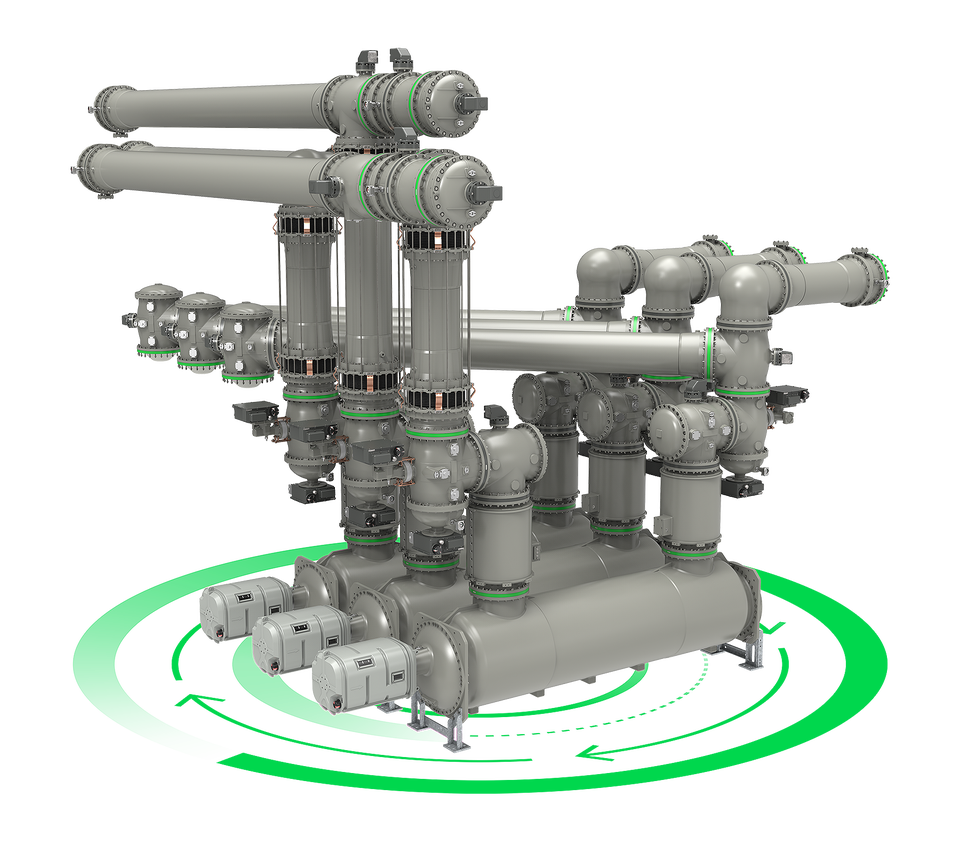
EconiQ 550 kV SF6‑free GIS—compact, all‑compartment eco‑gas design for transmission‑class substations.
SF6‑Free Insulation and Interruption at 550 kV
At the core of the release is the claim that all gas compartments in the 550 kV GIS—covering both insulation spaces and switching elements—use an alternative, eco‑efficient gas mixture rather than SF6.
According to Hitachi Energy, replacing SF6 at this voltage class reduces CO2‑equivalent emissions associated with the insulating gas by 99% relative to conventional SF6‑filled GIS, while maintaining the performance envelope expected of extra‑high‑voltage equipment. The company positions this 550 kV build as part of its EconiQ high‑voltage portfolio introduced in 2021 to migrate GIS and breakers away from fluorinated greenhouse gases without sacrificing footprint, safety, or reliability.
Engineering the jump to 550 kV without SF6 is significant. EHV GIS must withstand high electric fields across complex interfaces—spacers, cast‑resin supports, and conductor surfaces—over a wide temperature range, while interrupting fault currents and power‑frequency/temporary overvoltages without incipient discharge.
Achieving comparable dielectric margins with an alternative gas mixture requires careful control of field grading, conductor geometry, internal clearances, and surface finishes to avoid partial discharge onset. It also demands interrupter designs that manage arc energy and gas recovery dynamics in the different thermophysical environment of the new gas. The claim that the 550 kV EconiQ unit preserves the compactness associated with GIS indicates that those design levers—field control and interrupter kinetics—have been optimized to avoid the volume penalties that can accompany lower‑GWP gases.
Compact, Weather‑Resilient Substations for Backbone Networks
GIS technology encloses live parts in sealed, pressurized compartments, reducing substation footprint and limiting exposure to salt spray, dust, and storms—attributes that are especially valuable for urban or coastal EHV sites.
Hitachi Energy notes that the EconiQ 550 kV equipment ordered by Chubu Electric will be installed on the utility’s backbone transmission network, where 500/550 kV assets tie regional generation to major load centers. In such applications, space constraints, seismic considerations, and maintainability often drive a GIS decision; moving to an SF6‑free gas across all compartments extends those GIS siting advantages while addressing greenhouse‑gas intensity from the insulating medium.
Japan’s load profile is trending upward as industry electrifies and new hyperscale data centers come online, raising transmission utilization and accelerating reinvestment in EHV infrastructure. In that context, a 550 kV SF6‑free GIS offers a route to increase capacity and resilience without adding to banks of SF6 inventory.
GIS can be deployed in compact, indoor halls or coastal yards adjacent to converter stations and thermal or renewable generation clusters; at 550 kV, it also becomes a candidate for brownfield retrofit where air‑insulated switchgear would be physically impractical.
While the specific short‑circuit and continuous current ratings for the EconiQ 550 kV platform were not disclosed, its target use on a backbone network implies compatibility with high fault‑level substations and long‑distance interties.
Regulatory Momentum and Utility Adoption Strategy
SF6’s global warming potential—cited at roughly 24,300 times that of CO2 with an atmospheric lifetime exceeding a millennium—has placed the gas under intensifying policy scrutiny worldwide. Many jurisdictions have introduced timelines to eliminate new SF6‑filled equipment, though Japan has not yet set national rules to phase out SF6 in power gear. The Chubu Electric Power Grid order emerges from a utility‑level strategy announced in 2024 to transition to SF6‑free equipment by voltage class—adopting SF6‑free GIS up to 77 kV, and SF6‑free breakers at 275 kV and higher—now extended to the 550 kV GIS domain.
For equipment manufacturers, that kind of structured adoption pathway creates clear qualification targets; for grid operators, it offers a controllable migration that preserves spares strategies and operational familiarity while tapering SF6 inventories.
From a system‑wide perspective, removing SF6 from 550 kV GIS matters because EHV assets, though far fewer in count than distribution equipment, aggregate large gas volumes per bay. Eliminating SF6 at this level therefore reduces both routine emissions risk from handling and the potential environmental impact of rare but high‑volume releases.
The 99% reduction in CO2‑equivalent associated with the new insulating gas, if maintained across the equipment’s service life and end‑of‑life treatment, materially lowers the substation’s footprint from the switchgear alone. It also simplifies compliance planning as regulations tighten and reporting and leak‑rate thresholds become more stringent.
Design and Operational Considerations for Engineers
Moving to an alternative gas mixture brings practical design and O&M implications worth noting:
- Gas management and monitoring: Different gas chemistries have distinct humidity tolerances, by‑products, and pressure‑temperature curves. Engineers should review density monitoring setpoints, permissible moisture content, and gas handling procedures tailored to the EconiQ mixture, as these may differ from SF6 norms.
- Interruption performance and duty cycle: Arc‑quenching physics in the alternative gas can influence rated TRV withstand, autoreclose sequences, and cold‑load pickup behavior. Coordination studies and energization procedures should reflect any updated limitations or deratings communicated by the manufacturer.
- Interfaces and retrofitability: For brownfield projects, bus duct geometries, termination hardware, and GIS hall arrangements must be checked against any dimensional or pressure changes relative to incumbent SF6 bays to ensure mechanical interoperability and safe gas zones.
- End‑of‑life treatment: SF6‑free designs aim to reduce greenhouse‑gas impact, but end‑of‑life processes—recovery, reclamation, and material recycling—remain critical to realizing the claimed emissions benefit.
While Hitachi Energy indicates that the EconiQ 550 kV GIS retains the size and reliability profile engineers expect from conventional SF6 equipment, project teams should still plan for qualification testing that reflects local ambient extremes, seismic requirements, and switching duties specific to the intended substation topology.
Why This Matters
Bringing an all‑compartment SF6‑free design to 550 kV demonstrates that environmental performance gains are now achievable at the highest AC transmission voltage classes without abandoning the compactness and weather resilience that led utilities to adopt GIS in the first place. For grid owners preparing for larger, denser substations to support electrification and data‑center growth, the EconiQ 550 kV platform adds a decarbonized option to the short list of EHV switchgear architectures.
