Why Renewable Energy Is Essential for a Low-Carbon Future
This article explores why the transition away from fossil fuels is necessary, examines the environmental impacts of conventional energy sources, and discusses low-carbon alternatives for future electricity generation.
Worldwide energy use is increasing continuously and although every effort should be made to manage demand through energy efficiency and conservation this is not at all easy to achieve. Continuing to rely on fossil fuels to provide the world’s energy has many problems, the most pressing of which is the emissions of the greenhouse gases and it is now recognized that some fossil fuel deposits, particularly coal, will need to be left in the ground unused if catastrophic climate change is to be avoided.
Environmental Impact of Burning Fossil Fuels
The consequences of burning fossil fuel can be listed as:
- local effects – particulate emissions and effect on air quality,
- regional effects – acid rain,
- global effects – climate change.
Particulate Emissions and Poor Air Quality
Thermal power stations, internal combustion engines and building heating systems all produce gaseous emissions and very small particles that are damaging to human health. Examples of the local consequences of such emissions are the photo-chemical smogs that occur in some large cities, often from vehicle exhausts. The famous London smog of the 1950s, which was caused primarily by the burning of coal for industry and domestic heating, resulted in legislation to require the use of smokeless fuel in UK cities and the electricity-generating stations to be moved out of the cities.
Poor air quality in a number of large cities, particularly where atmospheric conditions concentrate the pollutants, is a significant cause of poor human health. Poor air quality disproportionally affects poorer members of society living close to the sources of the pollution.
Acid Rain
Burning coal in power stations produces Sulphur dioxide (SO2) and other pollutants that when emitted to the atmosphere cause acid rain and considerable environmental damage, particularly to lakes and forests. Acid rain tends to be a regional effect. Historically British coal-fired power stations caused environmental damage in Germany and Scandinavia; the prevailing winds blow from the west. Acid rain has been recognized as an important environmental problem; regulations in parts of the USA limit the Sulphur content of coal that can be burnt in power stations while in Europe large coal-fired power stations that are not fitted with flue gas de-sulphurization equipment have been phased out.
Flue gas de-sulphurization equipment extracts the SO2 from the flue gases of the power station boilers, but the equipment adds cost and takes significant power to operate, thus reducing the efficiency of the generating unit.
Climate Change
There is a now clear agreement among scientists and policymakers that the earth’s climate is being changed by human activity through the emission of greenhouse gases. The main greenhouse gases are carbon dioxide (CO2), methane (CH4), nitrous oxides (NOx) and fluorocarbons. Water vapor also plays a major role in the greenhouse effect.
The greenhouse effect is a most complicated phenomenon with important impacts of gases and particles in the atmosphere that can either increase or lower the earth’s temperature. However, it can be understood simply as the effect of gases in the upper atmosphere absorbing the long-wavelength radiation that is emitted from the earth’s surface (Figure 1).
The sun is a high-temperature source of energy with an effective temperature at its outer surface of around 6000 K. It emits short-wavelength (high-frequency) radiation that passes through the earth’s atmosphere. This radiation strikes the earth, warming it, and the earth then re-radiates long-wavelength (low-frequency) radiation from its lower surface temperature. The high-frequency radiation from the sun passes through the earth’s atmosphere largely unaffected, while the concentration of gases in the upper atmosphere absorbs and reflects the lower-frequency (longer-wavelength) radiation.
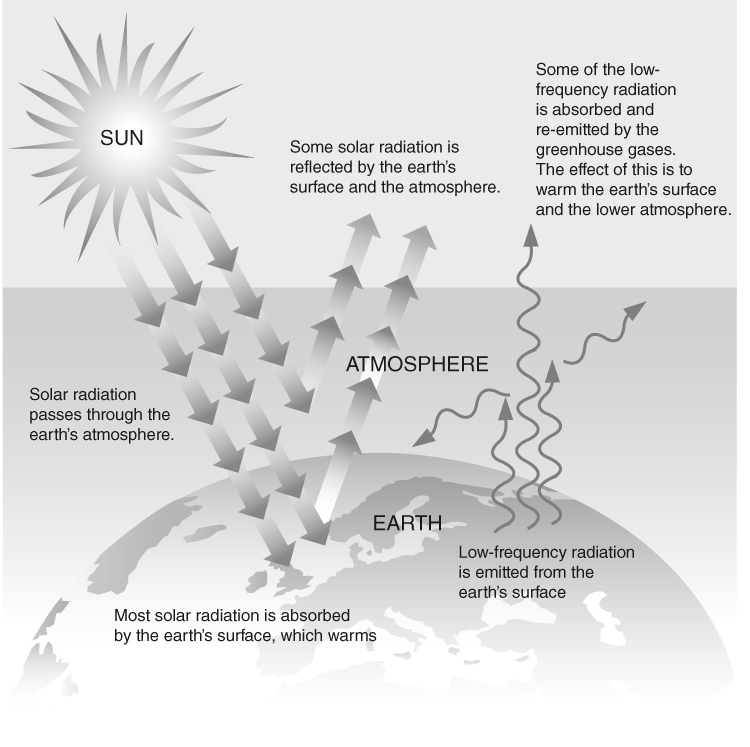
Figure 1 Simple representation of the greenhouse effect.
The temperature of the earth depends on the balance between the incoming high-frequency radiation from the sun and the lower-frequency radiation re-radiated from the earth’s surface. By increasing the concentration of greenhouse gases in the atmosphere, more of the low-frequency radiation is trapped and so the temperature of the earth increases. The concentration of existing greenhouse gases in the earth’s atmosphere causes the temperature of the earth to be maintained at a level suitable for life; without it the earth would be colder by some 30 °C.
By increasing the concentration of greenhouse gases, as we are currently doing, the earth’s temperature increases, and the climate is changed. Although an increase in average temperature has significant implications, the consequent effects such as increasing sea levels due to melting of the ice in the polar regions and increases in the frequency of extreme weather events are potentially even more serious. Greenhouse gases disperse throughout the earth’s atmosphere and so the effect is global.
Carbon dioxide is an inevitable product of burning fossil fuels and once emitted it remains in the atmosphere for more than 100 years. It is one of the most important greenhouse gases and many countries have policies to reduce emissions of CO2.
Countries responsible for 90% of the world’s emissions of greenhouse gases have agreed to reduce emissions to net-zero by 2050. Net-zero is the state when the greenhouse gases emitted into the atmosphere, particularly CO2, are balanced by actions to remove them.
By restricting the emission of CO2 and other greenhouse gases it is hoped to limit the rise in global mean surface temperature rise to around 1.5 °C above preindustrial levels. A rise of this magnitude with the associated increase in extreme weather events will still have important consequences for agriculture and biodiversity. Immediate action to reduce emissions has been shown to be essential as well as more cost-effective than delay.
Low-Carbon Electricity Generation
Electricity is only one form of energy, but its generation is easier to decarbonize with renewable energy than other uses of energy such as domestic or industrial heating, steel making or cement manufacture. A number of countries are making good progress in reducing the CO2 emitted by their electricity systems and the UK has set a goal of decarbonizing its electrical sector by 2035.
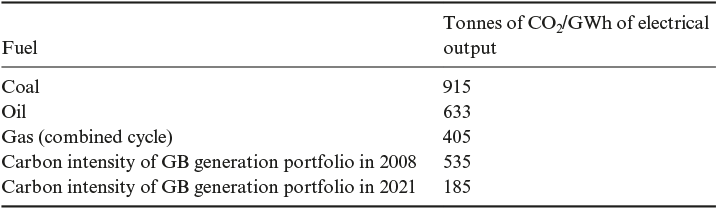
Table 1 shows the carbon intensities of the fossil fuel generation technologies that have been used in the interconnected national power system of Great Britain (GB). Carbon intensity of generation is the amount of CO2 emitted for every unit of electricity generated.
Coal generation is the most carbon intensive, but generation from coal has now largely ceased in GB. Heavy fuel oil is relatively expensive and hardly used in GB for electricity generation. There is a considerable amount of electricity generated from natural gas usually in combined cycle units of a gas turbine followed by a steam turbine. The carbon intensity of the GB generating portfolio has more than halved since 2008 mainly due to the move away from coal and the increase in renewable energy generation (solar PV, wind and biomass). Nuclear generation has remained roughly constant although some nuclear generating stations are reaching the end of their lives.
Table 1 Carbon dioxide emissions from electricity generation in Great Britain
The options to generate electricity without emitting CO2 are limited to:
- renewable energy,
- nuclear energy,
- fossil fuel generators equipped with carbon capture and storage
There are those who consider that nuclear fission (i.e. splitting a heavy atomic nucleus into two lighter nuclei to release a large quantity of energy) is an attractive technology, and that nuclear generation should be expanded. However, generation of electricity using nuclear fission has some important difficulties including high capital costs and continuing uncertainty over the disposal of nuclear waste.
Also, the close links between civil and military nuclear programmes during its historical development has led to concerns over its use in a number of countries. Even if nuclear fission maintains or expands its role in electricity generation in countries where the population supports its use, it is unlikely to be able to provide sufficient energy to substitute for fossil fuels in a world of increasing energy demand. Nuclear fusion (i.e. the combination of two light nuclei to form a heavy nucleus and release an even larger quantity of energy) remains a technology under development.
Removing carbon either before or after fossil fuels are burnt and storing CO2 underground has the attraction that modified conventional fossil-generating units can continue to be used. This is known as Carbon Capture and Storage (CCS) or Carbon Capture Utilization and Storage (CCUS) where some of the CO2 is used in chemical processes. CCS is an important future technology, particularly in combination with biomass generation, which results in the CO2 in the atmosphere being reduced. However, neither the technology for extracting the carbon from fossil fuel generation nor the technology for storing the CO2 have yet been implemented at commercial scale.
Example – Carbon Intensity of Generation
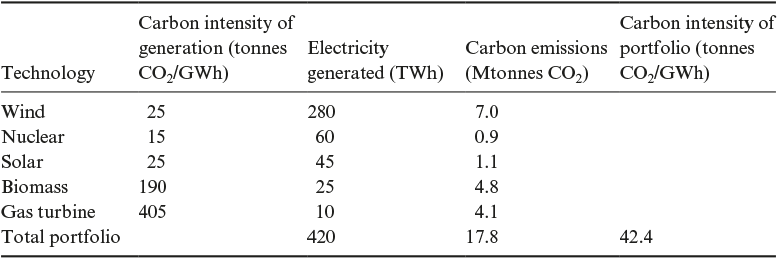
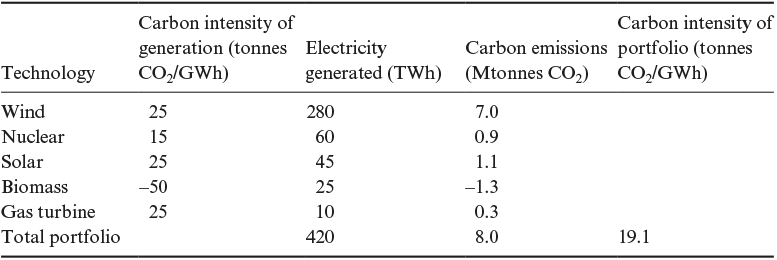
A nation’s annual electricity demand of 420 TWh is met by 280 TWh of wind generation, 60 TWh of nuclear, 45 TWh of solar, 25 TWh of biomass and 10 TWh generation from gas. The estimated carbon dioxide emission from natural gas generation is 405 tonnes/GWh, biomass 190 tonnes/GWh, solar and wind 25 tonnes/GWh and from nuclear generators is 15 tonnes/GWh.
(a) Calculate the carbon intensity of generation (CO2 emission per GWh of the electricity generated).
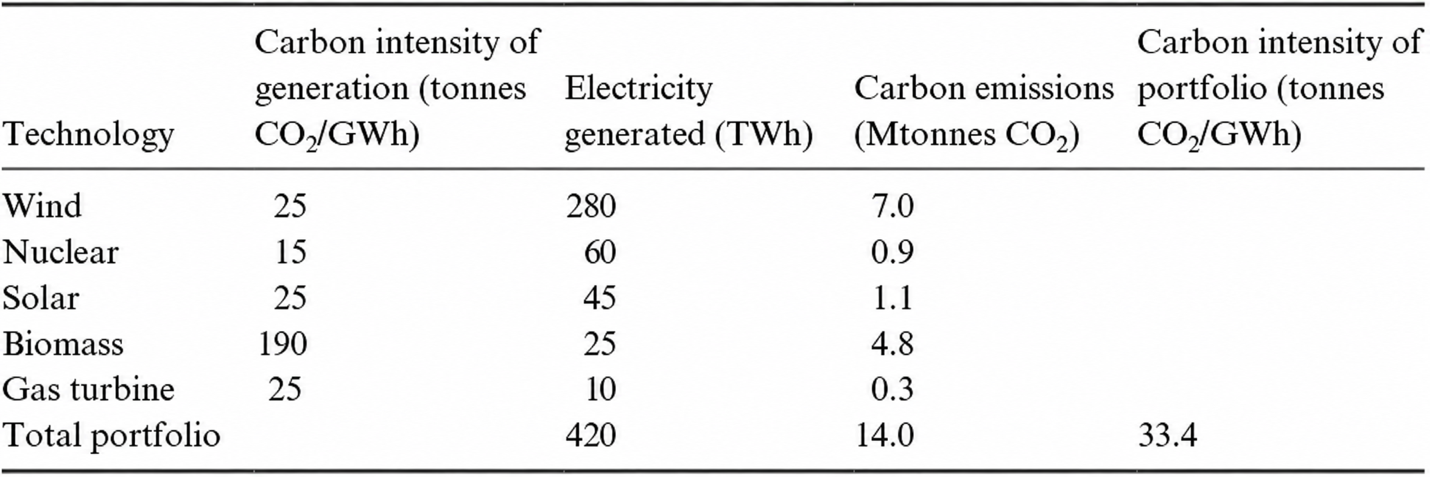
(b) If the combined cycle gas turbine generators are equipped with Carbon Capture and Storage (CCS) their carbon dioxide emissions are reduced to 25 tonnes/GWh. What is now the carbon intensity of generation of the portfolio?
(c) If the biomass generators are fitted with CCS, the effect is to reduce the amount of CO2 in the atmosphere by −50 tonnes/GWh. What is now the carbon intensity of generation?
Solution
(a) This calculation is conveniently done with a spreadsheet. The carbon intensity of the original portfolio is 42.4 tonnes of CO2/GWh.
(b) If carbon capture and storage is fitted to the gas turbine generators, then the carbon emissions from gas generation reduce to 0.3 Mtonnes and the carbon intensity of generation of the portfolio reduces to 33.4 tonnes of CO2/GWh.
(c) If the biomass generation is also fitted with CCS, then it captures and stores 1.3 Mtonnes of CO2. The carbon intensity of generation of the portfolio then further reduces to 19.1 tonnes of CO2/GWh.
Key Takeaways
The transition to renewable energy is essential for reducing greenhouse gas emissions, improving air quality, and limiting the long-term impacts of climate change. While nuclear power and carbon capture technologies can contribute to decarbonization efforts, renewable energy remains the most practical and scalable pathway toward cleaner electricity systems. As countries pursue net-zero targets, reducing the carbon intensity of power generation has become a key measure of progress. Expanding low-carbon electricity sources will play a critical role in ensuring sustainable energy supplies while protecting ecosystems and public health.


