From Grid to Gate: Powering AI Driven Data Centers at Scale
Texas Instruments presents a grid-to-gate power architecture that rethinks how energy is generated, converted, and delivered to efficiently support the rising power demands of AI-driven data centers.
The power path inside data centers wasn’t built for today’s AI loads. Legacy rack designs and grid interfaces now struggle with efficiency, density and cost.
Texas Instruments outlines a “grid-to-gate” approach that rethinks how energy is generated, converted and delivered all the way to processor gate voltages. The concept centers on high‑efficiency conversion, precise sensing and storage so renewable energy can reliably feed AI infrastructure.
AI Workloads Are Resetting Rack Power Distribution
Most server halls still route AC to each rack, where power‑supply units convert to a 48 V bus, step to 12 V, and then point‑of‑load stages deliver sub‑volt rails to chips. Every stage adds loss, heat and volume as racks scale up.
Generative AI intensifies those stresses. A single question to a large language model can draw about 10 times the power of a traditional search query, pushing distribution and cooling to their limits.
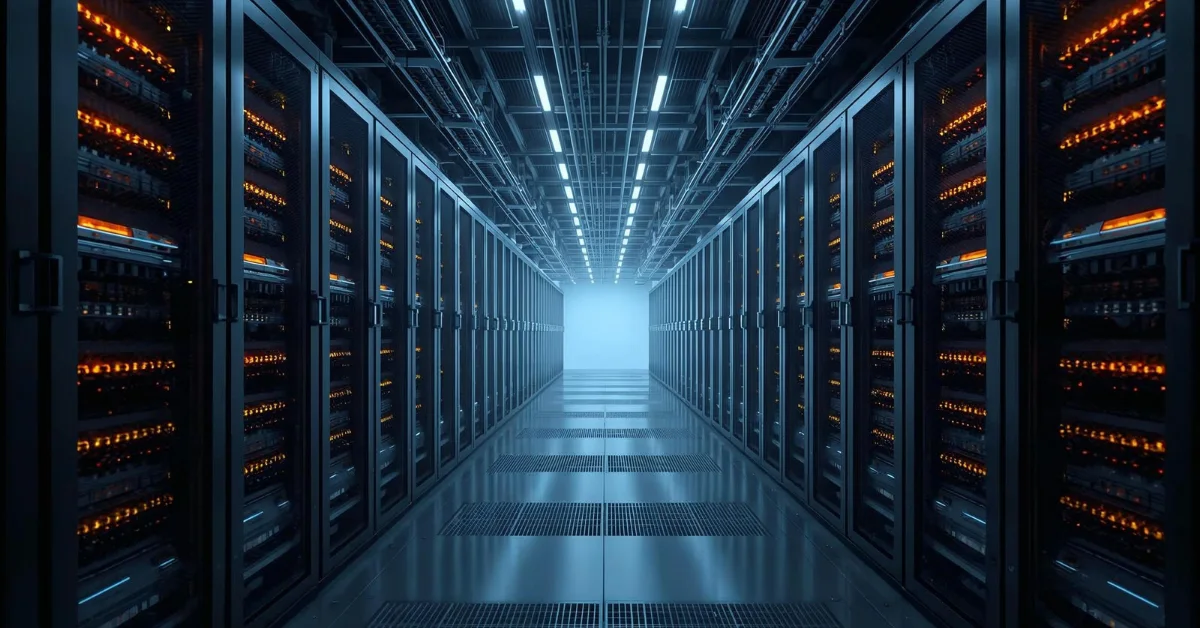
Modern AI data centers are pushing traditional power and cooling architectures to their limits, driving the need for grid-to-gate energy optimization.
Moving Conversion Off the IT Rack
Data center operators are migrating AC‑to‑DC conversion out of the compute rack to reclaim space and headroom. A practical near‑term step is a “sidecar” rack housing the PSUs beside the IT rack, concentrating power conversion and easing thermal design.
The longer‑term target is a dedicated power room that distributes high‑voltage DC across the server hall. Centralizing conversion reduces duplication at every rack and sets the stage for higher distribution voltages, lower copper mass and more streamlined protection and monitoring.
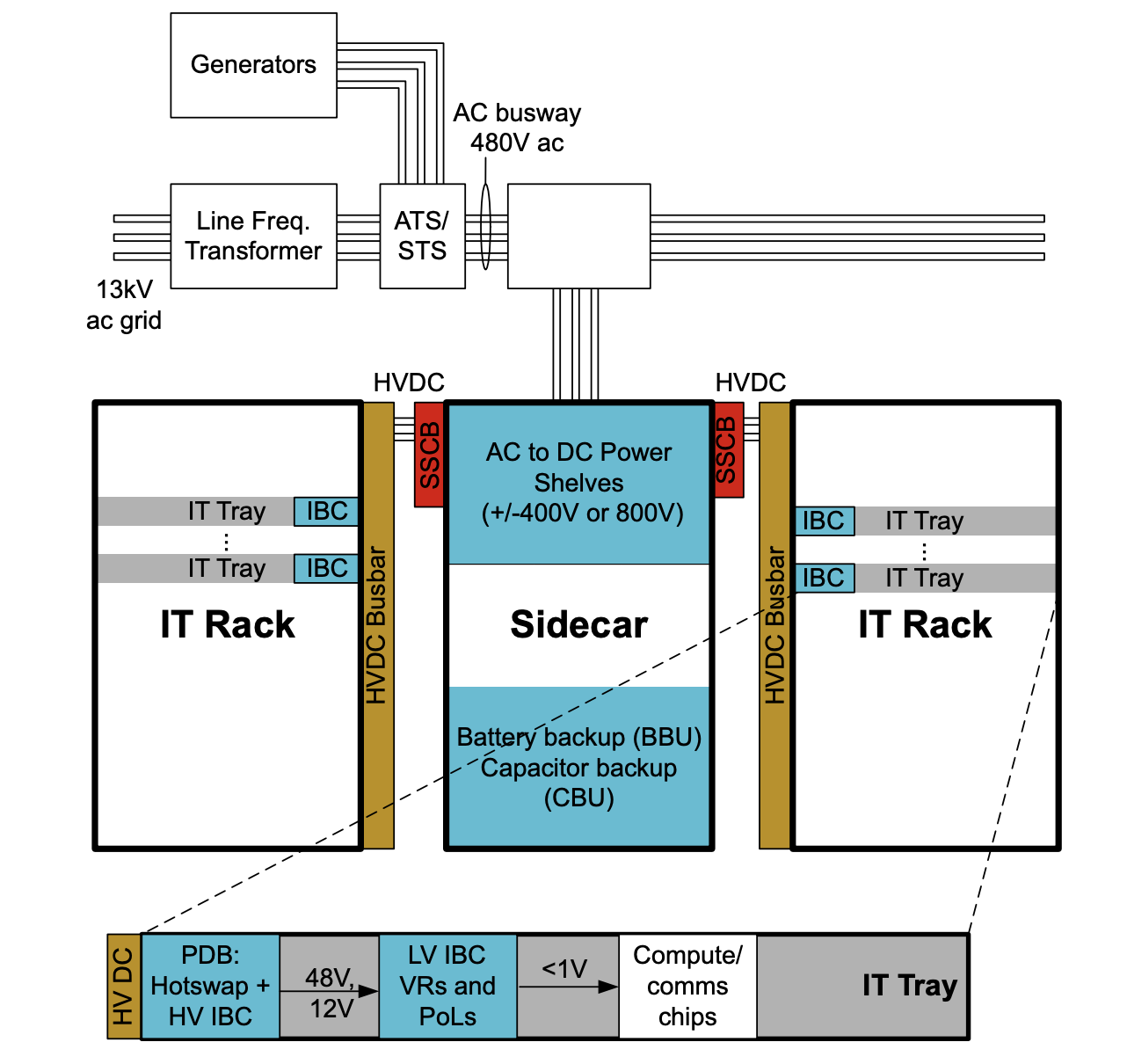
AI Computing DC Distribution Sidecar
Solar at Scale, With Semiconductors Doing the Heavy Lifting
AI data centers need vast, quickly deployable generation, and solar is becoming one of the most affordable options for new capacity in many regions. Independent analysis shows rapid deployment of clean technologies can lower total energy system costs, with solar PV among the least‑cost sources for new generation.
Semiconductors sit at the center of this PV build‑out. High‑efficiency conversion and accurate sensing are essential to turn variable DC from panels into grid‑quality power and to make solar a dependable contributor to data center loads.
ESS Design Priorities
Compute is 24/7; insolation is not. Battery energy storage systems (ESS) fill the diurnal gap so solar‑powered capacity can support AI clusters continuously, not just when the sun is up.
Battery‑management systems (BMS) make this possible at scale. They monitor cell voltages, estimate state of charge and state of health, and ensure stored energy is available on demand—functions that directly influence uptime, cycle life and safety in multi‑megawatt installations.
Engineering the “Grid‑to‑Gate” Power Path
The grid‑to‑gate lens encourages designers to co‑optimize every conversion step as a single electrical chain, from grid interface to sub‑volt rails at processor gates. That means scrutinizing efficiency, transient behavior and protection at each boundary—and, critically, the interactions between them.
In practice, this approach drives several priorities. First, push conversion density and efficiency where footprint is scarce—near racks and in sidecar PSUs—while managing conducted and radiated emissions into long DC runs. Second, raise measurement fidelity: tight tolerance on current and voltage sensing improves control loops, reduces guard bands and unlocks safe operation closer to component limits. Third, strengthen isolation and fault detection across high‑voltage DC distribution to contain failures and meet evolving safety codes.
Thermal design becomes a system problem, not a module problem. Moving AC‑DC stages out of the compute rack shifts heat sources, airflow paths and coolant zoning. Designers can consolidate high‑temperature components in serviceable power bays while keeping low‑voltage regulators near loads to minimize distribution losses and dynamic droop.
Control architecture also changes. Centralized power rooms invite supervisory control that coordinates rectification, DC‑link management and rack‑level converters. Fast telemetry and protection—fed by precision sensing—enable selective fault clearing and maintain power quality during workload surges typical of AI training and inference bursts.
Finally, the last centimeters matter. Point‑of‑load converters must deliver sub‑volt rails with fast transient response to cope with steep load steps from accelerators and CPUs. Any upstream gain in distribution efficiency is squandered if the final stage cannot hold regulation within tight windows during microsecond‑scale events.
Renewables, Storage and Distribution
Adopting solar and storage at data‑center scale is no longer just a sustainability gesture—it is a capacity strategy aligned with cost trends. As PV costs decline and ESS capabilities grow, the economic case strengthens for pairing centralized HVDC distribution with renewable generation and batteries.
For engineers, the opportunity is to reduce total losses, copper, and rack volume while improving serviceability and resilience. A grid‑to‑gate view helps quantify trade‑offs: where to place conversion stages, which voltages to distribute, how much sensing precision is worth in reduced guard bands, and how to apportion protection between centralized and rack‑level devices.
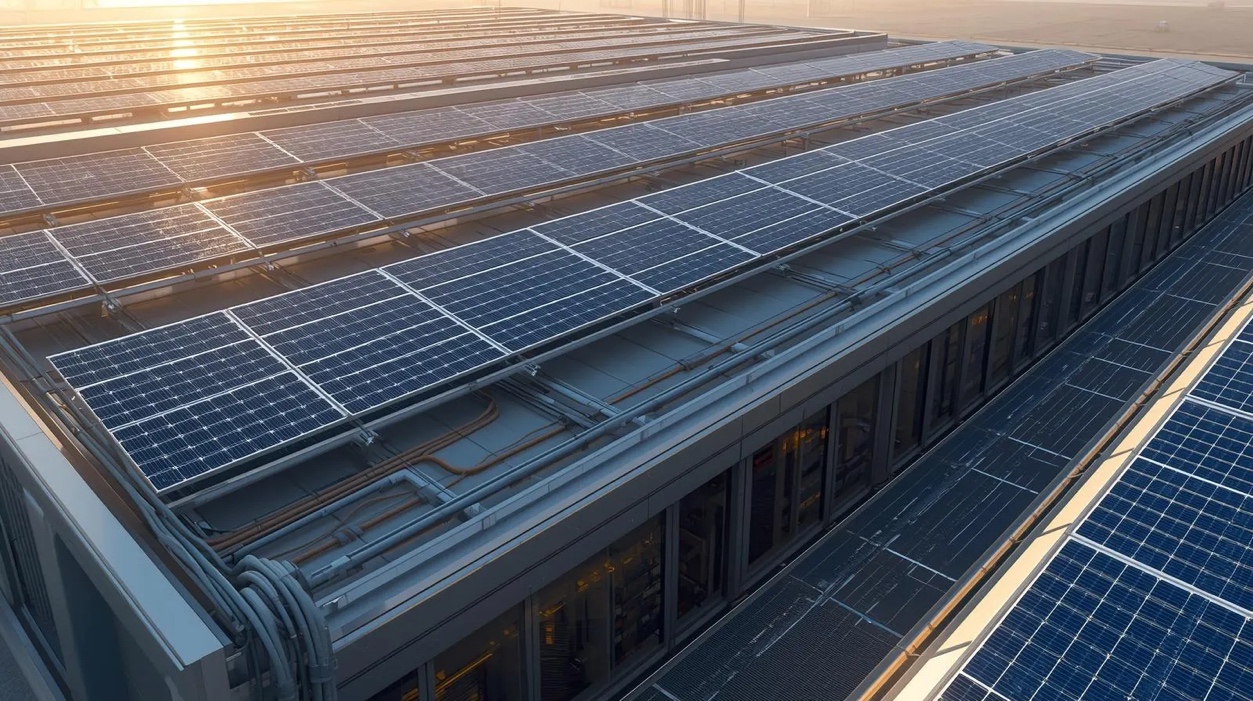
Solar PV systems are emerging as a scalable energy source to meet the growing power demands of AI-driven data centers.
Designing for the Third Energy Revolution
The shift to AI‑class computing is forcing a redesign of the power chain from generation to processor gates. By centralizing major conversions, distributing high‑voltage DC, and pairing solar with robust storage and precision sensing, data centers can scale without linear increases in losses, space or cost.
Expect rapid progress toward standardized HVDC distribution, tighter integration of measurement and control, and ESS systems tuned for data‑center duty cycles. Engineers who plan power systems holistically—truly from the grid to the gate—will be best positioned to deliver efficiency, reliability and sustainability at AI scale.
