Schneider Electric and ETAP Debut Physics-Based Digital Twin that Unifies Design and Operations
A new ETAP–Schneider Electric integration links engineering-grade power system models with live utility data to support faster, safer decisions for grids and mission-critical facilities.
At DistribuTECH 2026 in San Diego on March 2, Schneider Electric and ETAP introduced a physics-based digital twin intended to close the long-standing gap between planning studies and day-to-day grid operations. The companies position the system as a lifecycle model that persists from design through operations, allowing utilities and critical infrastructure owners to evaluate switching actions and operating conditions against the same study-quality network representation used for planning.
The announcement highlights deployment within Schneider Electric’s One Digital Grid software environment and alignment with the company’s ArcFM Web geographic information system (GIS) to bring asset location and topology directly into operational decision-making.
Physics-Based Simulation for Utility Networks
Unlike visualization-led twins that mirror SCADA states without an embedded solver, the ETAP-based twin is anchored in electrical physics and power system analysis methods. According to the companies, operators can run “what-if” contingencies, validate protection coordination, and simulate switching sequences before execution.
The toolset also supports arc‑flash hazard calculations to help organizations maintain compliance with NFPA 70E, and it preserves a single source of truth across the model lifecycle to limit version drift between planning, construction, and operations teams. In practical terms, this brings planning-grade fidelity—short-circuit, load flow, protection and selectivity analysis—into the control-room context to reduce operational risk and improve safety around work clearances and energization steps.
Integration of GIS and Power System Modeling
The announcement emphasizes interoperability with Schneider Electric’s One Digital Grid platform and EcoStruxure ArcFM Web. The former provides an umbrella environment that combines distribution operations, analytics, and edge automation, while the latter supplies a utility GIS that exposes network connectivity and asset attributes through a web interface.
Coupling ArcFM’s spatial model with ETAP’s simulation model enables operators to evaluate scenarios against the correct feeder topology, device coordinates, and circuit phasing, turning map-centric views into actionable, solver-backed operational insights. This integration path reduces the manual model handoffs that typically occur between GIS, planning tools, and distribution operations software, and it supports a more traceable change-management process as networks evolve.
Operational Impact for Utilities and Critical Facilities
From a utility standpoint, the ability to test contingencies and switching outcomes against a physics-based model before crews act can lower the likelihood of misoperations, nuisance device trips, and unintended islanding during restoration.
The companies also cite gains in interconnection processing—particularly for distributed energy resources—when protection coordination and hosting-capacity questions can be answered using a consistent model from study to field, rather than reconstructed in parallel systems.
The same approach applies to mission‑critical operators: data centers, hospitals, and aerospace facilities can use the twin to evaluate plant configurations, maintenance bypass strategies, and generator/UPS coordination without exposing live systems to risk.
Schneider Electric and ETAP report that ETAP technology is validated across more than 50,000 installations worldwide, spanning Tier IV data centers and nuclear sites, and that utilities have achieved measurable reductions in interconnection cycle time and nuisance trips when automated coordination studies are applied.
How the Workflow Changes in Practice
A physics-based operations twin reshapes several daily workflows.
- For switching, operators can preview feeder reconfiguration and backfeed strategies with accurate voltage profiles, fault levels, and relay settings, then carry forward approved steps into operating procedures.
- For protection engineering, study results—settings, margins, and device coordination—are not parked in stand-alone files; they remain attached to the same network model that dispatchers and field crews depend on, improving traceability when conditions change.
- For safety, arc‑flash calculations aligned to current operating states allow planners and supervisors to confirm boundaries and PPE categories before issuing work permits, reducing the chance that outdated studies guide live work.
Each of these workflows benefits from reducing the number of times network data is re-entered, filtered, or reformatted between systems.
Linking the Twin to a Broader Grid Software Stack
Positioning the twin within the One Digital Grid environment matters because it provides the connective tissue to other operational applications—distribution management, outage response, analytics, and DER orchestration—without rebuilding integrations for each use case. As utilities expand sensor coverage and edge controls, this architecture allows telemetry to update the twin’s boundary conditions and topology, while engineering simulations inform control recommendations.
Bringing the GIS layer into the loop adds location intelligence for switching zones, critical load clusters, and wildfire or storm exposure, strengthening event preparation and recovery planning.
Lifecycle Continuity Built on Prior integrations
The new offer extends a multi‑year trajectory of tying ETAP’s engineering models into Schneider Electric’s operational software. In 2022, the companies linked EcoStruxure Power Operation with ETAP’s operator training and simulation tools to enable model-driven training and predictive analysis for plant power systems—an early step toward the lifecycle continuity now targeted at utility-scale networks.
The 2026 announcement takes that concept further by embedding a physics-based twin directly alongside grid operations and GIS, enabling engineering-grade analysis at the point of operational decision.
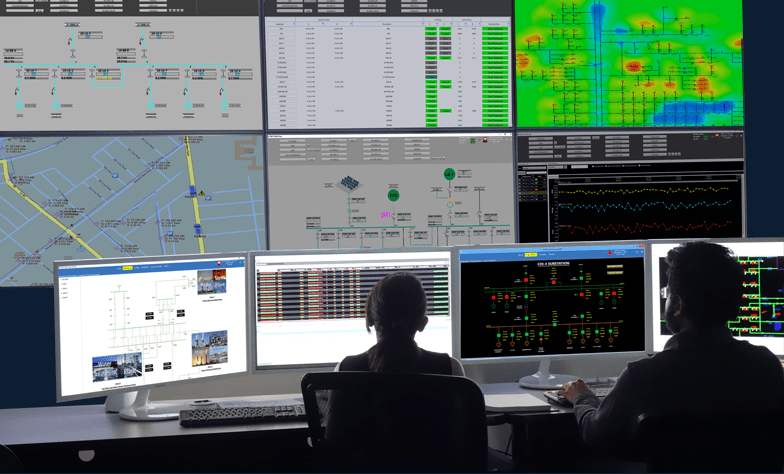
ETAP Operator Training Simulator
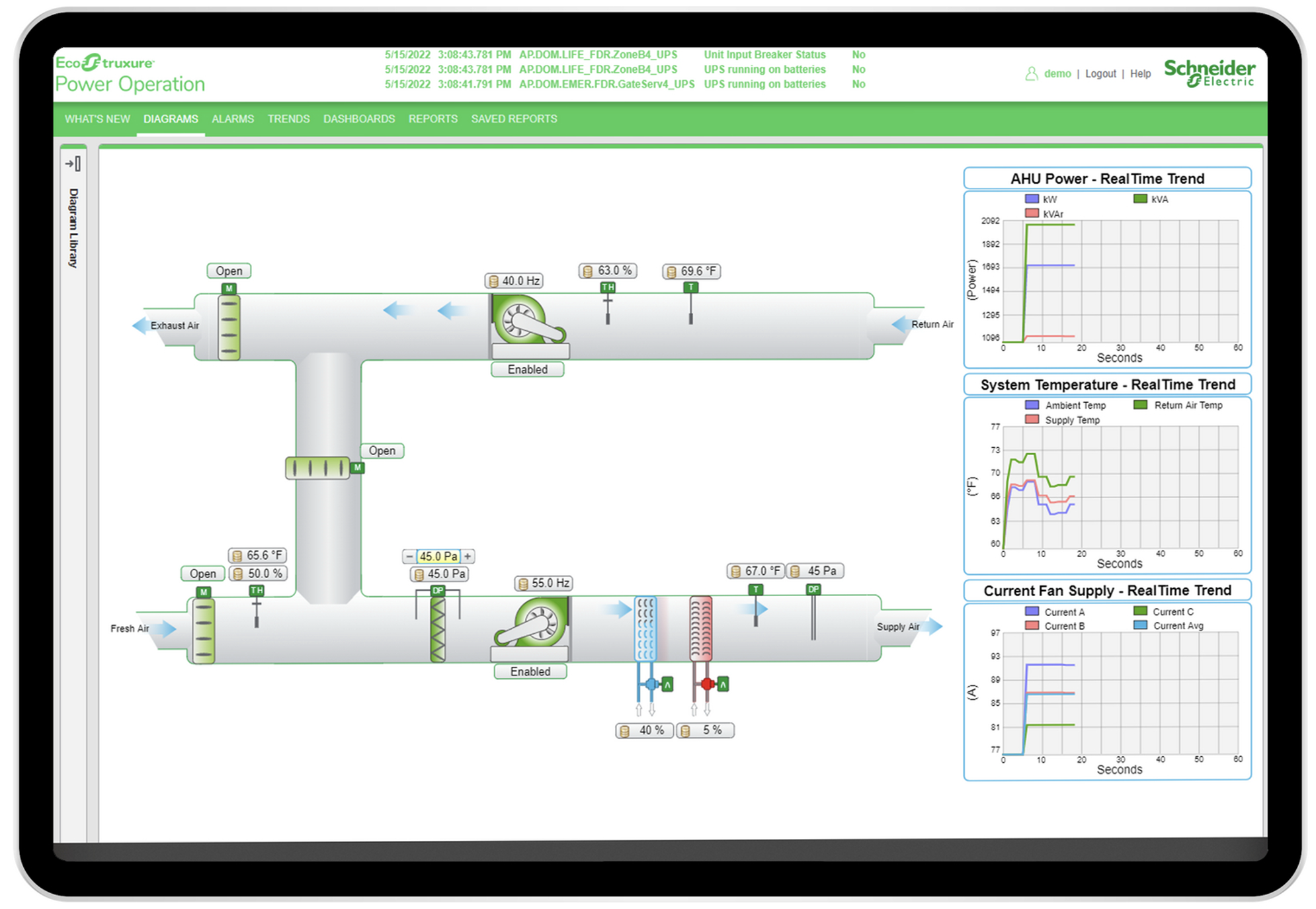
Schneider Electric’s EcoStruxure™ - Power management and control software
Ecosystem Context and Sectors Affected
ETAP has been part of Schneider Electric’s software portfolio since Schneider acquired a controlling stake in 2021, a move that consolidated electrical design, simulation, and operational capabilities under one umbrella for grid, industrial, and data center customers.
By introducing a twin that spans planning and operations and by situating it within a broader grid platform and GIS, the companies are targeting pressing industry needs: faster DER interconnections, resilience against extreme weather, safer switching, and reduced commissioning and outage risks for critical facilities.
Utilities, data center operators, healthcare systems, and aerospace sites—all with low tolerance for downtime—stand to benefit from more deterministic decision support grounded in physics rather than heuristics.
Engineering Significance
For electrical engineers and grid operators, the value proposition is less about a new user interface and more about eliminating model discontinuity. When feeder models, settings, and safety studies persist—from planning through live operations—organizations can replace ad‑hoc data translations with controlled, testable workflows. The result is fewer blind spots when switching, better-aligned protection across changing DER penetrations, and faster engineering turnarounds during storms and maintenance windows.
In short, Schneider Electric and ETAP are pushing the utility enterprise toward an operations environment where every control-room action can be rehearsed against a solver-backed, GIS‑aware twin before it touches the network.