Energy Storage Technologies: Enabling Renewable Energy and Electrification
Learn how different energy storage technologies support renewable integration and meet the unique requirements of stationary systems, transportation, and portable electronic devices.
To address the intermittency of renewable energy sources, efficient storage is considered key. In fact, the smart match of energy harvesting when it is available and supply on demand by introducing viable storage technologies by itself renders future energy management far more sustainable than our present “overproduction” to ensure that everybody can make use of it at any time.
The field of potential energy storage technologies, however, is very wide and versatile – just like the specific needs depending on the source, the application, and the device to be eventually powered. Generally, one may differentiate among (i) stationary storage, (ii) transportation, and (iii) portable electronic devices – as such also the scale of energy storage required.
Stationary Energy Storage
To date, only a few energy storage technologies have achieved practical relevance for stationary applications. The most relevant in terms of amount of stored energy is pumped hydropower, with a total contribution of about 99% to the worldwide stationary energy storage. It offers a rather high energy storage efficiency of 70–85% and power ratings from 100 to 3000 MW.
Nevertheless, its installation requires appropriate geographic conditions, since the overall storage capacity (and, thus, also the power rating) is eventually based on the possibility to store extensive amounts of water at varying heights. In fact, lifting 1 m3 of water by 1 m corresponds to an energy of 3 Wh – meaning that an energy storage capacity of 3000 MWh requires a water reservoir of one trillion liters of water – at least when lifted only 1 m in height. Moreover, such installations commonly have to also include a suitable dam system, so that the associated investment is rather high.
The same is true for the second most employed stationary storage technology, compressed air, which provides power ratings above 100 MW. Its utilization depends on the presence of, e.g. depleted gas fields, rock mines, or salt caverns to allow for the storage of suitable amounts of compressed air – in any case in combination with a nearby gas turbine power plant, which renders it less suitable for the combination with renewables.
As a consequence, electrochemical energy storage in the form of batteries has attracted increasing interest in recent years, thanks to its comparably lower installation cost, the independence of geographic conditions, and its excellent energy storage efficiency up to about 95% – and despite the size limitation to several megawatts. This recently increasing interest, however, is certainly also related to the great success of batteries for smaller scale applications.
Accordingly, one of the battery technologies that is frequently employed are lithium‐ion batteries, a term that covers, in fact, a very wide range of different cell chemistries – each with its own advantages, limitations, and remaining challenges. Alternatives are ambient temperature sodium‐ion batteries, especially with regard to the potential use of abundant elements and raw materials only, high‐temperature sodium batteries, or redox‐flow batteries. Particularly, the latter may provide high power ratings, thanks to the potential decoupling of energy and power density, since the redox active compounds are stored in large separated tanks.
Generally, the most important requirements for stationary battery storage (Figure 3) are cost and cycle life (the higher the cycling stability, the more energy is stored over the years and the less is the cost per kilowatt hour), while energy density is less important considering that the weight and volume of such batteries is not limiting their application. Safety is essentially important with respect to less maintenance and additional infrastructure needed. Power density is commonly less an issue, as such storage is more devoted to a constant load and the possibility to couple such batteries with high‐power (super‐)capacitors to buffer supply and demand peaks.
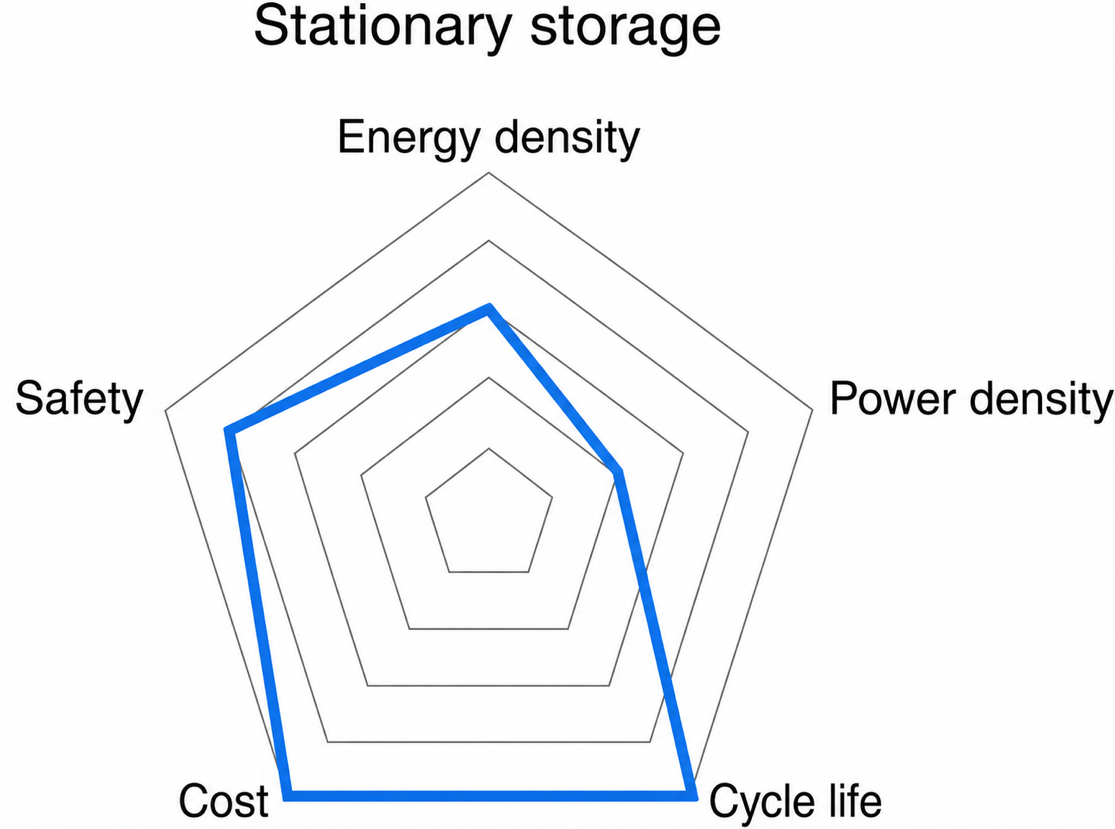
Figure 3 Spider web chart for the qualitative illustration of the specific requirements for batteries when employed for stationary storage applications.
Energy Storage Technologies for Transportation
The transportation sector is presumably the most demanding sector of all. First, the mobility demands of our society are continuously increasing. This starts with the way to work, the wish to maintain a frequent contact to family members and friends who are frequently not living nearby anymore, the desire (and ability) to explore increasing parts of the world, the centralization of the supply of goods, leisure activities or healthcare infrastructure, and business travels – just to name a few.
Second, the number of private vehicles keeps increasing globally – for the aforementioned reason and the increasing wealth of, e.g. large‐population countries such as China, Brazil, or India; a trend that will continue presumably or at least stabilize for several years to come.
Third, for the transportation sector, essentially all the characteristics of the energy storage technology are of great importance (Figure 4).
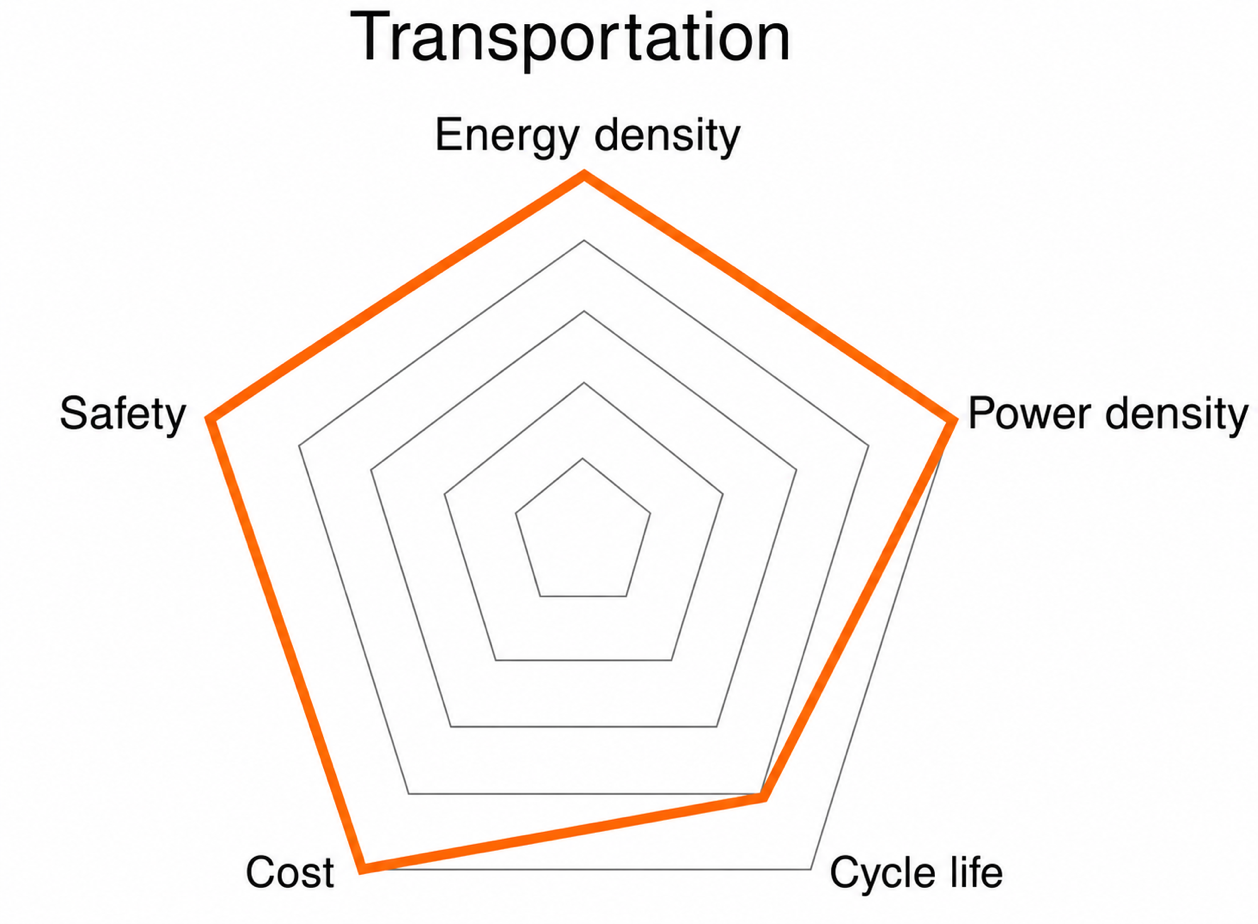
Figure 4 Spider web chart for the qualitative illustration of the specific requirements for batteries when employed in the transportation sector.
- High energy density translates into long driving range for a reasonable size and weight of the power source.
- High power density is needed for rapid acceleration, energy recuperation upon breaking, and fast charging.
- Long cycle life reduces the cost for replacing the power source, while guaranteeing a constant performance upon lifetime.
- Safety is of fundamental importance during daily usage and, in particular, in case of an accident – and the
- Cost is eventually decisive for the commercial success of whatever technology that will replace the state‐of‐the‐art combustion engine.
To date, there are basically two technologies that may power today's and tomorrow's vehicles: batteries, specifically lithium batteries, and fuel cells. While some car manufacturers focus solely on battery‐powered electric vehicles, others are still developing both systems, although the momentum is clearly on the battery side, thanks to their higher energy efficiency and the proven market success for portable electronic devices.
A recent study reported that the effective energy density of battery‐powered electric vehicles may outperform gasoline‐powered cars, if the drive train is taking into account, for driving ranges up to about 190 km – a value that has presumably increased in the meantime, thanks to the great progress in battery technology in the past 10 years.
Considering, moreover, smart energy storage and distribution systems for which the battery‐powered vehicle may serve as intermediate storage device for the grid – also referred to as the “vehicle‐to‐grid concept” – renders such technical solution as highly future oriented and essential part of the global transition to renewables.
Energy Storage Technologies for Portable Electronic Devices
The great success of batteries in our modern society originates largely from their substantial contribution to the development of portable electronic devices such as mobile phones, camcorders, and laptops. Without the successful commercialization of lithium‐ion batteries by Sony in 1991 and subsequently also several other (mostly Asian) companies, we would not be able to work during long travels, be available essentially everywhere in the world, or simply stay online wherever we go – all enabled by the currently used lightweight and small portable devices “powering” our daily life.
It is, thus, not surprising that particularly the development of lithium‐based batteries has triggered the recent thriving period of battery research in general with new technologies popping up and “old” battery technologies reviving. Nonetheless, the common requirements of portable electronic devices are different from those for stationary storage and transportation to a certain extent, as illustrated in Figure 5.
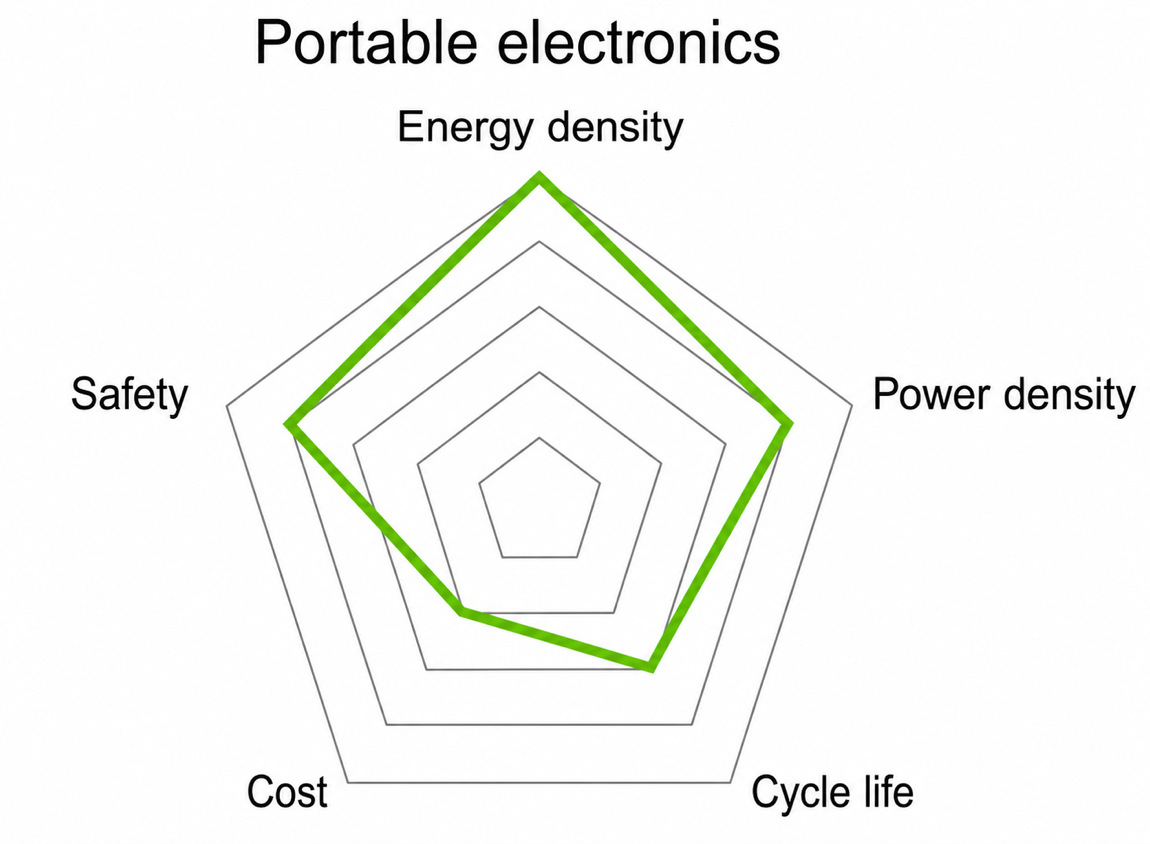
Figure 5 Spider web chart for the qualitative illustration of the specific requirements for batteries when employed in portable electronic devices such as mobile phones or laptops.
- Cost is certainly less an issue in such cases, as the corresponding share of the overall cost is frequently negligible at such scale.
- Similarly, cycle life becomes less important with respect to the life cycle of such products that are commonly outdated after a few years and replaced by the user.
- Safety, however, is important apparently as most devices are kept rather close to the human body.
- High power density ensures that highly demanding applications can also be supported, while recharging can be accomplished quickly.
- The most important aspect, though, is the energy density, as the progress in electronics is occurring at much faster pace, while the device will become as small and lightweight as possible.
The Variety of Battery Chemistries and Technologies
The abovementioned examples are far from being exhaustive, and each existing and new application has, and will have, its own specific requirements. On the one hand, this results in the need to continuously develop and realize new battery chemistries and technologies which provide these requested characteristics and features. On the other hand, such variety in battery chemistries and technologies ensures to some degree sustainability, as it is not always the same elements and compounds that are needed. As a matter of fact, this is maybe one of the greatest assets of batteries, i.e. the potential to tailor the battery chemistry to the needs of a given application – within certain limits, of course.
Key Takeaways
Energy storage has become a fundamental enabler of the global transition toward renewable energy by helping balance intermittent generation with demand. Different applications—including grid storage, electric transportation, and portable electronics—require distinct combinations of energy density, power capability, safety, cycle life, and cost, driving the development of diverse battery chemistries and storage technologies.
Lithium-ion batteries currently dominate many sectors, while alternatives such as sodium-ion, redox-flow batteries, and fuel cells continue to expand the range of available solutions. The ability to tailor energy storage technologies to specific applications is one of the industry's greatest strengths and will remain essential for achieving sustainable, efficient, and resilient energy systems.