From Aggregation to Dispatch: The Engineering Behind Virtual Power Plants (VPPs)
Virtual power plants promise grid-scale flexibility, but simple asset aggregation isn’t enough. Engineers need dispatch-grade coordination that respects physics, markets, and operations.
Hitachi Energy has introduced VirtuPlan, a digital planning and orchestration tool for distributed energy resources. The platform’s aim is to turn diverse DER portfolios into predictable, market-ready capacity that system operators can trust.
Why Aggregation Alone Falls Short
VPPs are growing fast as behind-the-meter solar, batteries, EV charging, and flexible loads proliferate. In the United States, more than 70 VPPs operate across 25 states, representing roughly 30–60 GW—momentum that the Department of Energy projects could scale to 80–160 GW by 2030, saving about $10 billion per year if deployed at scale.
The engineering challenge is to move from “many devices on a platform” to “a plant you can call on.” That requires forecasting, optimization, and compliance baked into a unified control strategy that behaves like conventional generation from the grid’s perspective.
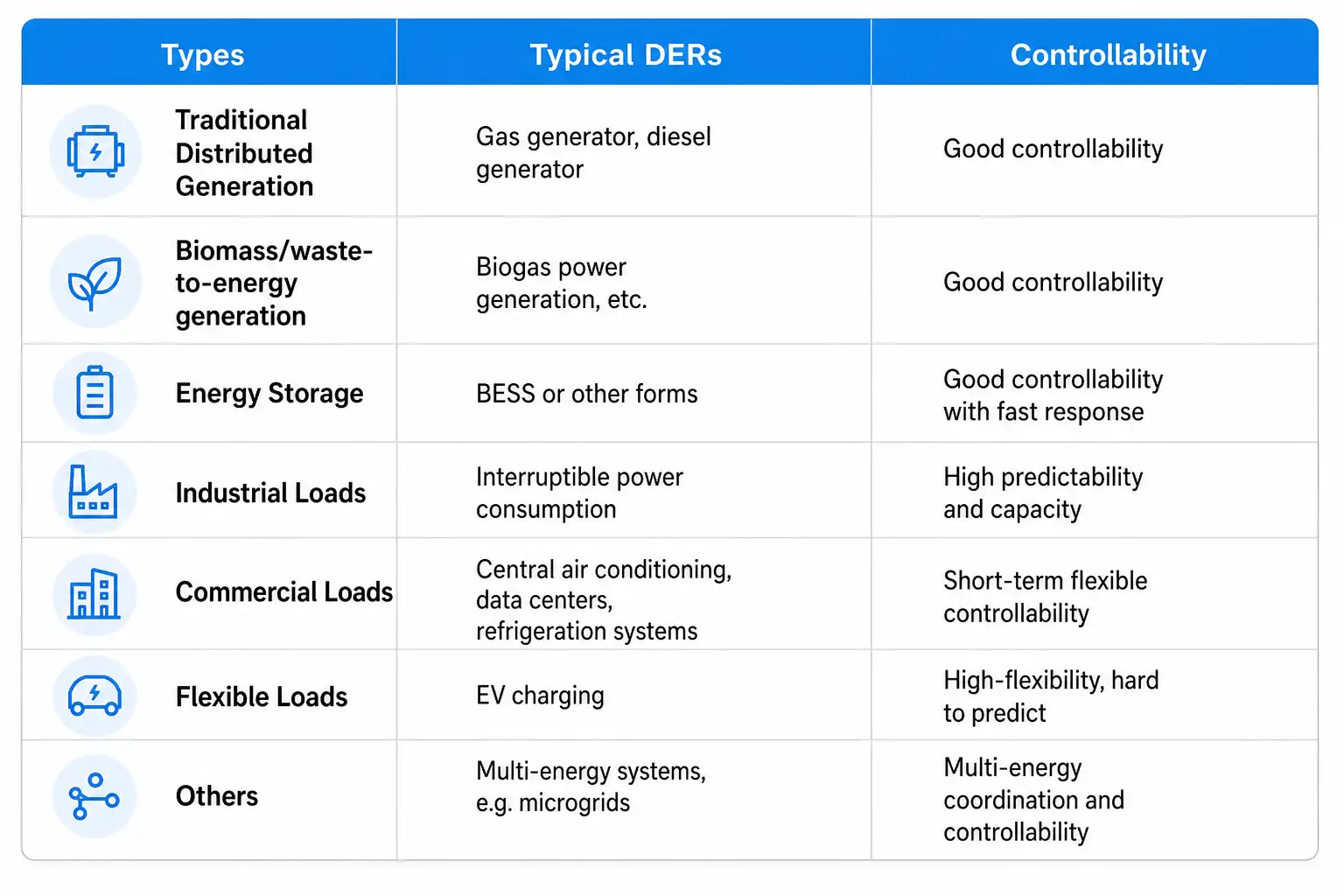
Different Types of DERs
Three-Gate Framework: Physics, Markets, Operations
Hitachi Energy frames VPP readiness around three coupled gates.
- First, physical asset behavior: dispatch must honor device limits, response times, states of charge, and thermal constraints across heterogeneous DERs.
- Second, market and settlement: participation must rest on credible baselines, value-stream alignment, and settlement integrity.
- Third, operational compliance: the system must be resilient, auditable, and efficient in real operations.
Many commercial platforms optimize one dimension well but falter on the others. In practice, engineers must satisfy all three concurrently for a VPP to be dispatchable and bankable.
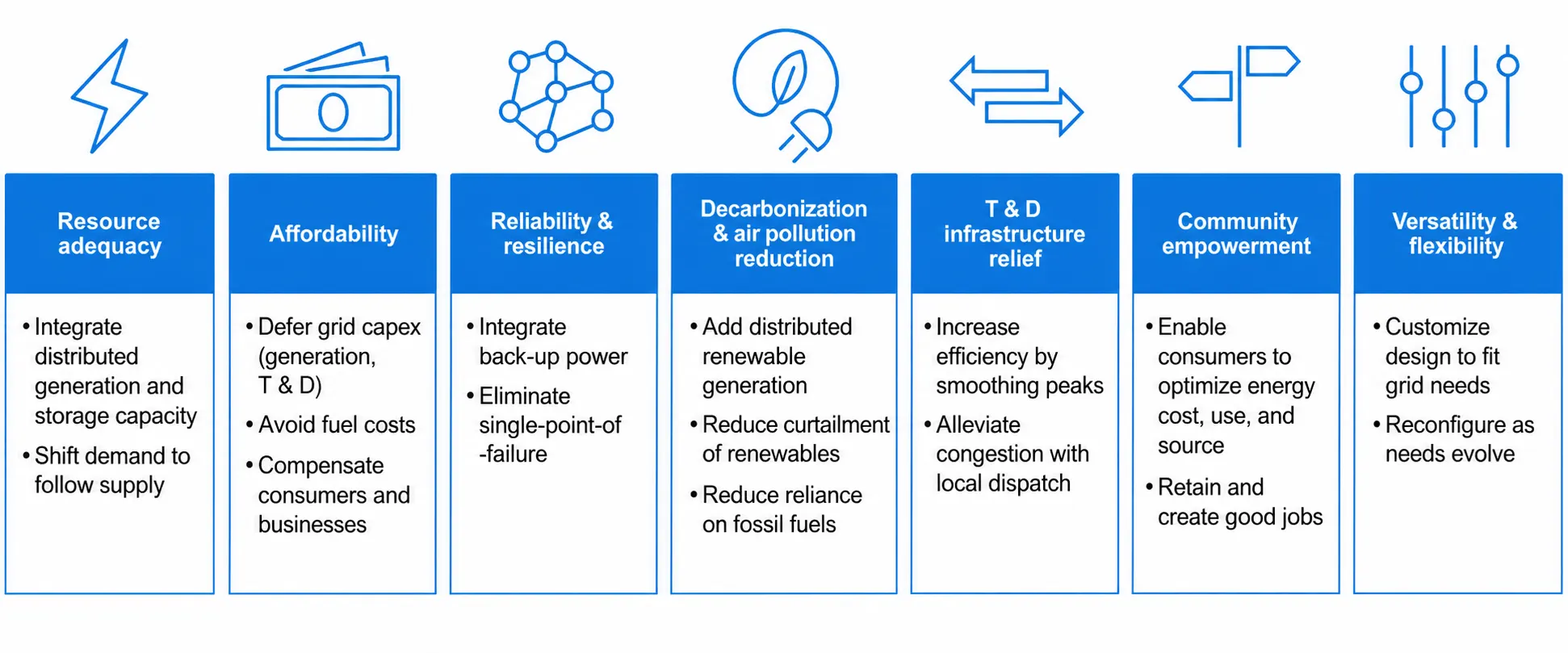
VPPs have the potential to perform a wide range of functions
Inside VirtuPlan’s Optimization Stack
The core innovation is model-based optimization that respects DER operating constraints while targeting multiple value streams. VirtuPlan pairs advanced forecasting with mathematical decision engines to schedule charging, discharging, and flexible load shifts without violating technical envelopes. The platform can pursue services from day-ahead energy to fast frequency response and congestion relief, and it supports multi-energy carrier use cases.
Predictability is the design goal. By explicitly modeling availability, limits, and local conditions, the system seeks to deliver committed capacity with minimal performance drift—key to market revenues and operator trust.
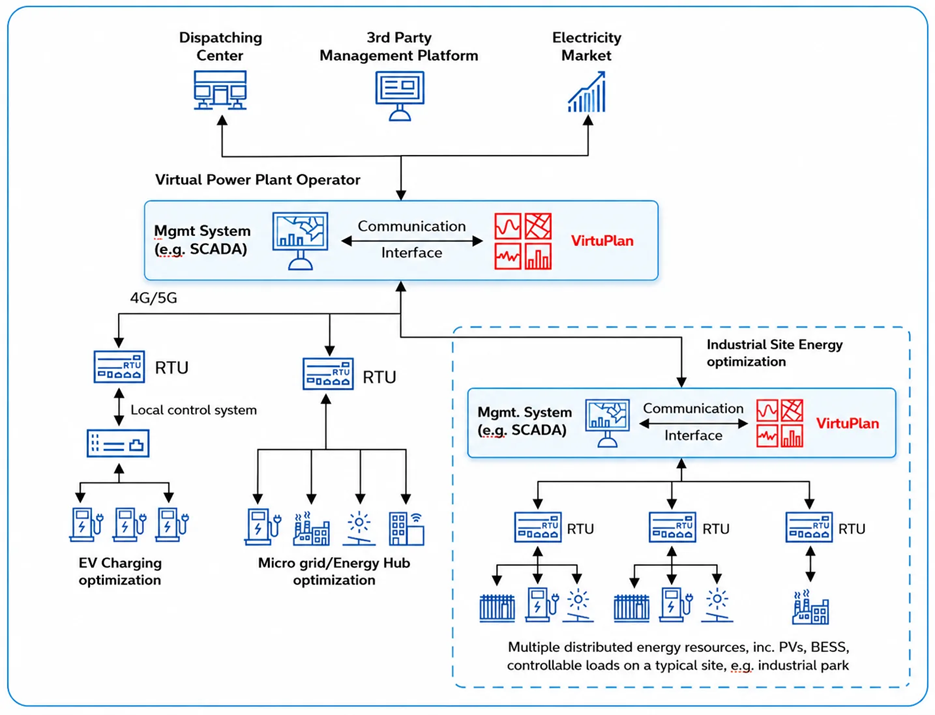
VirtuPlan System Architecture
In this architecture, VirtuPlan functions as the VPP “brain.” It determines what each resource should do, while existing automation and SCADA layers execute setpoints and control actions at the edge and site levels. This separation lets operators retrofit legacy assets and mix vendors without ripping and replacing local controls.
Modularity is critical as portfolios scale and diversify. The software is designed to accommodate new DER types, protocols, and functions over time, while maintaining cybersecure operation and consistent optimization logic across a growing fleet.
Market Integration and Settlement Confidence
Participation hinges on more than megawatts; it requires transparent baselines and settlement-ready data. VirtuPlan’s approach emphasizes value-stream alignment and traceability so that dispatch outcomes map cleanly to market products, whether energy, reserves, or demand-side services. That aligns with DOE guidance to standardize VPP operations and to integrate aggregations into wholesale markets under frameworks such as FERC Order 2222.
Economically, recent analysis by The Brattle Group found that a residential-flexibility VPP can deliver resource adequacy at roughly 40%–60% of the utility net cost of an equivalent gas peaker or utility-scale battery, depending on assumptions. This cost advantage strengthens the case for VPPs as a first resort for peak capacity and grid support.
Field Results at Scale: Zhejiang’s Numbers
Dispatch-grade performance is showing up in operations. In Zhejiang Province, China, Hitachi Energy supported a VPP for Zhejiang Energy Group that aggregates more than 200 DERs totaling 175 MW, including storage and adjustable loads. The platform provides continuous, real-time MW-level response, delivering average regulation rates above 20 MW per minute with up to 99% regulation accuracy, and frequency response surpassing local coal plant performance.
The same VPP coordinated 26 enterprise customers on a hot July day to add roughly 33,000 kWh of supply through flexible dispatch. In another project, connecting 40+ geographically dispersed DERs avoided an estimated $12 million in grid modernization costs and cut around 80,000 tons of CO2 annually versus an equivalent coal-fired output. These results underscore that properly orchestrated DER fleets can act like a utility-grade resource, not just a collection of devices.
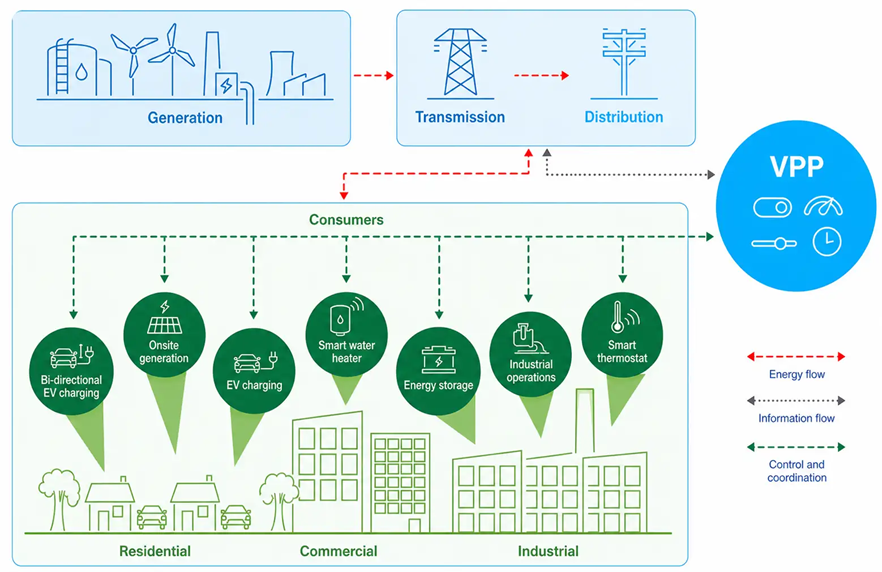
Virtual Power Plants (VPPs) are Aggregations of various Distributed Energy Resources (DERs)
What Matters to Practicing Engineers
Two implementation points stand out. First, strict constraint modeling. Site-level realities—HVAC comfort bands, EV charging windows, inverter ratings, ramp rates, telemetry latency—must be embedded in the optimizer, not handled as afterthoughts. Second, the SCADA handoff. Clear interfaces and fallback modes are essential to translate advisory setpoints into safe control actions under communications variability and cyber constraints.
Engineers should also plan for portfolio evolution. As new assets and tariff structures arrive, modular optimization services help preserve consistency while enabling feature growth, including AI-assisted analytics for forecasting and anomaly detection.
Making Flexibility Dispatchable
The shift from aggregation to dispatch-grade orchestration defines the next phase of VPPs. By combining model-based optimization, market-ready settlement processes, and robust operational integration, tools like VirtuPlan aim to convert DER diversity into predictable capacity that operators can count on.
If DOE’s liftoff scenario plays out, VPPs could deliver tens of gigawatts of flexible capacity by 2030 while lowering system costs. The engineering emphasis now is on predictability, interoperability, and lifecycle delivery—so virtual plants behave like real ones when the grid calls.