From GEO to Grid: The Engineering Case for Space‑Based Solar Power
Space-based solar power is emerging as a potential source of continuous, low-carbon electricity by transmitting energy from geostationary orbit to Earth using microwave power beaming.
Solar PV is cheap and fast to deploy, but it still goes dark at night and soaks up land. Grid planners want round‑the‑clock, low‑carbon power without the siting battles.
NASA and national programs in Asia are revisiting space‑based solar power (SBSP)—orbiting collectors that beam energy to Earth—as a path to firm, land‑light renewables. The core idea promises near‑continuous generation and flexible delivery, potentially easing storage needs and transmission bottlenecks.
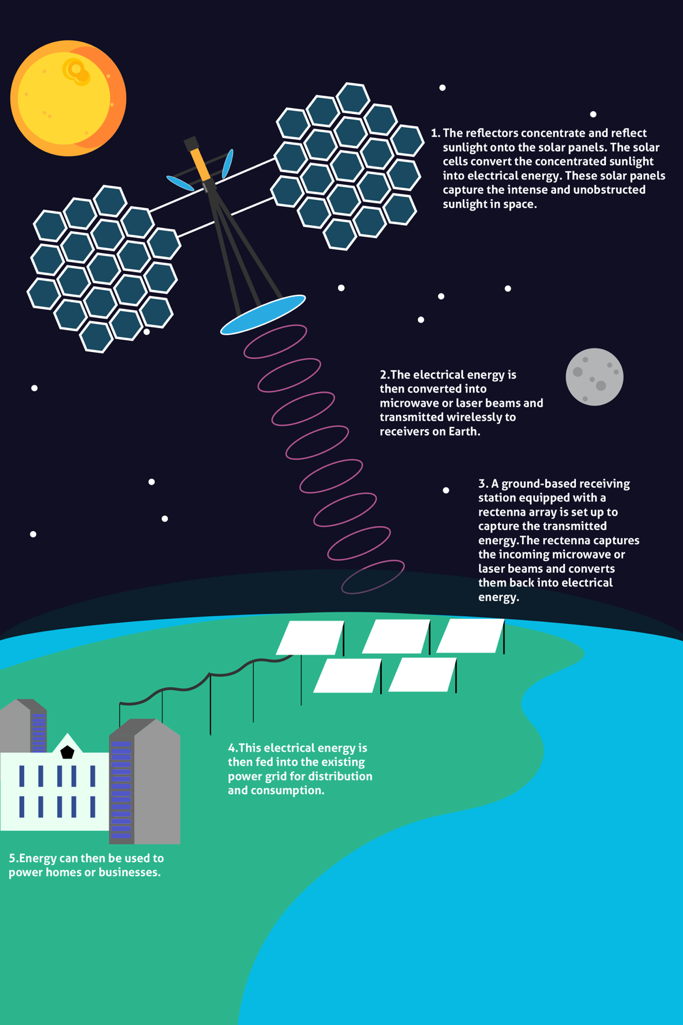
Stages of Space-Based Solar Power (SBSP)
Why GEO Matters for Duty Cycle and Grid Value
Most SBSP concepts place collectors in geostationary earth orbit (GEO) about 36,000 km above the equator. GEO avoids clouds and most eclipses, maintaining line‑of‑sight to a fixed ground receiver and enabling baseload‑like output.
NASA’s 2024 assessment modeled two representative architectures and found a heliostat‑based “swarm” design could generate power 99% of the year, while a planar PV array variant manages roughly 60% due to pointing limits. Both are normalized to deliver 2 GW to the grid to be comparable with very large terrestrial plants.
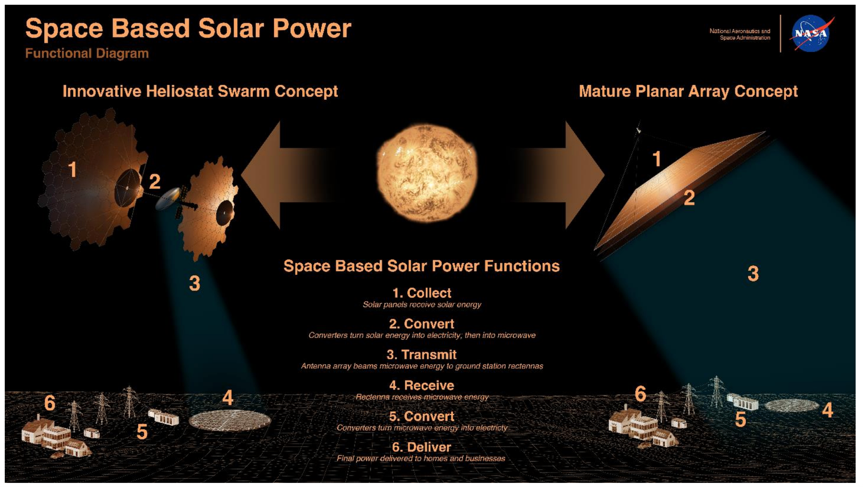
Heliostat Swarm Vs. Planar PV Array Architecture
Beaming Power Home: Microwaves, Rectennas, and Safety
SBSP satellites convert collected solar energy to RF and transmit it as a microwave beam to a rectifying antenna (“rectenna”) on the ground, which outputs DC for grid interconnection. Microwaves are favored because they propagate through weather with modest attenuation; lasers offer tighter beams but face higher atmospheric loss and more acute safety concerns.
Engineering the end‑to‑end link means closing budgets across space‑to‑ground path loss, beam‑forming accuracy, side‑lobe control, and rectenna conversion efficiency, all while meeting public safety constraints on power density. Early literature flagged human and aviation exposure as design drivers, reinforcing the need for beam‑control interlocks and conservative keep‑out envelopes.
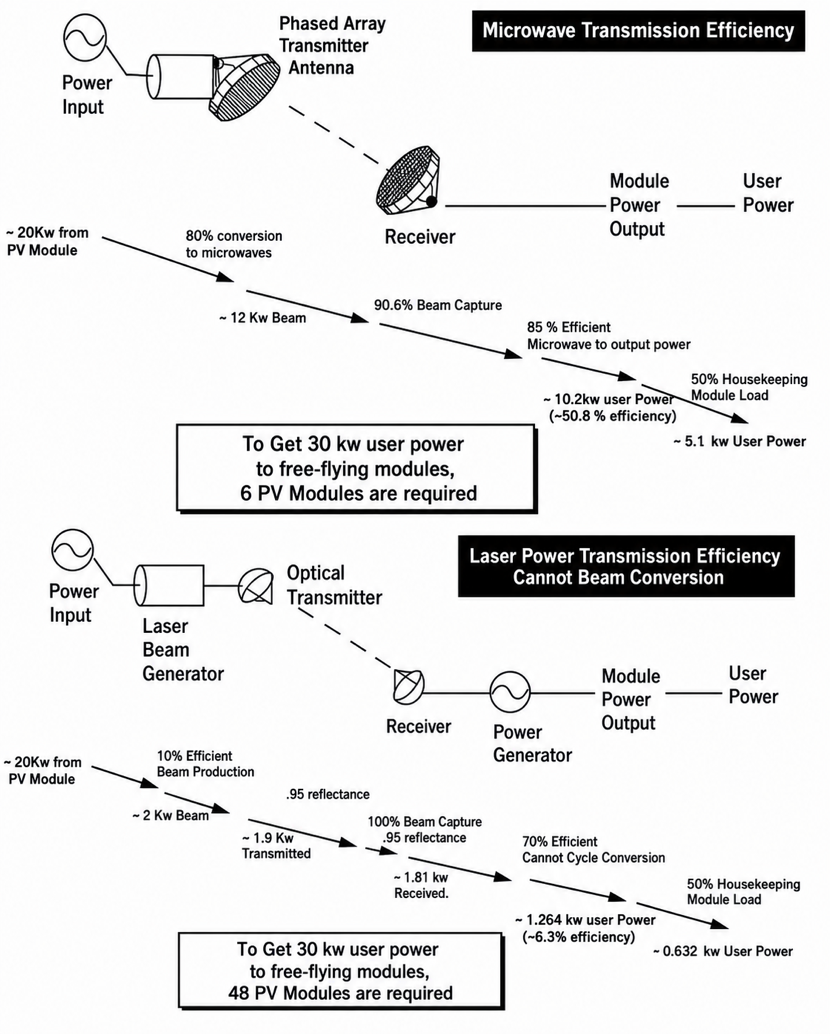
Comparison of Microwave and Laser Power Transmission
Hardware at Unprecedented Scale
NASA’s point designs illustrate the structural scale. The heliostat‑swarm variant requires about 11.5 km² of solar collecting area with a total mass near 5.9 million kg; the planar array concept grows to roughly 19 km² and 10 million kg. For context, these panel areas dwarf the International Space Station, and the mass rivals large satellite constellations.
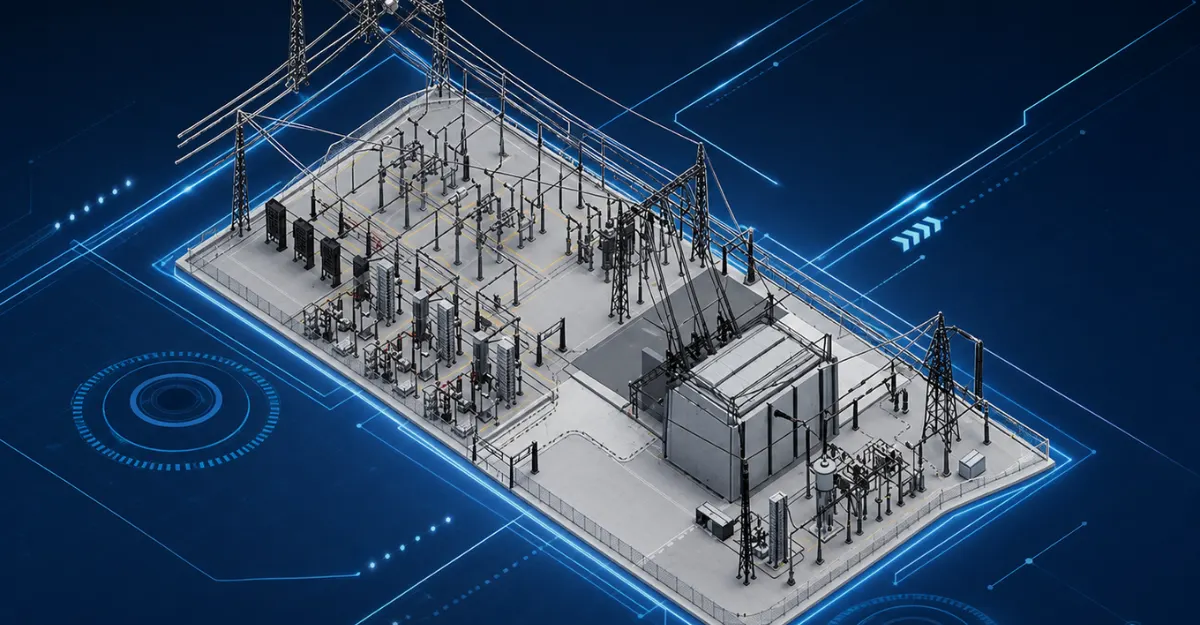
Scale extends to the ground segment. The more modular, planar concept requires multiple rectennas to match the 2 GW grid delivery target, increasing land and interconnection work even as the primary energy collection remains off‑planet. These ground realities will shape site selection, permitting, and grid tie‑in strategies.
Economics: Launch Dominates the LCOE
In NASA’s baseline scenario, launch is the largest cost driver—about 71% for the heliostat design and 77% for the planar array—because thousands of missions are needed to deliver multi‑megaton hardware to orbit and support refueling and assembly. The modeled levelized cost of electricity (LCOE) lands at roughly $\$0.61/\mathrm{kWh}$ for the heliostat concept and $\$1.59/\mathrm{kWh}$ for the planar array, far above mid‑century projections for terrestrial renewables.
Direct‑to‑GEO capability could cut required launches by more than half and reduce LCOE on the order of 40–50%, but it does not erase the economic gap by itself. The analysis also projects lifecycle greenhouse gas intensities of 26–40 gCO2eq./kWh, comparable to low‑carbon terrestrial sources—the emissions are dominated by launch and large‑scale manufacturing.
Assembly, Autonomy, and Debris: The Orbital Engineering Stack
NASA’s lifecycle scenario envisions development in the 2030s, transfer and assembly in GEO during the 2040s, initial operations from 2050 to 2080, and disposal to graveyard orbits by the mid‑2080s. That timeline presumes reliable in‑orbit assembly, modular servicing, and a long‑duration maintenance cadence—capabilities that will push autonomous robotics and on‑orbit logistics.
Debris risk scales with constellation size and operational lifetime. Designs must incorporate graceful degradation, replaceable modules, and end‑of‑life maneuvering, coordinated under international space‑traffic management to protect other GEO assets. These are not optional extras; they are core to licensability and insurability.
Global Momentum and Market Signals
Policy interest is broad. The U.S. is studying options but has not declared SBSP a formal agency mission; in Asia, China has outlined ambitions for an operational orbital power station in the 2030s, while Japan continues wireless‑power demonstrations. Analysts expect Asia‑Pacific to lead early deployments as technologies mature.
Market forecasts are early and vary widely. One projection pegs the SBSP market at about $4.7\ \text{billion}$ by 2030 with ~3.3% CAGR through 2040, while others estimate roughly $1.0\text{--}1.1\ \text{billion}$ by 2030, highlighting uncertainty in cost curves and program timing. For engineers, the spread reflects how launch prices, automation maturity, and rectenna siting will determine first‑mover economics.
Where SBSP Could Fit First
If microwave power beaming closes safely and economically, early use cases will value attributes that terrestrial renewables struggle to deliver. Continuous generation without large land footprints could support islands, remote industrial loads, and disaster response, where logistics dominate LCOE and siting is constrained. SBSP’s ability to “retarget” beams to different rectennas adds an operational flexibility dimension.
Grid‑connected rectennas will still demand robust protection, spectrum coordination, and interconnection studies akin to utility‑scale renewables. Expect grid‑code work on harmonic control, fault ride‑through, and curtailment interfaces to parallel RF safety certification.
Bottom Line
SBSP packages three promises: near‑continuous solar input, relocatable delivery, and minimal on‑Earth land use. NASA’s 2024 analysis shows that physics is not the blocker—economics and logistics are: multi‑kilometer structures, megaton‑class upmass, and thousands of launches keep LCOE far above ground alternatives today.
The engineering path is clear, if demanding: cut launch costs, automate on‑orbit assembly, harden beam control and safety, and standardize rectenna/grid interfaces. If those pieces move in step, SBSP could emerge as a firm, low‑carbon complement to terrestrial renewables in the 2030s–2050s, starting with niche, high‑value loads and maturing toward larger grid roles. For power engineers, the message is to monitor beaming demonstrations, rectenna prototypes, and autonomy milestones—their convergence will define when GEO power can compete at ground level.