Understanding Wind Energy: Turbines, Betz Limit, Power Calculations
Learn how wind turbines convert the kinetic energy of moving air into electricity, including turbine types, operating principles, wind power equations, the Betz limit, and practical performance calculations.
Wind energy is a form of solar energy. As you may know, because of the Earth’s tilt and orbit, the Sun heats the Earth and its atmosphere at different rates. You also know that hot air rises and cold air sinks to replace it. As the air moves, it has kinetic energy. Part of this kinetic energy can be converted into mechanical energy and electricity.
Historically, the Persians, Chinese, and Egyptians were among the first civilizations to harness wind energy to grind grains, pump water, and sail boats. As was the case with new technologies of that era, the methods for harnessing wind energy found their way to Europe, and the Europeans brought this technology to the Americas when they settled in the New World.
As you know, you can expect to experience windy days with different wind intensities during certain times of the year. Therefore, it also should be self-evident that the amount of wind energy that can be harnessed depends on how fast and how often the wind blows in a region. Thus, the potential for harnessing wind energy and generating electricity varies by geographical location. The United States wind resource map in Figure 1 shows annual average wind speeds at a height of 80 m above ground.
The rotors of wind turbines are usually mounted on tall towers. This is done because the wind speed increases with the vertical distance from the ground. On a windy day, air at a higher elevation moves faster than the air near the ground, as shown in Figure 2.
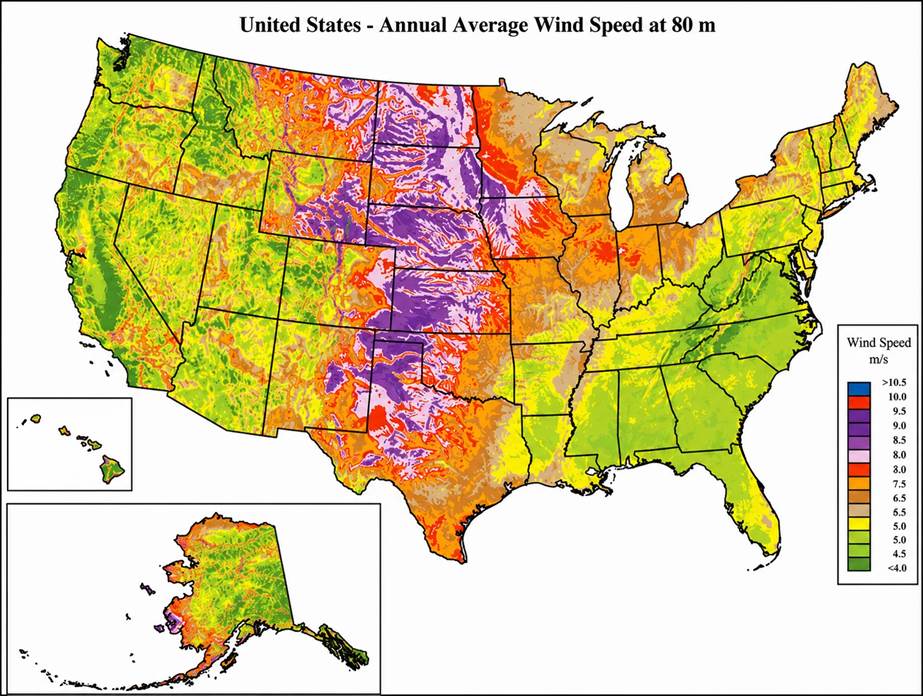
Figure 1 United States wind resource map.
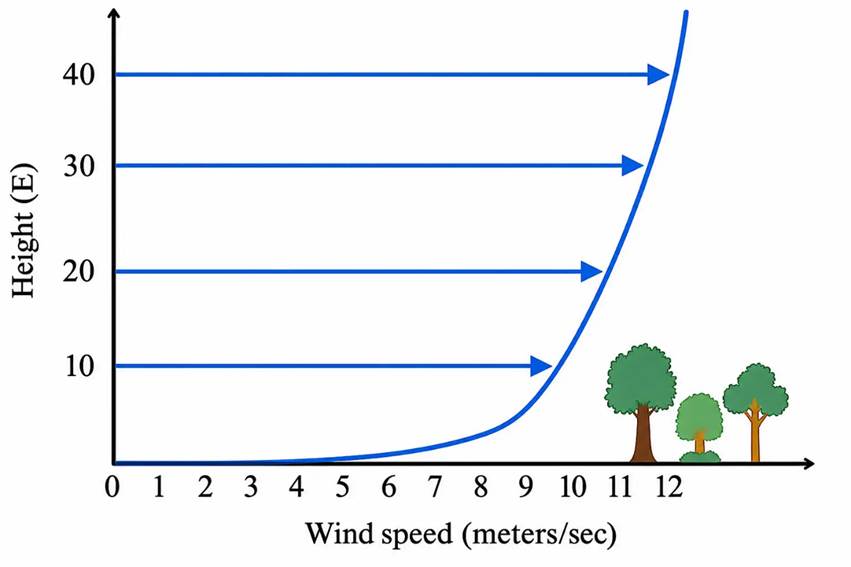
Figure 2 An example of wind speeds near the ground.
Wind Turbines
Two types of wind turbines are used to extract energy from the wind: vertical axis and horizontal axis. Schematic diagrams of vertical axis and horizontal axis turbines are shown in Figure 3.
The vertical axis turbine can accept wind from any angle, requires lightweight towers, and is easy to service. The main disadvantage of the vertical axis turbine is that, because the rotors are near the ground where the wind speeds are relatively low, it has poor performance.
Most wind turbines in use throughout the world are of the horizontal axis type. As the name implies, the rotor blades of a horizontal axis turbine rotate about an axis that is horizontal (see Figure 3). Wind turbines are typically classified as small ( <100 kW), intermediate ( <250 kW), and large ( 250 kW to 8 MW).
Two types of wind turbines are used to extract energy from the wind: vertical axis turbines and horizontal axis turbines.
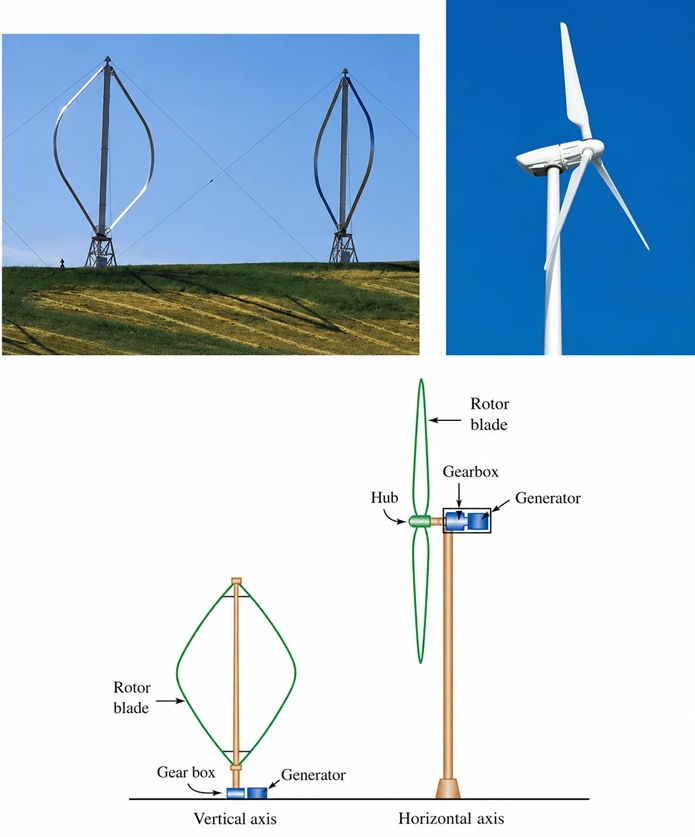
Figure 3 Vertical axis and horizontal axis wind turbines.
Wind Turbine Components
Here are some wind turbine terms that you will find useful.
- The blades and hub are called rotors. Most horizontal axis turbines have either two or three blades. The blades are typically made from wood, steel, aluminum, or fiberglass. Wooden blades are strong, lightweight, inexpensive, and flexible, whereas blades made from steel are strong, but they are also heavy and expensive. Newer turbines use fiberglass blades because they are strong, lightweight, and inexpensive. Aluminum blades are strong and lighter than steel, but they are also expensive. Depending on the size of the system and the material used, the blades can be as long as 100 feet or more.
- The gear box connects the low-speed shaft attached to the rotor to the high-speed shaft that is attached to the generator to increase the rotational speed.
- The yaw motor runs the yaw drive to keep the blades facing into the wind as the wind direction changes.
- A controller starts the wind turbine at speeds of about 8 to 16 miles per hour (mph) and stops the turbine at relatively high speeds to prevent damage to the blades and components. An anemometer measures the wind speed and transmits the data to the controller.
- A brake stops the rotor in emergencies or high wind speeds. The brake is applied mechanically, electrically, or hydraulically.
- The sweep area of the blades is shown in Figure 4. The sweep area is equal to the area of the circle through which wind moves; $\text{Sweep area}=\pi(\text{blade length})^2$.
- Rotor solidity is the ratio of the total rotor platform area to the total sweep area. Low solidity results in high speed and low torque, whereas high solidity (values greater than 0.8 ) results in low speed and high torque (see Figure 4).
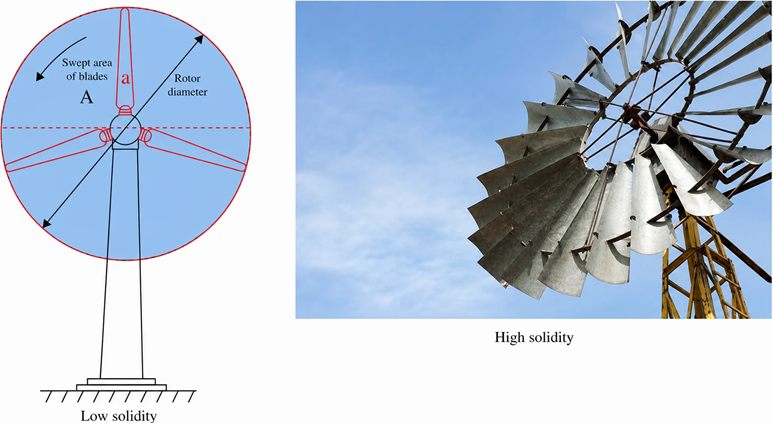
Figure 4 The turbine on the left has a lower solidity than the turbine on the right.
Betz Limit
Another important principle that you should know is the Betz limit, which states that not all wind power can be captured. Think about it; if all the wind energy is captured, the air behind the rotor will have zero speed, which would mean that no air is flowing over the blades. The theoretical limit for rotor efficiency is 59 percent, with most current wind turbines having an efficiency in the range of 25 to 45 percent.
The Betz limit states that not all wind power can be captured.
Let us now look at how we might estimate the amount of energy that can be extracted from wind. An object having a known mass m and moving with a speed 𝑉 has a kinetic energy that is equal to
$$\text{Kinetic energy}=\left(\frac{1}{2}\right)(\text{mass})(\text{speed})^2=\frac{1}{2}mV^2$$
We can apply this kinetic energy equation to the wind blowing over a turbine by noting that, in this case, m represents the mass of the moving air and 𝑉 is the wind speed. Next, recall the definition of power as
$$\text{Power}=\frac{\text{Energy}}{\text{Time}}$$
Then the amount of power that can be extracted from the moving air (wind) is given by
$$\text{Power}=\frac{\text{Energy}}{\text{Time}}=\frac{\left(\frac{1}{2}\right)(\text{mass})(\text{speed})^2}{\text{time}}=\left(\frac{1}{2}\right)(\text{mass flow rate})(\text{speed})^2 \ \ \ \ \ (1)$$
In Equation (1), the quantity $\frac{mass}{time}$ is called the mass flow rate; how much air per unit of time (for example, per second) is moving through the wind turbine’s sweep area. The mass flow rate is related to the density of the air and the volume of the moving air as shown in the following equation. Moreover, the volume of air moving through the wind turbine is related to the area (i.e., sweep area) and the distance traveled by air. Recognition of these facts then results in
$$\text{Mass flow rate}=\frac{\text{mass}}{\text{time}}=\frac{(\text{density})(\text{volume})}{\text{time}}=\frac{(\text{density})(\text{area})(\text{distance traveled})}{\text{time}}=\frac{(\text{density})(\text{area})(\text{speed})(\text{time})}{\text{time}}=(\text{density})(\text{area})(\text{speed})$$
$$\text{Mass flow rate}=(\text{density})(\text{area})(\text{speed}) \ \ \ \ \ (2)$$
Substituting Equation (2) into Equation (1), we get
$$\text{Power}=\left(\frac{1}{2}\right)(\text{mass flow rate})(\text{speed})^2=\left(\frac{1}{2}\right)(\text{density})(\text{area})(\text{speed})(\text{speed})^2$$
Or
$$\text{Power}=\left(\frac{1}{2}\right)(\text{density})(\text{area})(\text{speed})^3 \ \ \ \ \ (3)$$
Next, we must account for the Betz limit and the efficiency of the wind turbine. This last step yields a relationship for wind power in terms of turbine efficiency, air density, sweep area, and wind speed according to
$$\text{Wind power}=(\text{efficiency})\left(\frac{1}{2}\right)(\text{density})(\text{sweep area})(\text{speed})^3 \ \ \ \ \ (4)$$
Let us now look at some examples where we apply Equation (4).
Example 1
A wind turbine manufacturer states that one of its largest systems with a blade length of 35.25 meters (m) can generate 1.5 megawatts (MW) of electricity when the wind speed is 12 meters per second (m/s) or ∼27 miles per hour (mph). The manufacturer does not mention anything about the efficiency of its system, so let us calculate it. Note: The density of air is 1.2 kg/m3.
$$\text{Wind power}=(\text{efficiency})\left(\frac{1}{2}\right)(\text{density})(\text{sweep area})(\text{speed})^3$$
$$\text{Sweep area}=\pi(\text{blade length})^2=\pi(35.25\,\text{m})^2=3904\,\text{m}^2$$
$$1.5\times10^6\,\text{W}=(\text{efficiency})\left(\frac{1}{2}\right)\left(1.2\,\frac{\text{kg}}{\text{m}^3}\right)(3904\,\text{m}^2)\left(12\,\frac{\text{m}}{\text{s}}\right)^3$$
$$\text{Efficiency}=\frac{1.5\times10^6\,\text{W}}{\left(\frac{1}{2}\right)\left(1.2\,\frac{\text{kg}}{\text{m}^3}\right)(3904\,\text{m}^2)\left(12\,\frac{\text{m}}{\text{s}}\right)^3}=0.37\ \text{or}\ 37\%$$
Example 2
Estimate the power generated by the wind turbine of Example 1 for wind speeds of 6 m/s ( 13.4 mph), 8 m/s ( 17.9 mph), and 10 m/s ( 22.4 mph), assuming the same efficiency of 37 percent at all of the given wind speeds. Again, the density of air is 1.2 kg/m3.
$$\text{Wind power}=(\text{efficiency})\left(\frac{1}{2}\right)(\text{density})(\text{sweep area})(\text{speed})^3$$
For windspeed = 6 m/s,
$$\text{Power}=(0.37)\left(\frac{1}{2}\right)\left(1.2\,\frac{\text{kg}}{\text{m}^3}\right)(3904\,\text{m}^2)\left(6\,\frac{\text{m}}{\text{s}}\right)^3=187205\,\text{W}\approx187\,\text{kW}$$
For windspeed = 8 m/s,
$$\text{Power}=(0.37)\left(\frac{1}{2}\right)\left(1.2\,\frac{\text{kg}}{\text{m}^3}\right)(3904\,\text{m}^2)\left(8\,\frac{\text{m}}{\text{s}}\right)^3=443744\,\text{W}\approx444\,\text{kW}$$
For windspeed = 10 m/s,
$$\text{Power}=(0.37)\left(\frac{1}{2}\right)\left(1.2\,\frac{\text{kg}}{\text{m}^3}\right)(3904\,\text{m}^2)\left(10\,\frac{\text{m}}{\text{s}}\right)^3=866688\,\text{W}\approx867\,\text{kW}$$
Note the power generated is proportional to the wind speed cubed. Therefore, a relatively small increase in wind speed could result in a large increase in power generation. The results are summarized in the following table.
|
Wind Speed (m/s) |
Power Generated (kW) |
|
6 |
187 |
|
8 |
444 |
|
10 |
867 |
|
12 |
1,500 |
Today, China, the United States, Germany, and India are among the countries with the largest amount of electricity generated from wind. In the United States, the top five states with the largest electricity generation from wind were Texas, Iowa, Oklahoma, Kansas, and Illinois (refer to Figure 5). In fact, one of the largest wind farms in the United States is located in Texas, with 430 turbines that together produce 735 MW of electricity.
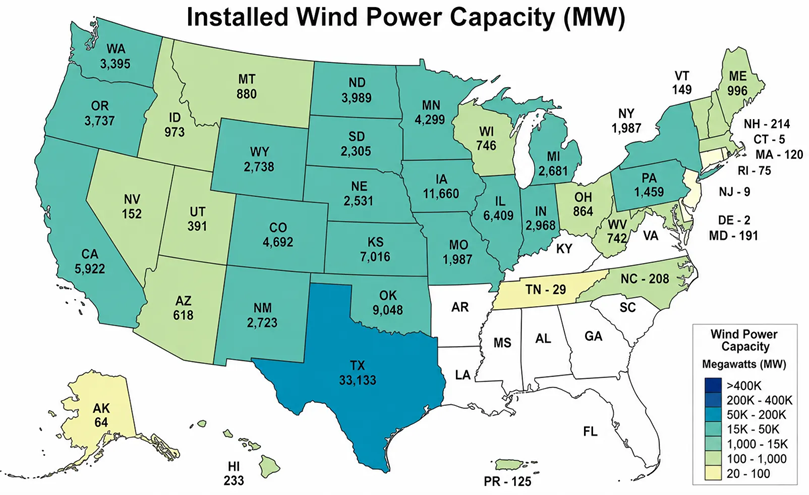
Figure 5 The top wind energy-producing states.
Example 3
In 2024, 182 billion kilowatt-hours (kWh) of electricity was generated from wind energy in the United States. Assuming an annual household electricity consumption of 10,000 kWh, how many households could be supplied with electricity from wind energy?
$$\text{Number of households}=\left(182\times10^9\,\text{kWh}\right)\left(\frac{1\ \text{household}}{10000\,\text{kWh}}\right)=182\times10^5\approx18\ \text{million}$$
Note that for this result we did not account for any losses in transmission lines.
Example 4
For Example 3, how much coal was saved (not consumed) because of wind energy generation? Assume coal has an average energy content of 10,000 Btu per pound; the coal-fired power plant has an efficiency of 36 percent. Also, 1 kWh=3,412 Btu.
$$\text{Amount of coal not consumed (lb)}=\frac{\left(182\times10^9\,\text{kWh}\right)\left(\frac{3412\,\text{Btu}}{1\,\text{kWh}}\right)\left(\frac{1\,\text{lb}}{10000\,\text{Btu}}\right)}{0.36}=172.495\times10^9\,\text{lb}$$
$$\text{Amount of coal not consumed (tons)}=\frac{\left(182\times10^9\,\text{kWh}\right)\left(\frac{3412\,\text{Btu}}{1\,\text{kWh}}\right)\left(\frac{1\,\text{lb}}{10000\,\text{Btu}}\right)\left(\frac{1\,\text{ton}}{2000\,\text{lb}}\right)}{0.36}=86,247,777\,\text{tons}\approx86.3\,\text{million tons}$$
Take a moment and think about this value! That is a lot of coal that is not being consumed, meaning it is not contributing to pollution and CO2 emissions.
Key Takeaways
Wind energy has become one of the world's fastest-growing renewable energy sources, providing utility-scale electricity without fuel consumption or direct greenhouse gas emissions during operation. Maximizing energy production requires careful consideration of site wind resources, turbine design, rotor size, tower height, and aerodynamic efficiency, while recognizing practical limits such as the Betz limit and variations in wind speed. Modern wind farms now play a critical role in national power systems by reducing dependence on fossil fuels, lowering carbon emissions, and supplying electricity to millions of homes.