Classification of Supercapacitors and Their Energy Storage Mechanisms
Learn about the major types of supercapacitors, including EDLCs, pseudo-capacitors, and hybrid capacitors, along with their operating principles, materials, and applications.
Figure 1 illustrates the comprehensive classification of supercapacitors, presenting a taxonomy that categorizes these energy storage devices based on various characteristics and operational principles. This classification scheme encompasses a diverse range of supercapacitor types, including but not limited to electrochemical double-layer capacitors (EDLCs), pseudo capacitors, and hybrid capacitors.
Each category is delineated based on its underlying electrochemical mechanisms, material composition, structural design, and performance attributes. By systematically categorizing supercapacitors, this classification framework facilitates a deeper understanding of their fundamental principles and technological capabilities, thereby guiding research, development, and application efforts in the burgeoning field of energy storage and conversion.
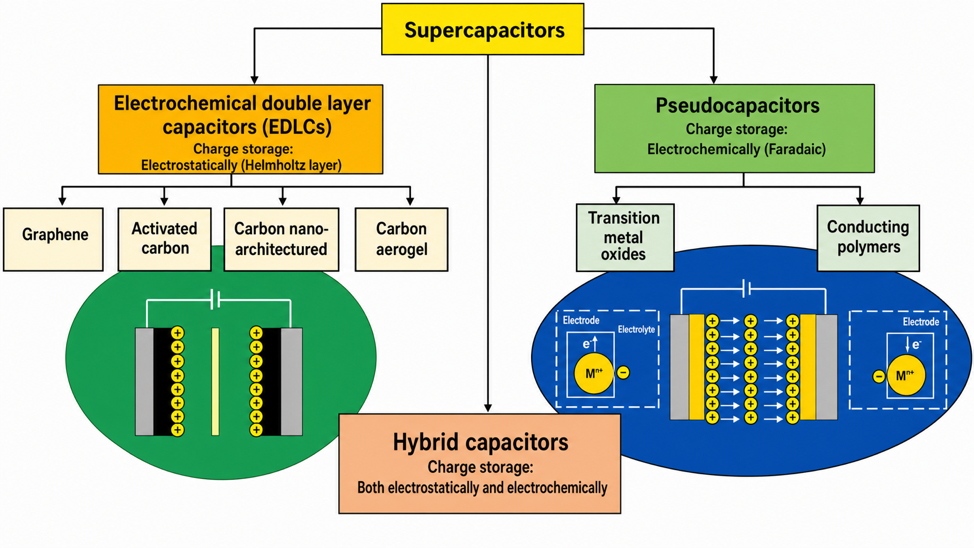
Figure 1 Classification of Supercapacitors
The three types of supercapacitors are as follows:
- Electrostatic double-layer capacitor
- Pseudo-capacitors
- Hybrid capacitors
Electrostatic Double-Layer Capacitors
The two electrodes of a supercapacitor are separated by a separator that is submerged in an electrolyte.
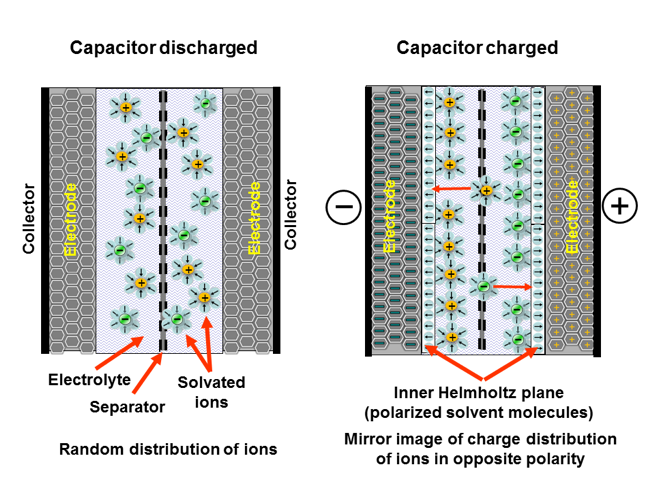
Figure 2 Function and Structure of an ideal double-layer capacitor.
Electrodes
A porous substance, usually carbon (activated carbon), is deposited over a thin metal film, usually aluminum, to create the two electrodes of a super-capacitor. The interface between the porous substance and the electrolyte is where the supercapacitor stores its charge when it is charged. A very large active surface for charge storage with strong electrical conductivity is provided by the use of activated carbon.
Electrolyte
The supercapacitor electrolyte’s job is to ensure that internal ions can move freely between the electrodes. The migration of anions to the positive electrode and of cations to the negative electrode ought to be unrestricted. Although they can be solid, electrolytes are usually liquid.
Ionic conductivity and supercapacitor cell voltage are frequently compromised in the selection of the electrolyte, and the goal of maximizing ionic conductivity may result in a breakdown voltage of the electrolyte as low as 1 V. The operating voltage of the supercapacitor must be restricted (2.5 - 3V) since the redox reaction will cause irreversible reactions during the charge and discharge phases.
Separator
The separator of a supercapacitor is often a piece of paper, which serves as insulation and prevents any conductive contact between the electrodes. It must, however, be able to dissolve in the electrolyte without impairing the electrolyte’s ionic conductivity.
The EDLC system is frequently used as an energy storage method. When compared to traditional electrolytic capacitors, this device has a higher energy density and a high-power density when compared to re-chargeable battery.
Because the electrodes or electrolyte contact electrostatically retains the charge without any redox reaction, the charging–discharging process in EDLC can occur quickly. Its enhanced energy-storage capacity is primarily attributable to the high conductivity of the electrolyte and the electrodes’ wide surface areas.
In the early stages of electrostatic double- layer capacitors’ energy device research, liquid-based electrolytes were used because they could produce outstanding and realistic electrochemical properties. However, a number of issues have impeded the development of liquid electrolytes (LEs), such as volatility, leakage problems, electrode corrosion, toxicity, thermal instability, and flammability.
Carbon Nanotubes
Carbon nanotubes are frequently employed as a high-power electrode material due to their high electrical conductivity and wide surface area. Furthermore, due to their great mechanical robustness and open tubular network, they are an excellent foundation for active materials. Carbon nanotubes’ discovery has substantially expanded carbon material research and engineering.
The overall resistance of the components of a supercapacitor is the most important factor in determining power density. Carbon nanotubes have received a lot of attention for supercapacitor electrode applications due to their unique pore structure, exceptional electrical characteristics, and good mechanical and thermal durability.
They are classified as either single-walled carbon nanotubes or multiwalled carbon nanotubes, and they both have received considerable attention as electrode materials for energy storage.
Other carbon structures researched for supercapacitor applications include activated carbon fibers (ACFs), carbon aerogels, and carbon onions. The general principles for supercapacitor electrode material selection are a large specific surface area with strong electrical conductivity.
ACFs have high surface areas, up to three thousand m2 g-1, and a controlled pore size distribution. Carbon aerogels are yet another intriguing material that could be used as an electrode for super-capacitors. They are ultra-light, extremely porous materials, primarily with mesopores, and can be used without the use of binding chemicals. Despite the difficulties in preparation, a novel form of carbon nanotube aerogel electrode material has shown promising capacitive capabilities.
Pseudo-Capacitors
Pseudo-capacitors, otherwise known as faradaic supercapacitors, are devices that differ from EDLCs. This capacitor’s electrodes contain redox-active materials that store electrical energy via a different method than EDLCs.
In reality, the EDLC only accounts for a portion of the charge, but faradaic mechanisms such as redox reactions, electro sorption, and intercalation can account for a considerable portion of the energy transfer and storage. When an external voltage is supplied to this capacitor, fast and reversible redox processes on the electrode occur, including the passage of charges between electrode and electrolyte. The charge and discharge operation of this capacitor is similar to that of an electric battery.
Pseudo-capacitors are a hybrid of a battery and an electrostatic double- layer capacitor. An electrolyte separates the two electrodes in this capacitor. The most popular techniques of charge storage are chemical and electrostatic reactions. Transfer rates are superior when the charge transfer is comparable to those of a battery due to thinner redox material over the electrode, since fewer ions permeate from the electrolyte into the structure would otherwise occur. Because of the various methods that perform charge storage, the pseudo-capacitors capacitance values are higher.
Working Principle of a Pseudo-Capacitor
A pseudo-capacitor accumulates electrical energy by transferring electron charge in between the electrode and an electrolyte reduction/oxidation reaction, electro sorption, and intercalation processes known as pseudo capacitance. A pseudo-capacitor is an integral component of an electrochemical capacitor that, along with an electrostatic double-layer capacitor, creates a supercapacitor.
Metal sulfides, metal oxides, metal hydroxides, metal nitrides, and conducting polymers are common constituents of pseudocapacitive. Metal oxides such as ruthenium dioxide, nickel oxide, MnO2, and conducting polymers such as polyaniline and polypyrrole are some of the examples of pseudo-capacitor materials.
Throughout the faradaic reactions, energy can be stored in pseudo-capacitors. Thus, they store charge electrostatically, where charge can be transferred between electrode and an electrolyte. When a voltage is supplied to the pseudo-capacitor, the electrode materials undergo both reduction and oxidation process.
The faradic method used in these capacitors, as compared to electrostatic double-layer capacitors, has the ability to speed electrochemical processes, resulting in higher specific capacitance and energy densities.
Pseudo-capacitor materials improve energy density, allowing for greater energy storage density in the volume of electrode materials at their surface. The main characteristics of these capacitor materials are that they are electrically conductive and have two oxidation states within a specific voltage window.
When compared to conventional capacitors, these capacitors have the highest capacitance density due to their unique storing charge principles. Hence, the result is that the total amount of electric charge stored in a pseudo capacitance is proportional to the voltage supplied to them.
Classifications of Pseudo-Capacitors
Pseudo-capacitors are subdivided into two categories, depending on the electrode materials used to store the charge within them.
- Metal oxide
- Conducting polymers
Metal Oxide
Metal oxide is a type of pseudo capacitive substance that undergoes reversible and quick redox reactions on the electrode materials’ surfaces. This electrode material is ideal for creating high-power supercapacitors because of their low resistance and high specific capacitance.
Metal oxides that are often used as supercapacitor electrodes include MnO2, RuO2, NiO, SnO2, IrO2, Fe3O4, V2O5, and MoO. Because of its superior electrical conductivity and specific capacitance, Ruthenium (II) oxide is the one of the most suitable electrode materials among various metal oxide electrode materials in the application of supercapacitors. However, the planet’s scarcity of “Ru” has limited its practical application. Given this fundamental difficulty, it is necessary to identify low-cost pseudo capacitance materials.
Metal oxides have varied oxidation states at different potentials and crystalline morphology that allow for maximum conductivity and charge distribution in their network. Metal oxides can change their oxidation state during oxidation and reduction surface processes, and protons can be introduced to and removed from the oxide lattice.
Conducting Polymers
Conducting polymers are utilized in redox pseudo-capacitors due to their rapid and reversible oxidation or reduction processes, low cost, and high electrical conductivity. The most often used conducting polymers are polypyrrole, polyaniline, polythiophene, p-poly p-phenylene vinylene, and p-poly e-ethylene dioxythiophene. These materials are typically formed through electrochemical or chemical oxidation of the monomer and are rendered conductive through the use of a conjugated link system and the polymer backbone.
Conducting polymers provide capacitance, higher conductivity, and lower equal series resistance as compared to carbon-based electrode materials. Once the ions have been oxidized and reduced, they are simply monitored or floated from the electrolyte to the conducting polymers before being returned to the electrolyte.
Because there is no phase transition, these polymers exhibit extremely reversible effects, resulting in greater cycling stability. As a result of redox activities that promote greater conductivity, they become positively or negatively charged.
Advantages of Pseudo-Capacitors
- The power density of these capacitors is higher.
- They have a long life span.
- Pseudo-capacitors can charge and discharge significantly more quickly than lithium-ion batteries.
- The electrode materials used in pseudo-capacitors boost energy density and allow for energy density storage both within and on the surface of the electrode materials.
Disadvantages of Pseudo-Capacitors
- Because of their poor energy density, these capacitors cannot be used to replace batteries in energy storage applications.
- As long-term energy storage solutions, they are ineffective.
- These capacitors’ output voltage does not rise linearly with charge.
Applications of Pseudo-Capacitors
- Pseudo-capacitors store electrical energy through a faradaic reaction.
- It is an electrochemical capacitor component that has the combination of an electrostatic double-layer capacitor with an electrochemical capacitor to generate a supercapacitor.
- These are used in consumer electronics.
- In wearable or flexible electronics
- Regenerative braking within automobile applications
- Kinetic energy (K.E) recovery systems like cranes, elevators, wind turbines, etc.
EDLC materials cannot improve energy density significantly; pseudo-capacitor materials, on the other hand, boost energy density and allow for energy storage density within and on the outermost layers of electrode materials. The major advantages of pseudo-capacitors include its low cost, lightweight, eco-friendliness, comfort, flexibility, increased safety, tuneable electrochemical characteristics, and so on.
Hybrid Capacitors
Hybrid capacitors are the result of combining an electrostatic double-layer capacitor and a pseudo-capacitor technique. Various electrodes with differing properties are utilized in these components. One electrode shows electrostatic capacitance while the other electrode shows electrochemical capacitance. Lithium-ion battery capacitors are an example of a hybrid capacitor.
The Future of Supercapacitors
Although there are now just a few uses for supercapacitors, future design improvements may increase their usefulness. For instance, scientists are still working on and experimenting with novel dielectric materials, such as barium titanate, polypyrrole, and carbon nanotubes, which may increase capacitance and energy density.
Within the contemporary “green” movement, the idea of using supercapacitors in conjunction with alternative energy sources to replace automobile batteries has gained popularity. As a result, some public transportation agencies have established test programs for capacitor-powered buses and trains.
The electric double-layer capacitor may become more functional and play a bigger role in the energy sector if these and other advances are successful.
Key Takeaways
Supercapacitors are broadly classified into electrostatic double-layer capacitors (EDLCs), pseudo-capacitors, and hybrid capacitors, each distinguished by unique charge-storage mechanisms and electrode materials. EDLCs rely on electrostatic charge accumulation using high-surface-area carbon materials, while pseudo-capacitors store energy through fast and reversible faradaic redox reactions using metal oxides or conducting polymers to achieve higher capacitance and energy density. Hybrid capacitors combine both electrostatic and electrochemical storage principles to balance power density, energy density, and cycle life for advanced energy-storage applications.