TI advances intelligence in BMS with industry’s highest‑cell‑count, EIS‑enabled battery monitor
Texas Instruments’ BQ79826Z Q1 combines 26 series cell monitoring with an integrated EIS engine, enabling earlier fault detection, higher measurement accuracy, and simpler architectures for EV and energy storage battery packs.
Texas Instruments’ BQ79826Z‑Q1 combines 26‑series cell monitoring with an integrated electrochemical impedance spectroscopy engine, enabling earlier fault detection, higher measurement accuracy, and simpler architectures for EV and energy‑storage battery packs.
Texas Instruments introduced an automotive battery monitor that combines 26-series cell measurement with an onboard electrochemical impedance spectroscopy (EIS) engine to improve safety diagnostics, accuracy, and scalability in EV and energy‑storage packs.
EIS-Based Diagnostics Move Inside the Cell
Texas Instruments’ BQ79826Z‑Q1 adds an integrated EIS measurement engine to a high‑channel‑count battery monitor, enabling the BMS to assess cell health from the inside rather than relying solely on external voltage and temperature sensors. By stimulating each cell and analyzing its impedance response across frequencies, EIS can surface early indicators of degradation and thermal‑runaway risk before they manifest at the pack level.
TI positions the device for both electric vehicles and stationary energy storage, where earlier fault detection supports safer operation and more predictable lifecycle management. The company also highlights the relevance to grid‑connected storage supporting AI‑driven power demand, where real‑time cell‑level visibility is increasingly critical.
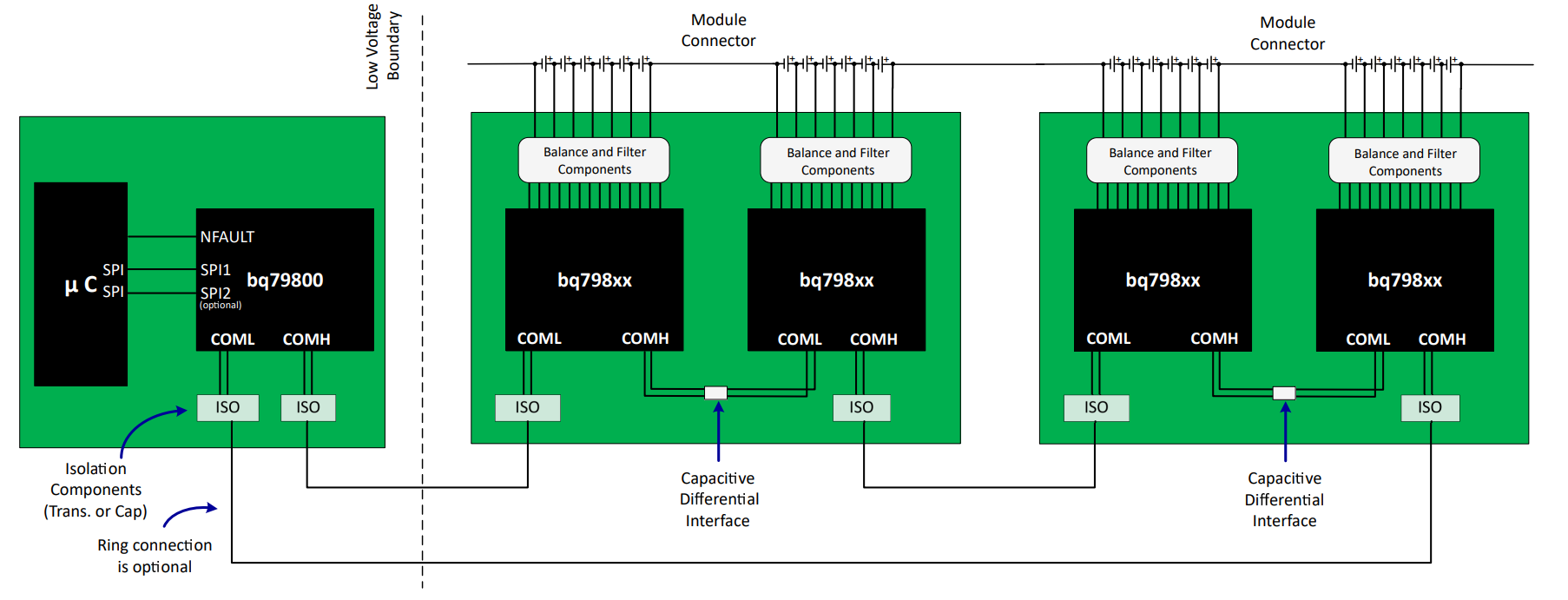
Battery Management System (BMS) Structure
Higher Channel Density Simplifies Large Packs
The monitor supports up to 26 cells per device—eight more than competing single‑chip solutions—allowing engineers to reduce the number of monitors, isolation boundaries, and interconnects in a given pack.
Fewer devices and harness points can cut bill of materials, simplify layout, and lower failure risk in high‑voltage strings. TI states the part delivers the highest cell‑count monitoring in its class and up to roughly 44% more channels than prior generations, targeting both 400‑V and 800‑V battery architectures.
Pre‑production units are available now, with production quantities planned by the end of 2026, giving OEMs a timeline to evaluate and qualify designs.
System Architecture, Safety, and Measurement Fidelity
From a BMS architecture standpoint, the BQ79826Z‑Q1 combines measurement density with signal‑chain detail suitable for functional safety. The device is specified for sub‑2‑mV voltage accuracy across –40°C to +125°C; TI’s preliminary datasheet lists <1.7 mV cell‑voltage accuracy with per‑channel ADCs and synchronized redundant measurements—figures that directly influence state‑of‑charge estimation, cell balancing precision, and range prediction.
Integrated passive balancing FETs support up to 300 mA with programmable PWM control, while an upgraded daisy‑chain interface operates at 2 Mbps (up to 4 Mbps with dual SPI), enabling large stacks with tighter device‑to‑device timing.
The monitor is stackable to 128 devices, with fast diagnostic test initiation reported at <100 ms for 800‑V packs of up to 250 cells, aiding end‑of‑line and field diagnostics. The device is developed to ISO 26262 with system and hardware capability up to ASIL D.
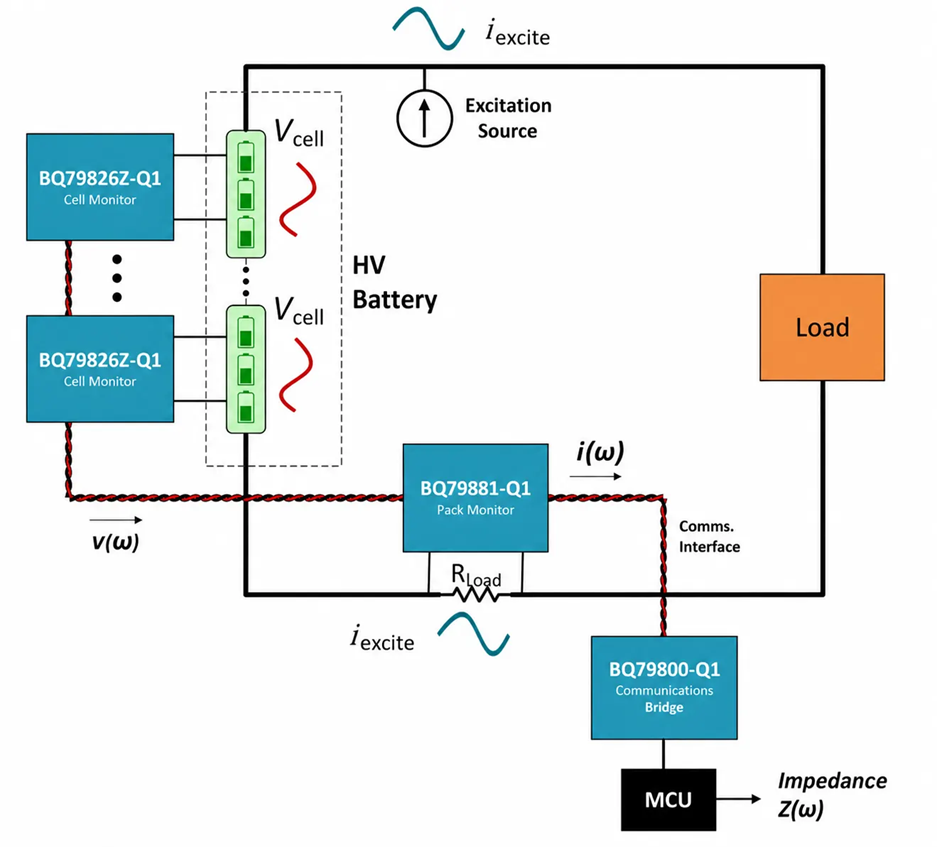
Pack EIS System Block Diagram
The EIS subsystem is engineered to be practical at pack scale rather than limited to lab instrumentation. According to TI’s datasheet, the EIS engine covers roughly 10 mHz to 3.5 kHz with device‑to‑device I/V synchronization on the order of microseconds. In practice, this frequency span helps resolve different electrochemical phenomena: low‑frequency features correlate with diffusion‑limited processes and long‑term capacity fade, while higher‑frequency segments are sensitive to ohmic resistance and interfacial impedance.
TI reports EIS measurement times that are about five times faster than previous solutions—an important consideration for in‑vehicle or in‑field diagnostics windows. Faster measurements reduce dwell and allow more cells to be characterized within a given thermal or operational cycle.
|
Feature Category |
Details |
|
26 Channels |
• 26S - 0 to 5.5 V range for cell, –2 V to 2 V range for busbar • 143 V Abs Max Rating, 9 V minimum • Busbar support on every channel, except first channel • Stackable up to 128 devices |
|
Voltage Accuracy |
• <1.7 mV accuracy, –40 to 125°C, Cell: 0 V to 5.5 V • Dedicated ADC per channel. Synchronized redundant measurement |
|
Passive Cell Balancing |
• Passive cell balancing with integrated FETs up to 300 mA odd/even balancing with programmable PWM control |
|
Smart EIS Engine |
• Integrated Electrochemical Impedance Spectroscopy measurement engine • Impedance Accuracy: 1% (with 1 A excitation and 200 µΩ impedance) • Measurement frequency: 0.01 Hz to 3.5 kHz • <5 µs I/V synchronization from device to device • Support for global and local excitation |
|
Sensor & GPIOs |
• 20 GPIO: Temp Sensor (NTC/PTC), voltage measurement, interrupt • SPI/I²C interface • Temperature Threshold (Active/Sleep) • Pressure Threshold / Peak Detector (Active/Sleep) • On-chip memory for one-time custom programming |
|
Diagnostics & Protection |
Monitoring • Low Power Monitoring Mode (<20 µA power consumption) • Cell Over-voltage, Under-voltage (OVUV) • Cell Over-temperature, Under-temperature (OTUT) • 2× die temperature monitors • Supply (BAT) • Open Wire Detection Redundancy Paths • Cell Voltage • GPIO/NTC Voltage • Limp Home Mode Diagnostics • Automatic diagnostics during cell balancing in active mode Functional Safety Compliant • Developed under ISO26262 • System and hardware capability up to ASIL-D |
|
Upgraded Daisy Chain Interface |
• 2 Mbps bus speed, up to 4 Mbps with dual SPI • <±5 µs device-to-device synchronization • Closed Loop BCI: 200 mA, Open Loop BCI: 300 mA • Isolation: Transformer or capacitor-only • FDTI Time: <100 ms for 800 V packs or 250 cells • Support for stack, ring, multidrop, and split ring • Device-to-device automatic communications balancing |
|
Power |
• Integrated DC-DC Converter • Shutdown: <10 µA • Sleep Mode with monitoring: As low as 20 µA • Active Mode: <5 mA |
|
Package |
• 100-pin QFP, 4 mm pitch • PowerPad on bottom |
BQ79826Z-Q1 Battery Monitor Salient Features
Bridging Cell Modules, Pack Control, and Software Analytics
For system‑level deployment, TI pairs the cell monitor with its BQ79881‑Q1 pack monitor and an optional communications bridge, forming a chipset intended to scale across different module sizes, chemistries, and mechanical designs. This partitioning maps to common EV and ESS architectures: cell‑level devices manage measurement and balancing, while the pack‑level controller arbitrates limits, contactors, and communications to the vehicle or site controller.
Embedding EIS at the measurement layer feeds richer inputs to pack‑level algorithms—including model‑based estimators and machine‑learning classifiers trained to recognize impedance signatures associated with plating, gas formation, or separator degradation—enabling proactive derating, maintenance scheduling, or pack isolation before conditions escalate.
Operational Impact on EV Fast Charging and Grid-Scale Storage
For automotive engineers, tighter voltage accuracy and cell‑to‑cell synchronization support more aggressive fast‑charge profiles while preserving safety margins, as pack controllers can make decisions using higher‑fidelity state estimates and earlier thermal‑risk indicators. Integrated balancing at hundreds of milliamps helps correct module imbalances that otherwise limit usable energy or extend charge times.
In stationary storage, operators can use EIS‑derived health metrics to inform dispatch and maintenance, improving uptime and asset life—particularly in high‑throughput environments buffering AI‑driven load swings.
Across both domains, the reduction in device count per string and higher‑speed daisy chaining lower wiring complexity and can shrink PCB area, with knock‑on benefits for reliability, manufacturability, and cost per watt‑hour monitored.
Industry Outlook
Integrating EIS into a high‑density cell monitor moves predictive diagnostics from the lab onto the vehicle or into the containerized ESS, shifting BMS design from reactive alarms to condition‑aware control. The approach addresses two persistent engineering problems—early thermal‑runaway detection and long‑term capacity management—while consolidating hardware in high‑voltage stacks.
With pre‑production silicon available and volume targeted for late‑2026, pack designers in automotive and grid storage have a near‑term path to evaluate EIS‑informed control strategies alongside conventional voltage, current, and temperature sensing.