Texas Instruments Introduces High-Performance Isolated Power Modules for EVs and Data Centers
Texas Instruments introduced IsoShield-based isolated DC/DC power modules that integrate planar transformers to deliver higher power density and compact isolated bias solutions for EV, industrial, and data center applications.
Texas Instruments has introduced two compact isolated DC/DC power modules aimed at pushing power density and simplifying isolated bias generation in automotive, industrial, and data center designs. The new UCC34141‑Q1 and UCC33420 integrate isolation and power conversion in small packages to reduce board area while meeting demanding safety and EMI targets.
Announced on March 23, 2026, the devices are the first to use TI’s IsoShield packaging approach, which co‑packages a planar transformer with the power stage. TI positions the family as an alternative to discrete isolated-bias implementations, citing up to three times higher power density and solution‑size reductions of as much as 70% compared with traditional designs.
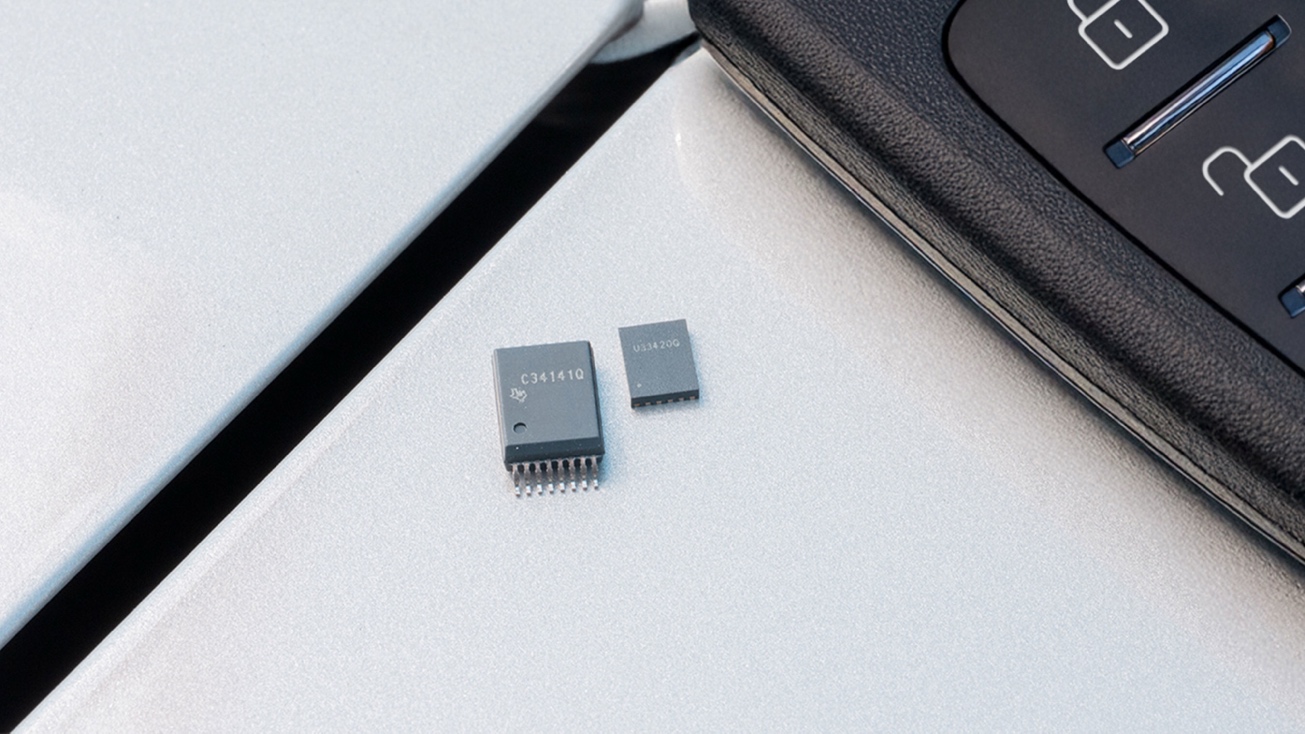
TI’s new isolated power modules, featuring proprietary IsoShield technology, deliver higher power density in a smaller footprint while reducing size, cost, and weight.
Product Overview
The UCC34141‑Q1 targets reinforced-isolation gate‑driver bias rails in high‑voltage systems such as SiC and IGBT traction inverters, on‑board chargers, and industrial drives. It delivers dual regulated outputs from a wide input range and is qualified for automotive use. The UCC33420, by contrast, addresses low‑voltage isolated rails in logic, sensing, or communications domains with a single 5 V output in an ultra‑small package. Together they cover mid‑voltage (6–20 V) and low‑voltage (5 V) input rails common in EV and server platforms.

UCC34141-Q1 Module Block Diagram

UCC33420 Module Block Diagram
In both devices, IsoShield integrates the planar transformer with the power stage, trimming parasitics and interconnect length compared with board‑level magnetics. TI states that the packaging approach supports functional, basic, and reinforced isolation capabilities and is intended to enable distributed power architectures that avoid single‑point failures in safety‑critical systems.
Key Features and Specifications
|
UCC34141‑Q1 (automotive, reinforced isolation) |
|
|
Input voltage range |
5.5 V to 20 V (withstands transients up to 28 V) |
|
Output Voltage Range |
+15 V to +25 V |
|
Typical output power |
1.5 W |
|
Isolation rating |
Reinforced |
|
Operating Temperature |
–40°C to 125°C |
|
Regulated Outputs |
2 |
|
Package |
5.85 mm × 7.5 mm × 2.6 mm module size |
|
Features |
|
|
Fully integrated isolated planar transformer |
Programmable (VDD – COM) output voltage (15V to 20V, ≤ ±1.5% total regulation accuracy) |
|
Adaptive spread spectrum modulation (SSM) |
Strong magnetic and radiated field immunities |
|
Reduced inrush current soft-start
|
ENA pin for logic enable and programming input UVLO |
|
Open-drain Power-Good for fault indication |
Integrated protections: UVLO, OVLO, short-circuit, OVP, UVP, and thermal shutdown. |
|
< 3pF isolation capacitance |
> 8.2mm creepage and clearance |
|
Static and dynamic CMTI > ±250kV/µs |
AEC-Q100 qualified for automotive applications |
|
UCC33420 (industrial/automotive variants, basic isolation) |
|
|
Input voltage range |
4.5 V to 5.5 V |
|
Output Voltage Range |
4.85 V to 5.7 V |
|
Typical output power |
1.5 W |
|
Isolation rating |
Basic |
|
Operating Temperature |
–40°C to 125°C |
|
Regulated Outputs |
1 |
|
Package |
4.0 mm × 5.0 mm × 1.0 mm module size |
|
Features |
|
|
Power dense isolated DC/DC module with integrated transformer technology |
Adaptive spread spectrum modulation (SSM) |
|
Meets CISPR-32 Class B emission |
Strong magnetic fields immunity |
|
Overload and short circuit protection |
Thermal shutdown |
|
Low inrush current soft-start |
Enable pin with fault reporting mechanism |
|
Planned safety certifications include DIN EN IEC 60747‑17 (VDE 0884‑17), UL 1577/CSA, IEC 62368‑1 and IEC 60601‑1 |
Robust isolation barrier:
|
TI reports that IsoShield‑based modules can provide up to 2 W of isolated power while reducing solution size by as much as 70% versus discrete designs. The announcement lists mid‑voltage and low‑voltage options and highlights availability of evaluation hardware and models to accelerate prototyping.
Technology Context
Integrating the transformer and power stage within a single package reduces interwinding capacitance and loop inductance relative to board‑mounted magnetics. Lower parasitics help limit common‑mode currents, easing EMI design and improving dv/dt immunity—a critical requirement alongside fast‑switching SiC and GaN power stages. The UCC34141‑Q1’s low isolation capacitance (<3 pF) and high CMTI (≥±250 kV/µs) exemplify this approach, while the UCC33420’s EMI performance targets CISPR‑32 Class B without extensive filtering.
IsoShield’s planar transformer enables tight control of leakage and coupling, supporting regulated outputs and accurate bias rails for gate drivers. Co‑packaging also shortens the thermal path and enables compact layouts, which TI claims can achieve up to three times the power density of discrete isolated‑bias solutions. For engineers building distributed isolated supplies—for example, biasing multiple gate drivers across a traction inverter—this integration reduces external BOM and supports architectures that mitigate single‑point failure risk.
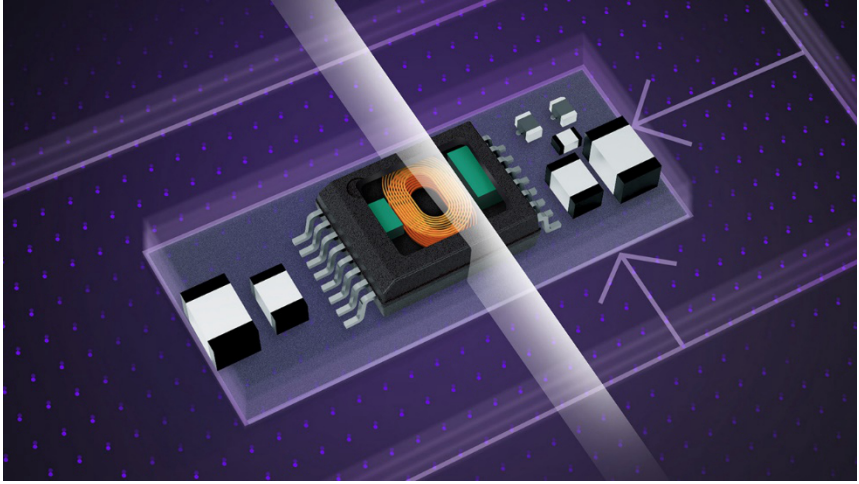
UCC34141-Q1 Module with IsoShield technology in a 5.85 mm × 7.50 mm × 2.65 mm package
The modules include spread‑spectrum modulation to distribute switching energy and reduce peak emissions. Both devices incorporate protection features such as input under‑ and over‑voltage lockout, short‑circuit limiting, and thermal shutdown, which are useful when isolated rails must start reliably into unknown loads or during transient events on EV battery lines or server backplanes. Reinforced isolation options, AEC‑Q100 qualification (UCC34141‑Q1), and planned safety certifications (UCC33420) align the family with the documentation and compliance checkpoints typical of automotive and industrial product lifecycles.
Applications
Automotive powertrains: The UCC34141‑Q1 supplies dual positive/negative rails commonly used by SiC and IGBT gate drivers in traction inverters, DC-DC converters, and on‑board chargers. Its wide 5.5–20 V input range and tolerance for higher transient voltages match conditions on 12‑V or pre‑regulated rails in EVs, while reinforced isolation and high CMTI protect against fast switching edges. TI also showcased the IsoShield modules inside a 300‑kW SiC traction‑inverter reference design at APEC 2026, underscoring the intended role in high‑power drivetrains.
Industrial and robotics: For PLC I/O, motor drives, and sensor gateways, the UCC33420 offers a compact, low‑profile 5 V/1.5 W isolated rail with 3 kVRMS basic isolation and CISPR‑32 Class B emissions performance, helping to reduce filter size. Its 4 mm × 5 mm × 1 mm package is suitable for space‑constrained modules and mezzanine cards.
Data centers and AI compute: As server architectures migrate to higher bus voltages and denser accelerator trays, distributed isolated bias rails simplify partitioning and help confine faults. TI positions the IsoShield line for these environments, where packing more power into smaller spaces directly translates into higher rack‑level density. The company highlighted related demonstrations for 800 V‑to‑6 V distribution and AI compute trays in conjunction with the APEC launch.
Conclusion
By integrating a planar transformer and power stage in compact packages, TI’s IsoShield‑based UCC34141‑Q1 and UCC33420 give engineers a straightforward path to higher power density, lower EMI, and documented isolation performance. For EV traction inverters, industrial controls, and data center platforms, these modules can reduce BOM and board area while addressing compliance and reliability requirements typical of high‑performance isolated power designs.