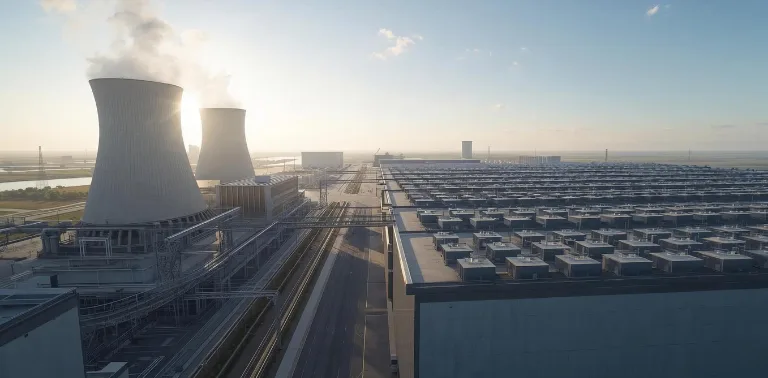
Designing the AI‑Era Grid: Why a Mixed‑Fleet Transmission Strategy Matters
A mixed-fleet transmission strategy combining HVDC, FACTS, HTS cables, and hybrid AC/DC architectures could help utilities meet the rising power and stability demands of AI-driven data centers.
Data center growth tied to artificial intelligence is colliding with transmission constraints. One‑size‑fits‑all grid plans struggle when loads rise fast, cluster in tight geographies, and need near‑perfect power quality.
An opinion analysis published by Utility Dive argues for a “mixed‑fleet” transmission approach tailored to local physics and timelines. The piece contends that combining HVDC, advanced AC reinforcements, and emerging options like HTS cables can integrate hyperscale load and remote renewables without sacrificing stability.
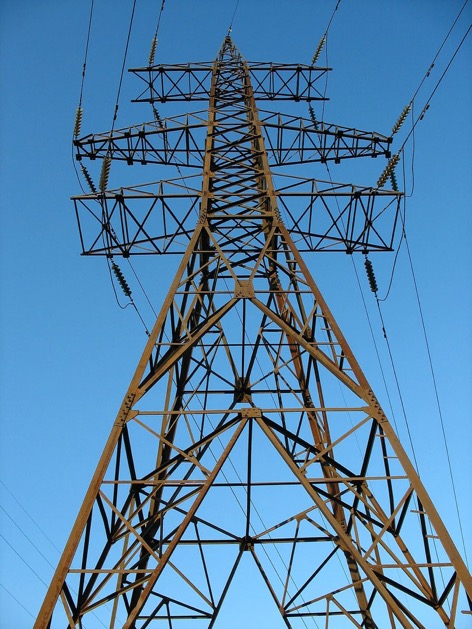
View of Electrical Power Transmission Tower
From Thermal Constraints to Stability Limits
The article frames a shift underway in planning criteria. Thermal congestion still matters, but dynamic stability, short‑circuit strength, and voltage recovery are becoming the binding limits as converter‑based resources and clustered loads rise.
That shift is pronounced around hyperscale AI facilities. Utilities are now facing requests for campuses drawing hundreds of megawatts to beyond a gigawatt, often on aggressive timelines and at locations where the AC backbone is already stressed. The resulting challenge is less about moving energy in aggregate and more about delivering it with resilience and power‑quality guarantees at weak interconnection points.
HVDC Where Distance and Control Dominate
High‑voltage direct current remains the top choice for long‑distance bulk transfer, submarine corridors, and asynchronous ties. Modern voltage‑source converter (VSC) HVDC adds granular power‑flow control, rapid reactive support, and black‑start capability—useful when importing remote wind or solar into dense load centers through constrained corridors.
For engineers, the control benefits are practical. VSC stations can hold DC power setpoints under contingency, modulate to damp interarea oscillations, and support weak grids by injecting reactive current within a power‑electronics time frame. But planning still hinges on the receiving‑end AC node: if short‑circuit ratio and voltage stability are marginal, the “best” line on a cost‑per‑MW basis can underperform at the delivery point.
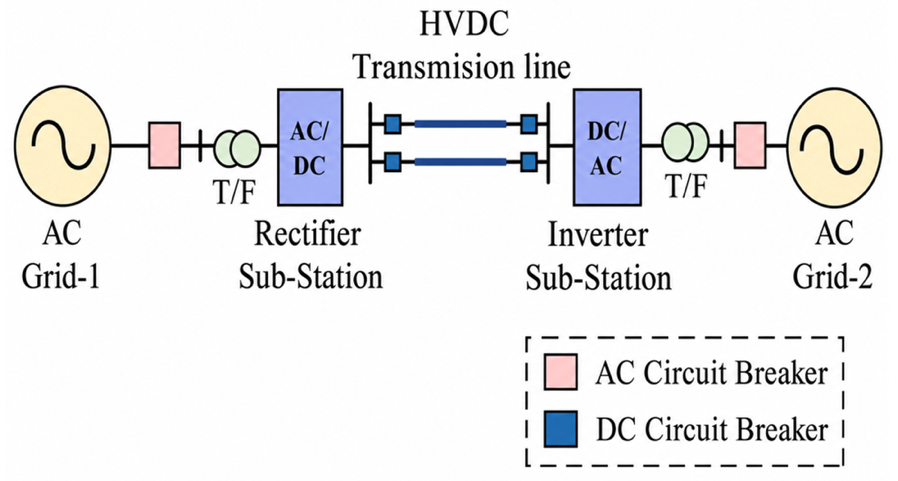
HVDC Transmission System Schematic Diagram
Reinforcing Existing Corridors with FACTS
The fastest gains often come from strengthening the AC system already in the ground. Flexible AC Transmission Systems—especially STATCOMs and unified power‑flow controllers—can unlock headroom on constrained rights‑of‑way by increasing dynamic voltage margin, shaping flows, and stabilizing post‑contingency performance. In many metro and suburban corridors, these devices deliver the best mix of speed, cost control, and operational familiarity.
This is also where power‑quality targets for AI campuses intersect with system needs. Fast voltage regulation from a STATCOM can reduce flicker and improve ride‑through during nearby faults, while a UPFC can redirect real and reactive power to honor thermal limits elsewhere. Importantly, these solutions preserve AC system strength rather than replacing it, which helps maintain protection performance and short‑circuit duty where needed.
High‑Temperature Superconducting Cable for Dense Urban Delivery
When the constraint is right‑of‑way—not distance—power density wins. High‑temperature superconducting (HTS) cable can move hundreds of megawatts through narrow underground paths with lower impedance and excellent power‑quality characteristics, making it compelling for short‑to‑medium runs into city cores or large campus clusters. Installed cost and cryogenics remain hurdles, but the technology has moved beyond the experimental stage for targeted use cases.
For planners, HTS changes the calculus inside congested streets. Its compact footprint and magnetic field containment can ease siting, while lower losses at high currents support multi‑hundred‑megawatt feeders without parallel duct banks. The operational tradeoffs are different—cryogenic reliability, fault management, and repair logistics must be factored into resiliency studies—but the path to siting approvals can be smoother than for new overhead corridors.
Multi‑terminal DC for Routing Flexibility
Point‑to‑point HVDC is proven, but many AI‑era topologies demand something more flexible. With multiple renewable injection points, multiple delivery nodes, and clustered loads that cannot tolerate single‑path risk, meshed or multi‑terminal DC (MTDC) can provide routing agility and redundancy that AC or simple DC links lack. The payoff is operational optionality; the price is complexity in controls, protection, and interaction with the surrounding AC grid.
That complexity is manageable with modern converters and communication‑assisted protection, but it must be engineered from the start. Each DC/AC interface needs adequate short‑circuit strength and voltage support, and fault‑clearing sequences must be coordinated so DC faults don’t propagate or strand converter stations. As with any networked system, observability and cybersecurity become core design criteria, not afterthoughts.
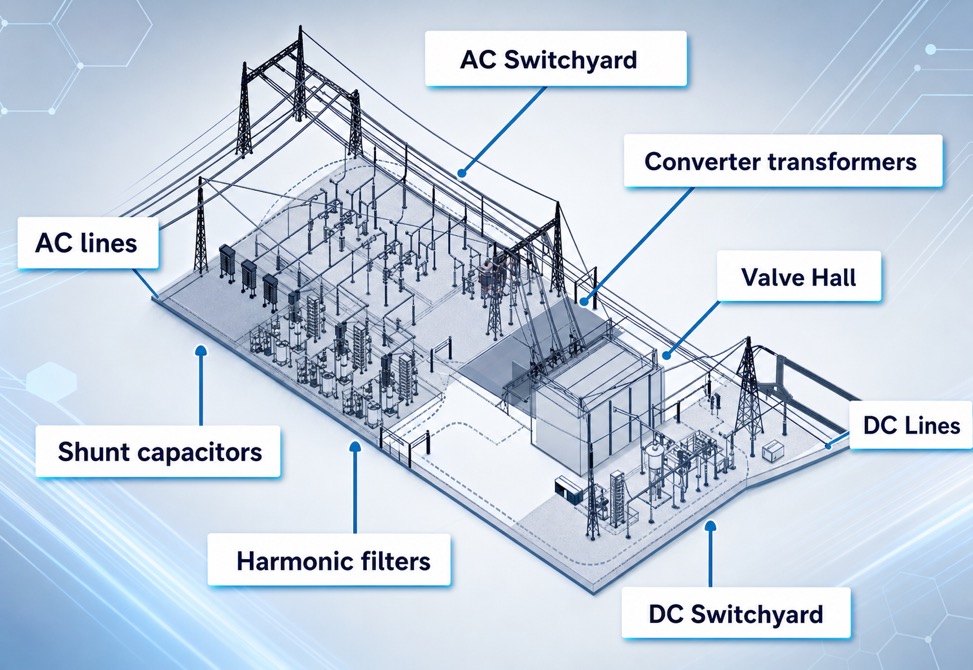
HVDC Converter Station Components
Hybrid AC/DC Architectures as the Default
The Utility Dive analysis argues the strongest answers blend technologies instead of picking sides. Examples include HVDC backbones that deliver remote generation, paired with targeted AC reinforcements—STATCOMs, series compensation, or storage at critical nodes—to preserve system strength and contingency performance. For offshore wind, an HVDC landing can feed a robust onshore hub buttressed by dynamic VAR support to handle weak‑grid conditions.
The engineering workflow also changes. Rather than starting with a preferred technology, planners should first pin down the dominant constraint: bulk transfer over distance, urban power‑density delivery, or reinforcement of an existing stressed network. From there, the tool that best addresses timeline, right‑of‑way, system strength, voltage stability, fault duty, and resilience requirements becomes evident.
Why this Matters to Utility Engineers
AI campuses exhibit minimal tolerance for interruption and stringent power‑quality specifications. At the same time, renewable‑heavy systems run with lower inertia, weaker fault characteristics, and more power‑electronics interactions than legacy grids. That combination makes instability—oscillatory behavior, poor voltage recovery, or control‑loop interactions—the grid risk to beat over the next decade, eclipsing simple thermal congestion in many locations. A strategy that reinforces AC strength while adding controllable transfer paths addresses both.
For transmission owners, the approach also aligns with permitting and procurement realities. FACTS and targeted upgrades can be deployed on shorter horizons while HVDC and MTDC projects navigate siting. HTS can solve specific bottlenecks where public acceptance of new overhead lines is lowest. Staging these elements provides incremental reliability benefits and buys time for larger corridors to come online.
Engineering the Right Mix, Not the “Right” Technology
The core message is simple: the AI‑era grid rewards precise matching of technology to constraint. HVDC remains the backbone for long‑distance moves; FACTS strengthen stressed AC corridors; HTS unlocks urban power density; MTDC brings routing flexibility; and hybrid AC/DC designs tie them together. Utilities that start with stability and power‑quality requirements—and assemble a tailored mix—will integrate large loads faster without compromising reliability. That is the mixed‑fleet strategy in practice, and it is likely to define transmission engineering over the next planning cycle.