Infineon’s Hybrid Hall-and-Coil Current Sensor Targets Wideband, Low-Noise Power Conversion
Infineon Technologies introduced the XENSIV™ TLE4978, a hybrid Hall-and-coil current sensor family that combines DC accuracy, 9 MHz bandwidth, ultra-low noise, and integrated protection for SiC- and GaN-based power conversion systems.
Infineon Technologies has introduced the XENSIVTM TLE4978, a coreless, galvanically isolated magnetic current sensor family aimed at high-performance power electronics where low noise and fast transient response are critical.
By fusing Hall sensing with coil-based pickup in a single die, the device is positioned to address measurement accuracy and bandwidth requirements in systems moving to higher switching speeds with SiC and GaN devices. According to Infineon, the TLE4978 combines ultra-low noise with high bandwidth and accuracy to support next-generation EV charging, renewable energy, and data center power designs.
Hybrid Architecture for DC to MHz-Range Sensing
The engineering centerpiece is a hybrid topology that integrates differential Hall elements with monolithic differential air coils—functionally similar to a compact Rogowski structure—on one die. The Hall path provides stable, offset-controlled measurement at DC and low frequency, while the coil path captures fast di/dt components for wideband response. This division of labor enables a single sensor to cover steady-state and switching-dominated operating conditions without resorting to multiple transducers or complex signal fusion at the system level.
Infineon states the TLE4978’s approach directly addresses the accuracy-versus-speed tradeoff that typically forces designers to choose between DC-capable Hall devices and high-bandwidth inductive solutions.
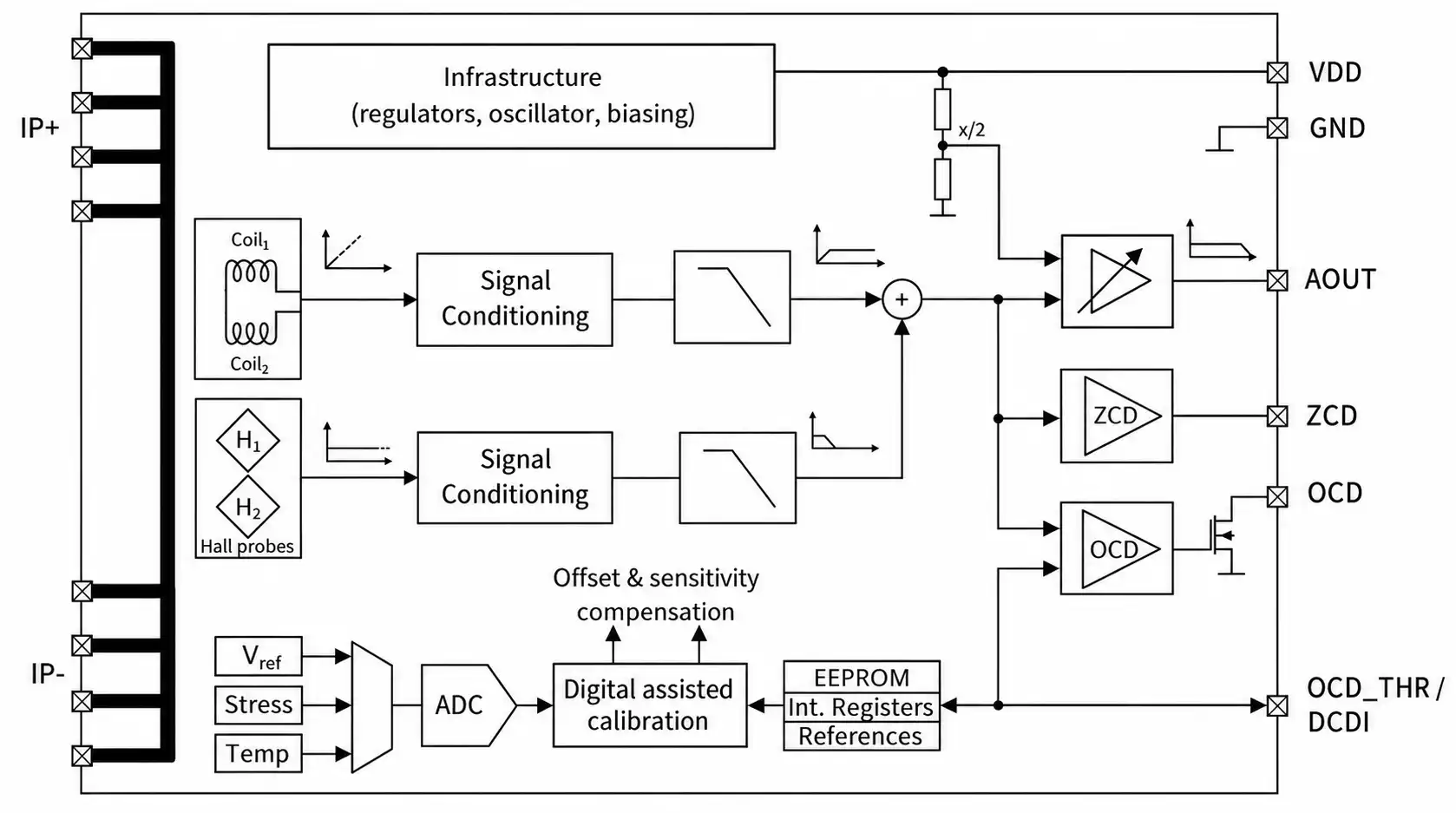
Infineon’s TLE4978 Current Sensor Functional Block Diagram
For high-frequency converters, the bandwidth ceiling is notable: the sensor is specified with 9 MHz bandwidth, allowing accurate measurement of switching edges and ripple in fast SiC and GaN stages with minimal phase lag in the current feedback loop.
Low intrinsic noise—given as 38 mA rms—helps preserve signal fidelity at low currents and during small-signal events such as soft-start, light-load operation, or current-mode control ramp tracking. Accuracy figures include a ±1.2% sensitivity error and a ±200 mA offset error across the full rated temperature and lifetime window from -40°C to 150°C, reducing the need for multi-point calibration during production or field compensation in embedded software.
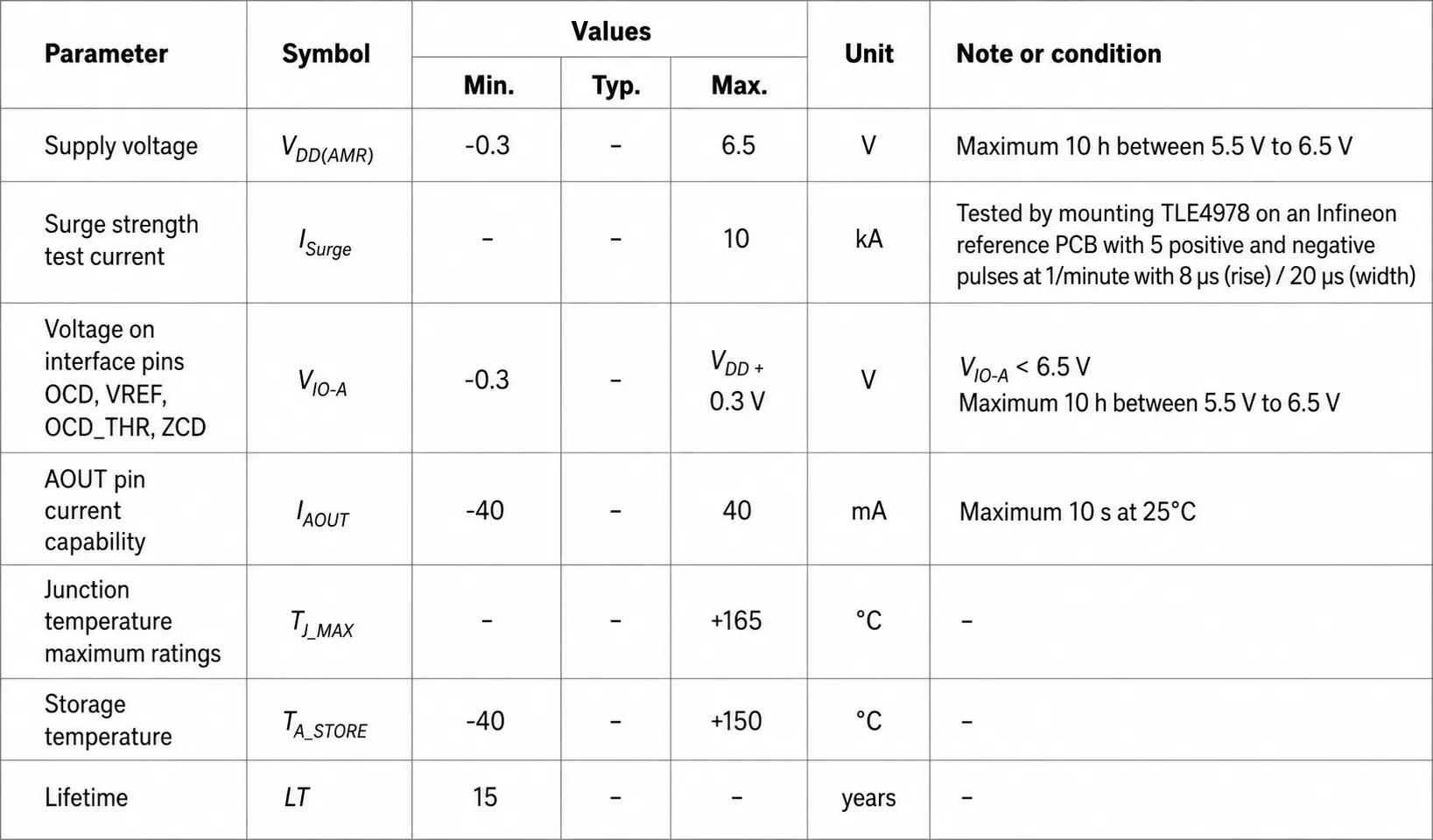
TLE4978’s Absolute Maximum Ratings
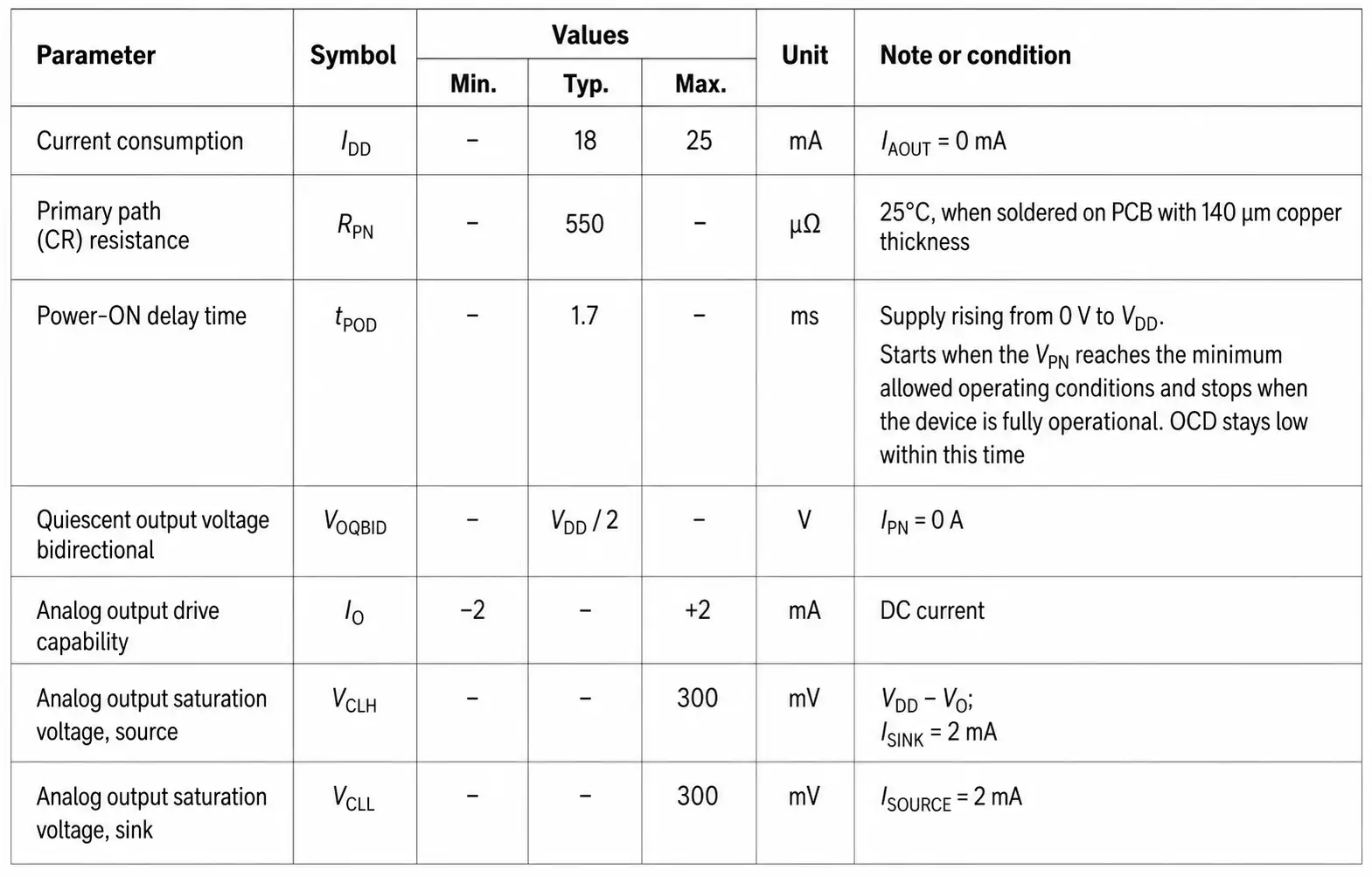
TLE4978’s Electrical Characteristics
Safeguards, Interface, and Isolation for Noisy HV Environments
Protection and observability features are embedded rather than bolted on. A hardware overcurrent detection (OCD) path reacts in 100 ns, fast enough to trip upstream protection or initiate a gated turn-off sequence before device stress accumulates during a short-circuit or shoot-through event. Designers can set OCD thresholds through a digital configuration and diagnostic interface (DCDI) or an external resistor network, enabling either firmware-controlled commissioning or fixed, BOM-level limit setting.
The device also integrates zero-crossing detection (ZCD); Infineon positions this as the first implementation of ZCD within a coreless magnetic current sensor, which can simplify timing for interleaved phases, valley switching, or transitions in boundary-conduction-mode stages without separate comparators.
Packaging is an industry-standard DSO-16 (300 mil) with options for reinforced or basic isolation and 8 mm clearance and creepage to accommodate typical line-derived topologies.
From a layout and thermal standpoint, the current rail resistance is specified at 550 micro-ohms, limiting insertion loss and self-heating while supporting up to 60 A nominal current. For safety and reliability requirements in road vehicles, the TLE4978 family is described as ISO 26262 capable up to ASIL-B and qualified to AEC-Q100 Grade 0, aligning with under-hood thermal profiles and long-term drift constraints.
These attributes, combined with proprietary shielding for high common-mode transient immunity, are aimed at maintaining measurement integrity in the presence of large dv/dt and di/dt typical of half-bridge nodes and compact busbar geometries.
Implications for SiC/GaN Control Loops and System Efficiency
Current feedback is a primary lever for dynamic performance, efficiency, and protection in modern power stages. As switching frequencies move higher to reduce magnetics size and improve transient response, measurement bandwidth and phase accuracy become limiting factors for loop stability and overshoot control.
A sensor with multi‑MHz bandwidth can reduce phase lag in current-mode or average current-mode loops and improve the fidelity of ripple injection schemes, potentially allowing more aggressive compensation or higher crossover frequencies. At the same time, maintaining low noise helps avoid duty-cycle jitter and false trips in digital controllers that mix analog sensing with high-resolution PWM modulators.
The hybrid Hall/coil structure also reduces common pitfalls of purely core-based devices—such as magnetic saturation, hysteresis, or excess offset drift—when subjected to DC bias and high peak currents. Coreless isolation avoids magnetic core losses and associated thermal drift, which is relevant for converters that swing between light-load and high-crest-factor conditions.
For designers weighing shunt-plus-isolator architectures, the TLE4978’s insertion resistance and integrated isolation offer an alternative that removes high-side shunt power dissipation and the complexity of precision differential amplification on a noisy reference.
Designed for EV Charging, PV Inverters, and AI Data Center PSUs
Target applications span high-voltage DC-DC and on-board chargers in electric vehicles, where fast, accurate current sensing can shorten charging time while enforcing stringent protection thresholds.
In PV inverters, wide bandwidth and strong CMTI help maintain stable operation under rapidly changing irradiance and grid conditions while enabling fine-grained MPPT and fault handling.
And in data center power—particularly AI server platforms with steep transient loads and dense power shelves—the combination of low noise and MHz-range response supports tighter regulation, improved transient handling, and potential efficiency gains through refined current sharing and phase management.
Infineon highlights suitability for AI data center PSUs and other high-demand segments where each incremental gain in conversion efficiency translates into meaningful energy and thermal savings at scale.
Engineering Takeaways
- The hybrid Hall-plus-air‑coil die architecture directly addresses the DC accuracy versus high-frequency bandwidth tradeoff, which is central to SiC/GaN control loops.
- Integrated 100 ns hardware OCD and built-in ZCD reduce external circuitry and loop-timing uncertainty, speeding design iterations and protecting expensive switches during fault events.
- Low rail resistance, automotive-grade qualification, and isolation geometry consistent with high-voltage stages make the device practical for both traction-side converters and grid-tied PV equipment.
By combining DC-capable Hall sensing with MHz-class inductive pickup and packaging it with protection, diagnostics, and automotive-grade robustness, Infineon’s TLE4978 gives power designers a single-sensor path to higher loop bandwidth and lower measurement noise in demanding EV, renewable, and data center platforms.