Diodes Intros Automotive Smart Load Switch for Low-Voltage Rail Control in ADAS and Infotainment
Diodes Incorporated introduced the DML1012ALDSQ, an automotive-qualified smart load switch featuring ultra-low RDS(on), integrated protection, and power sequencing for ADAS, infotainment, and cluster display power rails.
Diodes Incorporated has introduced the DML1012ALDSQ, an automotive‑compliant smart load switch aimed at controlling low‑voltage power rails in vehicle electronics. The device targets power sequencing and power‑gating tasks in advanced driver-assistance systems (ADAS), infotainment platforms, and cluster displays, where stable startup and low-loss distribution are increasingly critical as processors, memory, and sensors proliferate on 0.8 V to 3.3 V rails.
The switch integrates protection and control features to simplify rail management while minimizing conduction losses. The DML1012ALDSQ is an AEC‑qualified part intended for use in IATF‑certified production flows and PPAP documentation environments.
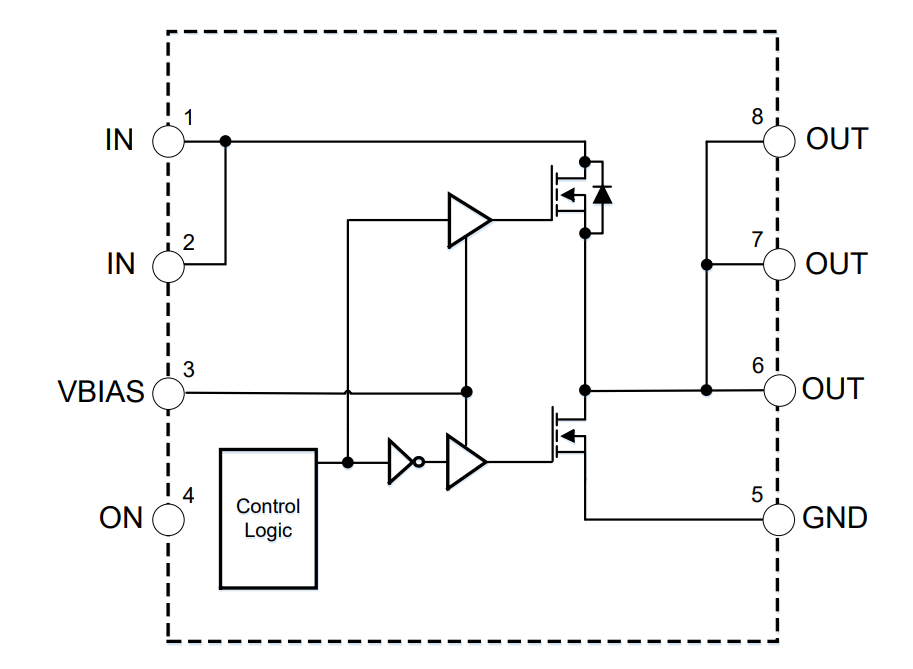
DML1012ALDSQ Functional Block Diagram
Ultra‑Low RDS(on) N‑MOSFET for Efficient Rail Switching
At the core of the device is an N‑channel MOSFET optimized for very low on‑resistance to limit distribution losses on logic rails that can carry several amperes. The DML1012ALDSQ specifies a maximum on‑resistance of 8 mΩ (with bias applied), enabling up to 6 A of continuous load current. For a rail delivering 6 A, that resistance corresponds to roughly 0.29 W of I²R dissipation at steady state, a modest thermal burden for compact automotive modules.
By keeping the series drop small, the switch preserves downstream regulation margin on rails at or below 1 V where tens of millivolts can matter to timing and power‑good thresholds.
The part operates across a 0.8 V to 4 V input range, which aligns with common SoC core and peripheral voltages in ADAS domain controllers and infotainment head units. This range makes it suitable for gating rails such as 0.8–1.2 V cores, 1.8 V memory and sensors, and 3.3 V auxiliary logic without resorting to multiple discrete FETs and RC soft‑start networks.
Diodes rates the device for a 6 A continuous output current and highlights a junction‑to‑case thermal resistance of 8 °C/W, contributing to thermal headroom under sustained load.
|
Symbol |
Parameter |
Conditions |
Min |
Typ |
Max |
Unit |
|
VIN |
IN Supply Voltage |
VON = 5 V |
0.8 |
1.05 |
VBIAS − 1.5 |
V |
|
VBIAS |
VBIAS Supply Voltage |
— |
3.2 |
5 |
5.5 |
V |
|
ID |
Maximum Continuous Current |
VON = 5 V |
— |
6 |
— |
A |
|
IPLS |
Maximum Pulsed Switch Current |
VIN = VON = 5 VPulse < 300 μs, 2% Duty Cycle |
— |
9 |
— |
A |
|
IQ |
Quiescent Supply Current of VBIAS |
IOUT = 0, VON = 5 V |
— |
28 |
— |
μA |
|
IOFF |
VBIAS Shutdown Supply Current |
VON = 0, VOUT = 0 |
— |
— |
2 |
μA |
|
IINOFF |
IN Shutdown Supply Current |
VON = 0, VOUT = 0 |
— |
— |
2 |
μA |
|
ION |
ON Leakage Current |
VON = 5 V |
— |
— |
1 |
μA |
|
VONH |
ON High-Level Voltage |
— |
1.2 |
— |
— |
V |
|
VONL |
ON Low-Level Voltage |
— |
— |
— |
0.5 |
V |
Switching ON Resistance
|
Symbol |
Parameter |
Conditions |
Min |
Typ |
Max |
Unit |
|
RON |
Switch ON-State Resistance |
IOUT = −200 mA, VON = 5 V, VBIAS = 5 V |
— |
— |
8 |
mΩ |
|
IOUT = −200 mA, VON = 5 V, VBIAS = 3.3 V |
— |
— |
10 |
mΩ |
||
|
RPD |
Output Pulldown Resistance |
IOUT = 15 mA, VON = 0 |
— |
— |
200 |
Ω |
Electrical Characteristics (TA = +25°C, VBIAS = 5 V, VIN = 1.05 V, unless otherwise specified.)
Inrush Management, UVLO, and Quick Discharge for Predictable Sequencing
Beyond conduction efficiency, the switch addresses two failure modes common in dense automotive compute nodes:
- inrush surges at turn‑on
- floating nodes at shutdown
A controlled output slew rate tames inrush current into large bypass networks, reducing supply dip and cross‑coupling on shared upstream rails. Quick output discharge actively bleeds the load node when the switch turns off, ensuring repeatable restart behavior and avoiding residual charge that can confuse downstream supervisors or leave analog blocks partially biased.
The device also integrates undervoltage lockout (UVLO) to inhibit operation if the upstream source falls below a defined threshold, protecting against brownout‑induced glitches during cranking or transient events. Off‑state leakage is kept low to support deep sleep power budgets, while typical quiescent draw is listed at 28 μA, assisting module‑level energy targets.
Collectively, these controls reduce the need for external components and trim the tuning effort often required to stabilize multi‑rail bring‑up.
Thermal Performance and 3 mm × 3 mm Packaging
For packaging, Diodes uses a V‑DFN3030‑8 footprint measuring 3 mm by 3 mm with a thermal path suited to the part’s 6 A rating. The combination of low RDS(on) and an 8 °C/W junction‑to‑case thermal parameter allows designers to keep copper areas compact while maintaining temperature margins, particularly important in stacked PCBs behind instrument clusters or in space‑constrained ADAS sensor modules.
Engineers can pair the device with modest copper thieving and vias to the chassis or heat spreaders commonly used in infotainment mainboards without excessive routing compromise. In many cases, the thermal behavior enables the switch to sit close to the load—reducing loop inductance and overshoot during switching events—while still meeting automotive derating rules for lifetime reliability.
The DML1012ALDSQ’s 3 mm square outline also simplifies multi‑channel layouts, where several identical rails need sequencing and isolation within a limited envelope.
Automotive Qualification and Use Cases in ADAS Compute and Displays
The device is presented as automotive‑compliant, qualified to AEC‑Q101, manufactured in facilities certified to IATF 16949:2016, and offered with PPAP support—requirements that streamline adoption into OEM and Tier‑1 programs.
Those credentials, plus the integrated protections, align the part with rail control near high‑value processors and imager chains where consistent startup behavior is essential to diagnostic coverage and safety goals. Typical placements include gating the core and memory rails of SoCs in centralized ADAS ECUs, sequencing high‑resolution cluster display controllers, and switching sensor and SerDes rails to isolate faults and reduce standby draw.
From an engineering standpoint, the DML1012ALDSQ condenses the set of discrete elements often used to make low‑voltage rails behave well in automotive environments—soft‑start, output discharge, UVLO, and a low‑loss FET—into a compact package with known thermal characteristics and automotive documentation.