One-step milling unlocks high‑utilization sulfur cathodes for solid‑state batteries
Addressing low sulfur utilization in solid‑state batteries, the University of Chicago and UC San Diego with LG Energy Solution use one‑step mechanochemical milling and micron‑scale sulfide electrolytes to form a conductive interphase.
Electrified transport needs safer batteries with more energy per kilogram and a lower bill of materials. Sulfur promises both, yet its theoretical capacity has remained stubbornly out of reach in practical cells.
Researchers at the University of Chicago’s Pritzker School of Molecular Engineering, working with UC San Diego and industry partners, report a fabrication approach that finally moves the needle. Their single‑step, mechanochemical mixing strategy boosts sulfur utilization in all‑solid‑state designs and scales to pouch cells, pointing to longer‑range EV packs at lower cost.
Rewiring Sulfur’s Limitations with Architecture, Not Chemistry
Sulfur and its discharge product Li2S are electronically insulating and undergo large volume change, which wrecks the contiguous ion–electron pathways needed for conversion reactions. In solid electrolytes, the lack of liquid wetting further raises the bar for “triple‑phase” contact at active surfaces.
The team’s premise is simple: keep the materials, change the microstructure. By engineering intimate solid–solid contact and a thin, ionically conductive interphase, they enable high active‑material utilization without resorting to exotic additives or costly catalysts.
Single‑Step Mechanochemical Mixing that Builds a Conductive Interphase
The group replaces hand‑mixing and multi‑step milling with a short‑duration, high‑energy co‑milling of sulfur, a sulfide solid‑state electrolyte (LPSCl), and conductive carbon. The one‑step route forms a metastable, thiophosphate‑rich interphase on sulfur particles while simultaneously distributing SSE and carbon to create contiguous ion and electron networks.
Electrochemically, the architecture delivers sulfur discharge capacities near 1500 mAh $ g{_{s}}^{-1}$ at 25 °C—approaching the 1675 mAh g−1 theoretical limit—with coulombic efficiencies exceeding 100% as the sulfide SSE contributes reversible capacity. For practicing engineers, that’s a clear signal that interphase design and percolation dominate utilization in solid‑state Li–S, more than changes in bulk chemistry.
Particle Size, Tortuosity, and Cycle Life: Why Micron Beats Sub‑Micron
Not all “smaller is better.” The study shows that tailoring both sulfur and SSE particle sizes to the micron scale lowers ionic tortuosity and mitigates chemo‑mechanical damage during cycling. Sub‑micron sulfur offers higher first‑cycle utilization, but it accelerates interfacial degradation and impedance growth.
Quantitatively, cells with micron‑scale sulfur achieve 81% capacity retention after 500 cycles, versus 61% with sub‑micron sulfur under similar conditions. The takeaway for electrode designers: optimize for transport and mechanical stability together, not just surface area.
High Areal Loading at Room Temperature—And Under Practical Pressure
High utilization at thin loadings is one thing; doing it at pack‑relevant areal capacities is what matters. The engineered sulfur cathode sustains stable cycling at areal capacities up to 11 mAh cm−2 at room temperature, retaining 87% after more than 140 cycles. That performance reflects both the percolated composite and the thin, conductive interphase formed during co‑milling.
Just as important, the architecture carries into pouch‑cell formats operated at “low” stack pressures for solid‑state systems. The team demonstrates an anode‑free Li2S pouch cell with 4.7 mAh cm−2 areal capacity, delivering about 900 mAh g−1 reversible capacity under 10 MPa stack pressure—orders of magnitude below the hundreds of MPa often used in lab pellet cells.
Managing electrode “breathing” by pairing sulfur with silicon
Conversion electrodes “breathe,” swelling and shrinking as sulfur converts to Li2S and back. The researchers show that this through‑thickness change can be turned into an advantage when the positive and negative electrodes expand out of phase, offsetting stack‑level swelling. Pairing sulfur or Li2S positives with silicon‑based negatives reduces internal stress and helps preserve interfacial contact across cycles.
This complementary breathing is a mechanical design knob that sits alongside electrochemistry and transport. It points to cell‑level co‑optimization—matching cathode chemistry and anode architecture—to maintain pressure windows and minimize shear on brittle sulfide electrolytes.
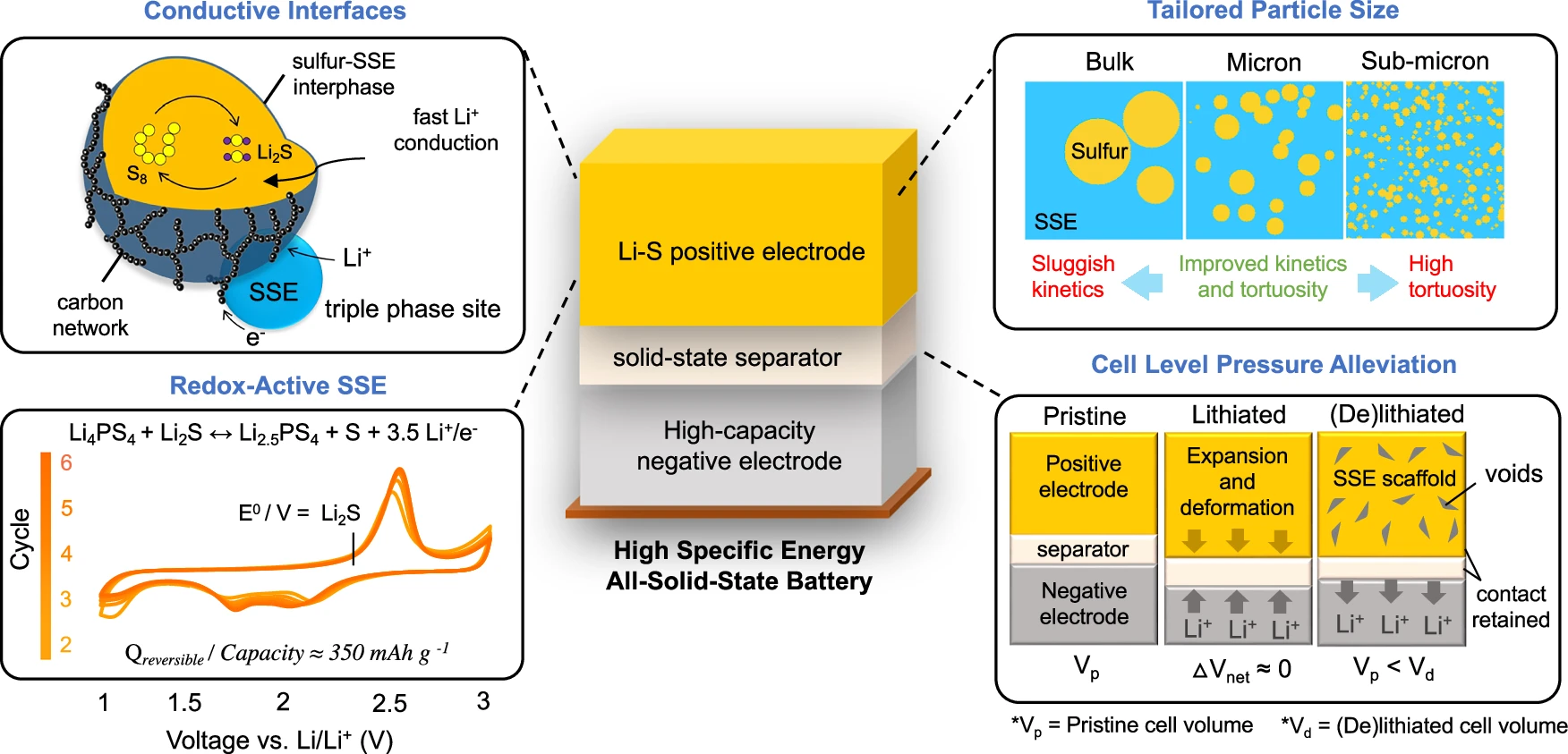
All-solid-state battery featuring engineered Li-S conversion positive electrodes
Dry Processing, Thinner Separators, and an Industry Bridge
From a manufacturing perspective, the method uses dry‑processed composite electrodes and avoids solvent routes that complicate sulfide handling. The pouch work also reduces separator thickness from hundreds to tens of micrometers, boosting stack‑specific energy without resorting to extreme sulfur weight fractions that would raise tortuosity. These choices align with emerging dry‑electrode lines being explored for EV cells.
Crucially, the research sits within an academic–industry partnership that includes LG Energy Solution, improving the odds of translating lab‑scale insights into manufacturable processes and realistic validation protocols. The group has already demonstrated the approach in practical pouch cells, not just coin or pellet formats.
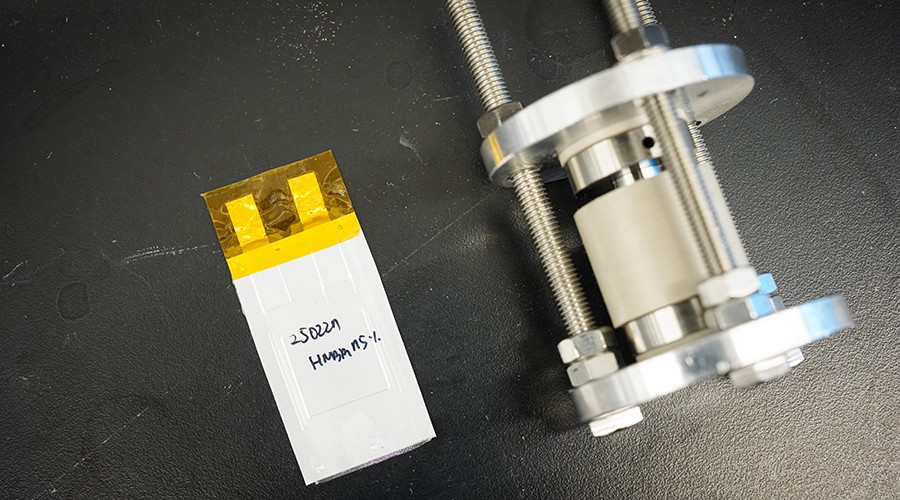
The engineered Li-S electrodes demonstrated improved performance in a practical pouch-cell format (left) suitable for EV-oriented battery designs.
What this Means for Engineers
For cathode engineers, the message is that microstructure and interphase engineering can extract sulfur’s capacity without expensive materials changes. One‑step co‑milling simultaneously solves percolation and forms a conductive interphase that participates in charge storage, which explains the near‑theoretical sulfur utilization.
For cell designers, the data at 5–11 mAh cm−2 and operation at 10 MPa suggest a feasible path to high‑specific‑energy ASSBs with more forgiving pressure windows and thinner separators. The complementary “breathing” strategy with silicon anodes adds a practical lever to manage stack mechanics over life, easing scale‑up to larger formats.
Sulfur’s practical turn in solid‑state
This work reframes sulfur cathodes as an architectural problem rather than a materials dead‑end. By co‑milling to build a conductive interphase, optimizing particle sizes for transport and mechanics, and validating at high areal loadings in pouch cells, the team shows a credible route to safer, lower‑cost, high‑energy batteries.
Next steps include extending cycle life at elevated rates, further reducing stack pressure toward module‑level norms, and integrating the process on pilot dry‑electrode lines. If these translate, sulfur‑based solid‑state packs could deliver EV ranges well beyond today’s Li‑ion while cutting cathode cost and critical‑metal exposure.