Factors Affecting Vehicle Dynamics and Motion Control
Learn about the major factors influencing vehicle dynamics, including powertrain behavior, suspension geometry, mass distribution, aerodynamics, tires, and tractive forces.
In the engineering and design of vehicles-on-wheels vehicle dynamics is the study of the vehicle in motion and how it behaves in motion. It is important for design and engineering professionals to fully understand what a vehicle does and basically what does it add up to. Essentially, EVs work in generally the same way as ones powered by gas, diesel, biodiesel, and hydrogen. There is a fuel source, a drive unit, and a gearbox to provide forward and backward motion. In short, a vehicle-on-wheels includes subsystems/modules as follows.
- EV power module—includes EV Traction, Electronic Control Unit (ECU), Transmission Control Unit (TCU), motor, gear box—single-speed transmission, drive axles.
- EV chassis module—includes suspension, steering, braking and parking, tires and wheels.
- EV body module—includes bonnet, doors, roof, trims, and so forth.
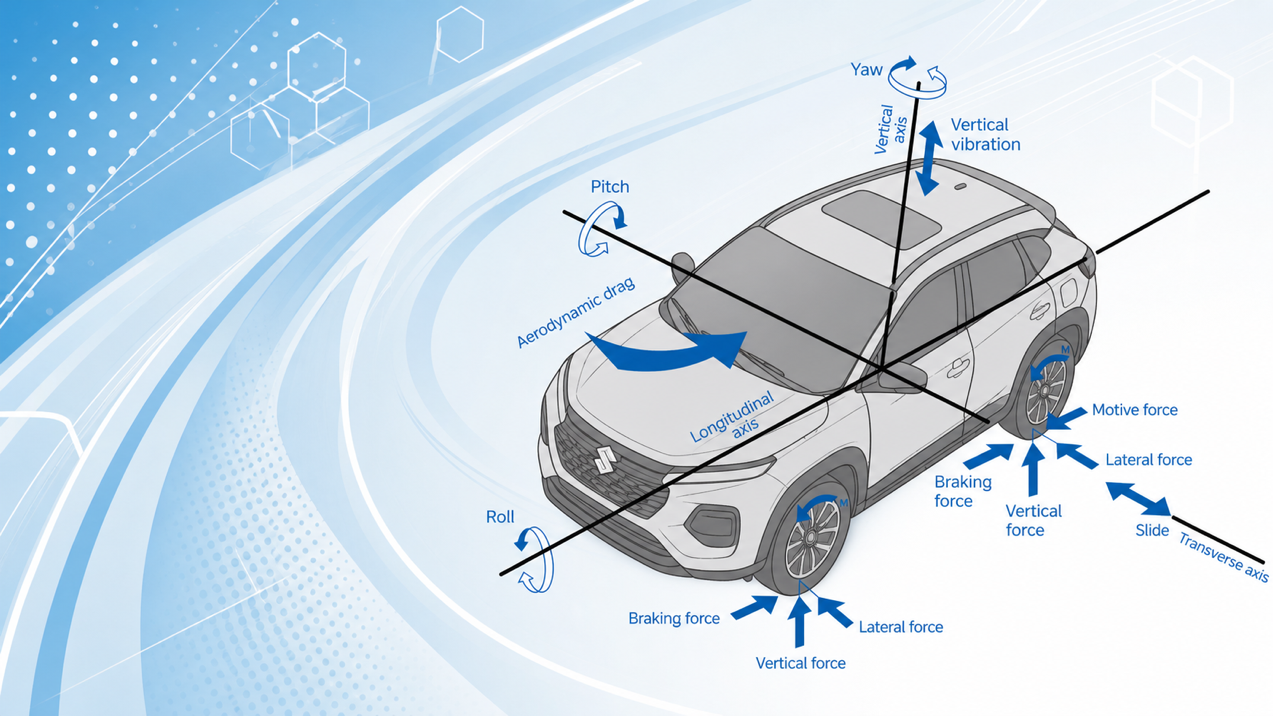
Figure 1. Vehicle Dynamics – Longitudinal, Lateral, Vertical
What is Vehicle Dynamics?
Vehicle dynamics is a subset of engineering dealing with and based on established mechanics. Simply, vehicle dynamics for vehicles-on-wheels is the study of vehicle motion. More specifically, vehicle dynamics is the study of how a vehicle’s forward movement changes in response to driver inputs, propulsion system outputs, ambient conditions, air/surface/water conditions, and so forth.
Simply, and to the point vehicle dynamics is all about the study of how much energy is required to propel vehicles-on-wheels and the limiting factors involved in determining the amount of energy required to move the vehicle.
Again, it is all about motion. Okay, that is logical but what are the factors affecting vehicle dynamics?
Factors Affecting Vehicle Dynamics
The factors affecting vehicle dynamics are many and varied, including drivetrain and braking, suspension and steering, distribution of mass, aerodynamics, and tires. The dynamics that govern vehicle motion based on the forces acting on a rolling vehicle include aerodynamic drag, rolling resistance, hill climbing, linear and angular acceleration, and tractive force. Let’s look at each of the factors affecting vehicle dynamics.
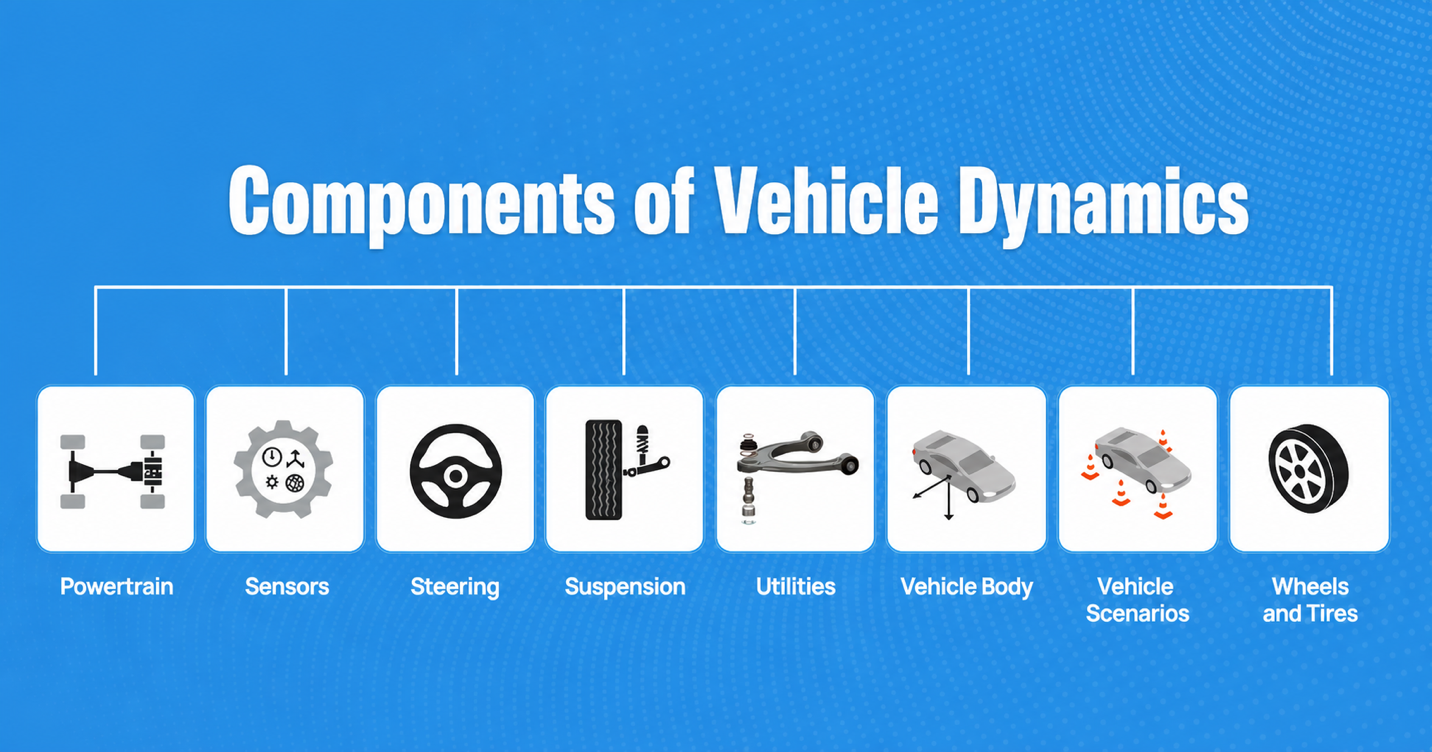
Figure 2. Vehicle Dynamics Components
Vehicle-On-Wheels Layout
In the drivetrain and braking factor category of vehicle dynamics vehicle-on-wheels layout is derived from the location of the engine and the drive wheels. The layouts can be divided into the three categories of front-wheel drive (FWD), rear-wheel drive (RWD), and four-wheel drive (4WD). In practice the many different combinations of engine location and driven wheels actually employed are dependent on the application for which the vehicle-on-wheels will be used.
Powertrain
Simply, the powertrain consists of the units that provide power to the wheels of the vehicle.
Braking System
The braking system is composed of mechanical devices that restrain motion by absorbing energy from the moving system.
Geometry Of Suspension, Steering, And Tires
- One of the considerations in suspension and steering systems in vehicles-on-wheels is steering geometry, namely the Ackermann steering geometry; it is a consideration that is focused on the geometric arrangement of linkages used to steer the vehicle-on-wheels and the intention is to avoid the need for tires to slip sideways when following whatever the path around a curve. The geometric solution is for all wheels to have their axles arranged as radii of circle with a common center point (Norris, 1906). Okay, what does all this mean? It means that in “turntable steering” as the rear wheels are fixed, the center point must be on line extended from the rear axle. Note that intersecting the axes of the front wheels on this line as well requires that the inside front wheel be turned, when steering, through a greater angle than the outside wheel (Norris, 1906).
Instead of the preceding turntable steering, where both front wheels turned around a common pivot, each wheel gained its own pivot, close to its own hub. While more complex, this arrangement enhances controllability by avoiding large inputs from road surface variations being applied to the end of a long lever arm, as well as greatly reducing the fore-and-aft travel of the steered wheels.
Note that modern vehicles-on-wheels do not use Ackerman steering, even though the principle is good for slow-speed maneuvers but it ignores important dynamic and complaint effects.
- Axle track in vehicles-on-wheels refers to those vehicles having two wheels on an axle; it is the distance between the hub flanges on an axle. Track refers to the distance between the centerline of two wheels on the same axle. Axle and track are commonly measured in millimeters or inches.
- Camber angle is one of the angles made by the wheels of a vehicle; stated differently, it is the angle between the vertical axis of a wheel and the vertical axis of the vehicle when viewed from the front or rear.
- Caster angle causes a wheel to align with the direction of travel. Caster displacement moves the steering axis ahead of the axis of rotation.
- Ride height or ground clearance is the distance or space between the base of the vehicle tire and the lowest point of the vehicle (usually the axle).
- Roll center of a vehicle is the notional point at which the cornering forces in the suspension are reacted to the vehicle body.
- Scrub radius is the distance at the road surface between the tire center line and the steering axis inclination.
- Steering ratio is the ratio between the turn of the steering wheel (in degrees) or handlebars and the turn of the wheels (in degrees). For electric motorcycles and bicycles the steering ratio is 1:1, because the steering wheel is attached to the front wheel. In most electric passenger cars the ratio is 12:1 and 20:1 (ratios 13–14 are considered fast and ratios above 18 are considered slow).
- Toe, in vehicles-on-wheels toe (aka tracking), as a function of static geometry, and kinematic and compliant effects is the symmetric angle that each wheel makes with the longitudinal axis of the vehicle.
- Wheel alignment sometimes referred to as breaking or tracking consists of adjusting angles of wheels to manufacturer specifications.
- Wheelbase is the distance between the front and rear axles of a vehicle-on- wheels.
Mass Distribution
Some aspects of vehicle dynamics are due to mass and its distribution. Mass distribution is the spatial distribution of mass within a solid body. These include:
- Center of mass is the unique point where the weight relative portion of the distribution sums to zero.
- Moment of inertia depends on the moment of the very different moment of inertia depending on the location and orientation of the axis or rotation.
- Roll moment is a product of force and distance and causes a vehicle to roll, rotating about its longitudinal axis.
- Sprung mass in a vehicle-on-wheels with a suspension is the portion of the vehicle’s total mass that is supported by the suspension, including in most applications approximately half of the suspension itself.
- Unsprung mass sometimes called unsprung weight of a vehicle is the mass of the suspension directly connected.
- Weight distribution is the apportioning of weight with a vehicle-on-wheels.
Aerodynamics
Some aspects of vehicle dynamics are due to aerodynamics aspects. These include:
- Automobile drag coefficient is a common measure in automotive design. Drag is the force that acts parallel to and in the same direction as the airflow.
- Automotive aerodynamics is the study involved with reducing drag, wind noise, and preventing undesirable lift in vehicles-on-wheels.
- Center of pressure is the point where the total sum of a pressure field acts on a body causing a force to act through that point.
- Downforce is a downward lift force created by the aerodynamic features of a vehicle-on-wheels.
- Ground effect (automobiles) is a series of effects that have been exploited in automotive aerodynamics to create downforce.
Vehicle dynamics is directly affected by the tires of a vehicle-on-wheels. For instance, one of the interesting factors affecting vehicle dynamics is known as the Magic Formula tire models. Developed by Hans Pacejka the Magic Formula actually consists of a series of formulae that Pacejka developed over the last 20 years.
The Significance of the Magic Formula?
Well, the truth be told, the Magic Formula is widely used in professional vehicle dynamics simulations because they are reasonably accurate, very easy to program, and more importantly they solve quickly.
So, What is So Magical about the Magic Formula?
First off, there is no particular physical basis for the structure of the equations chosen, but they fit a wide variety of tire constructions and operating conditions—in short, the Magic Formula is not only easy to use but is adaptable to several different applications or requirements and is widely used in professional vehicle dynamics simulations and they are reasonably accurate, easy to program, and solve quickly.
Vehicle Dynamics Related to Tires
Along with the Magic Formula there are other aspects of vehicle dynamics related to tires include camber thrust, circle of forces (i.e., a useful way of thinking about the dynamic interactions between the vehicle’s tire and road), contact patch (i.e., the pneumatic touch of the tire to road surface), cornering force, ground pressure, pneumatic trail (i.e., the trail of the tire), and radial force variation (i.e., road force variation is the property of a tire that affects steering, traction, braking, and load support).
- A property of pneumatic tires that describes the delay between when a slip angle is introduced and when cornering force reaches its steady-state value is known as relaxation length. Rolling resistance is the force resisting the motion when a body (tire) rolls on a surface.
- The torque a tire develops as it rolls along is known as self-aligning torque (aka aligning torque, aligning moment, SAT, or MS); it tends to steer it, that is, rotate it around its vertical axis.
- Skid occurs when one or two tires slip relative to the road.
- Slip angle or sideslip is the angle between the direction in which a wheel is pointing and the direction in which it is actually traveling.
- Another characteristic in vehicle dynamics related to tires is slip, which is the relative motion between the tire and the road surface it is moving on. A subset of slip is spinout that occurs when a vehicle rotates in one direction during a skid.
- Steering ratio refers to the ratio between the turn of the steering wheel (in degrees) and the turn of the wheel (in degrees).
- The behavior of tires under load is called tire load sensitivity.
Pure Dynamics
Beyond distribution of mass, aerodynamics, and tires some attributes and aspects of vehicle dynamics are purely dynamic.
- For example, body flex is a lack of rigidity in a vehicle-on-wheels’ chassis.
- The axial rotation of a vehicle-on-wheels toward the outside of a turn called body roll is another example of a purely dynamic aspect of vehicle dynamics.
- Another term used in vehicle dynamics for a pure dynamic attribute or aspect is bump steer. Bump steer is caused when one wheel falls down into a rut or hole or hits a bump causing the vehicle-on-wheels to turn itself.
Note that there are several other factors, attributes, and aspects of pure dynamics that impact vehicle dynamics and more importantly vehicle operation. A few of these other factors, attributes, and aspects of aerodynamics affecting operation of vehicles-on-wheels include directional stability, critical speed, pitch, yaw, roll, speed wobble, understeer, oversteer, weight transfer, and yaw—it is these factors that affect vehicle operation.
However, if we have to sum up the factors, attributes, and aspects of vehicle dynamics related to environmental impact on vehicles-on-wheels it comes down to the forces acting on a rolling vehicle-on-wheels. And these forces are all about aerodynamics; at least, aerodynamics is where we begin—and we do this by describing aerodynamic drag, rolling resistance, linear acceleration, hill climbing, angular acceleration, and the total of them all, and this equates to the total tractive force required to propel the vehicle.
Key Takeaways
Vehicle dynamics examines how vehicles respond to driver inputs, propulsion systems, road conditions, and environmental forces, with motion influenced by drivetrain layout, braking, steering geometry, and suspension design. Tire behavior, mass distribution, and aerodynamics play critical roles in determining stability, handling, efficiency, and traction, while factors such as drag, rolling resistance, hill climbing, and acceleration directly impact the energy required to propel a vehicle. Advanced concepts such as Ackermann steering, slip angle, weight transfer, and Pacejka’s Magic Formula help engineers accurately model real-world vehicle behavior and optimize performance.