Hitachi Energy Debuts HyFlex Compact to Displace Diesel Generators with Zero-Emission Mobile Power
Hitachi Energy’s HyFlex Compact is a portable hydrogen fuel cell–battery hybrid delivering zero‑emission, grid‑quality power for temporary and off‑grid sites.
Hitachi Energy introduced HyFlex Compact, a portable hybrid generator designed to supply zero‑emission electricity for temporary and remote operations where grid access is limited or unavailable. Launched in London on June 11, 2026, the system addresses growing pressure to electrify construction, industrial maintenance, and other transient loads while eliminating the particulate, NOx, and CO2 footprint of diesel gensets.
The offering extends the company’s zero‑emission power portfolio and is aimed at projects that require dependable, grid‑quality AC power on tight timelines and in challenging environments.
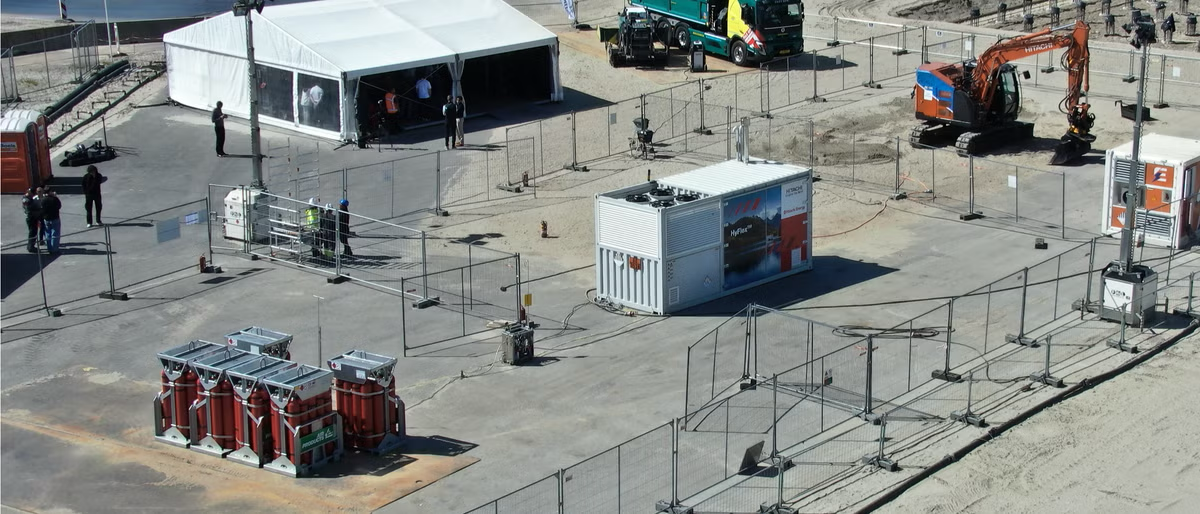
Live demonstration illustrated the concept of a zero-emission construction site in action
Hybrid Architecture: Fuel Cells Meet High-Performance Batteries
HyFlex Compact combines a hydrogen fuel cell stack with high‑performance batteries, power electronics, thermal management, and auxiliaries in a single transportable enclosure governed by an integrated control system.
In operation, the fuel cells convert hydrogen to electricity while producing heat and water as by‑products. The battery subsystem supports fast transients and peak shaving, allowing the fuel cell to operate near its optimal efficiency point. Optional AC and DC input modules enable the unit to behave as a mobile microgrid node, orchestrating additional sources—such as a small PV array, local grid connection, or other distributed assets—to stabilize voltage and frequency and reduce hydrogen consumption whenever supplemental power is available.
Designed for standalone or grid‑connected use, the platform focuses on reliable AC output under variable load profiles common to construction tools, site electrification equipment, and mobile charging.
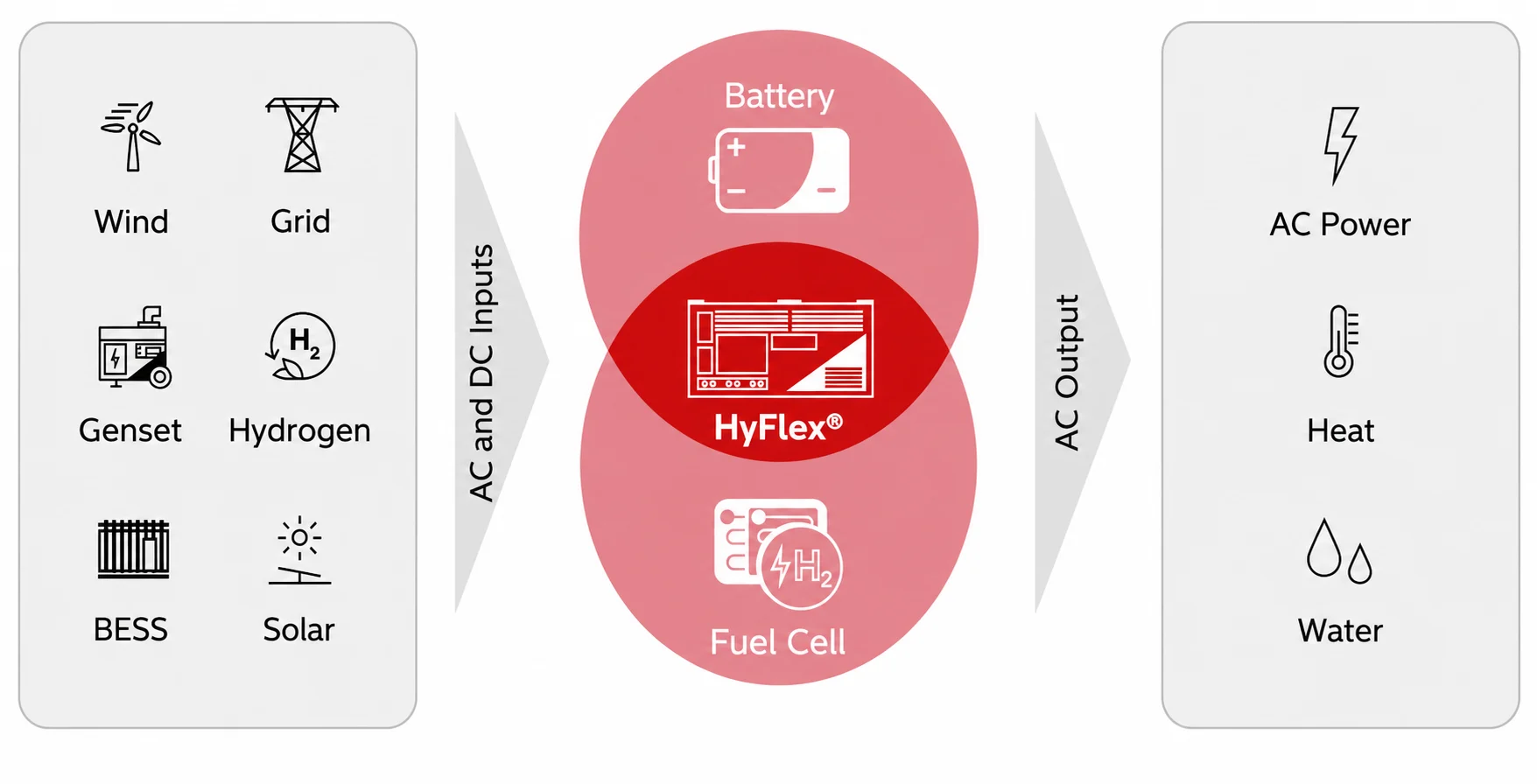
Integrating fuel cells, batteries, and various power assets into a unified smart energy solution.
From Demonstrators to Mobile Microgrids
The HyFlex Compact builds on earlier field deployments that validated hydrogen‑to‑power integration with real loads. In the Netherlands, a HyFlex generator supplied a battery‑electric excavator at Air Products’ Rotterdam site, illustrating a pathway to zero‑emission construction by pairing onsite hydrogen with electric plant and machinery. Elsewhere, the technology has been trialed to provide shore power to vessels at berth—substituting fuel‑burning auxiliary engines with a quiet, emissions‑free alternative—and to decarbonize temporary worksites in Sweden.
These pilots informed the system‑level approach now embodied in HyFlex Compact: tight coordination of fuel cell stacks, DC buses, conversion stages, and supervisory controls to sustain grid‑like power quality in harsh and dynamic conditions.
Why this matters for engineering teams is the operational flexibility. Temporary power demands fluctuate with duty cycles and shift patterns, and conventional gensets typically trade off fuel efficiency against ramp response and noise. By hybridizing electrochemical generation with energy storage and configurable inputs, HyFlex Compact can address step loads and inrush currents while optimizing hydrogen usage over a workday.
The platform architecture—fuel cell prime mover, battery buffer, and grid‑forming power electronics—aligns with established microgrid control philosophies, simplifying interconnection with other site assets and easing compliance with power‑quality requirements on mixed AC/DC job sites.
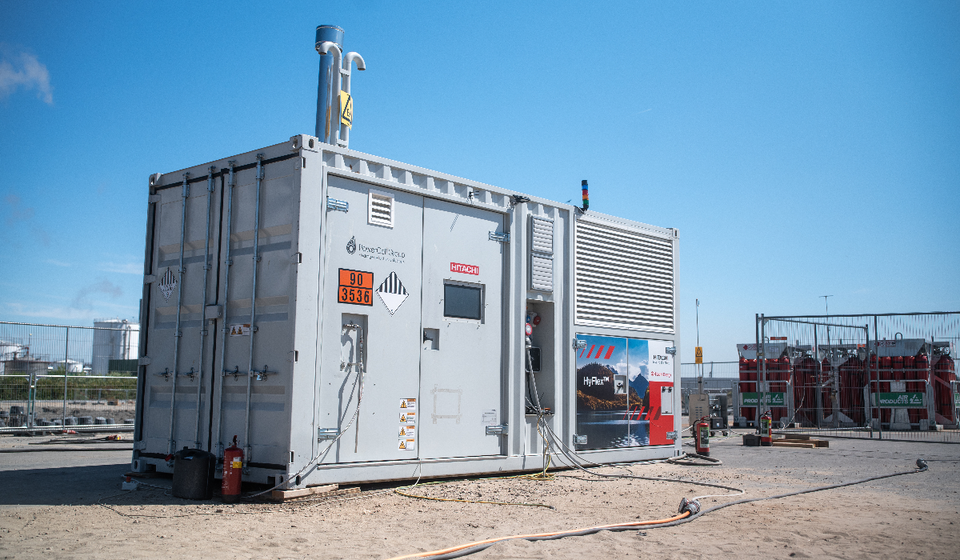
HyFlex Compact at the live demonstration in Rotterdam, Netherlands
Mobile Power for Construction, EV Charging, and Remote Industry
Hitachi Energy positions the system for a wide range of use cases: construction and temporary civil works, events and festivals, ad‑hoc EV charging deployments, mining and remote industrial operations, and critical infrastructure requiring resilient backup where combustion‑based units are restricted by noise or air‑quality limits.
Because the unit can accept both AC and DC inputs, project teams can integrate whatever local resources are available—grid spurs, temporary PV, or other distributed assets—rather than relying solely on delivered hydrogen. This modularity lets operators scale capacity by combining multiple energy inputs and matching the hybrid’s control strategy to real‑time load behavior and fuel availability, a core requirement as electrification spreads to sites not originally designed for high‑power connections.
Building the Power Electronics Backbone
The introduction of HyFlex Compact coincides with Hitachi Energy’s broad investment in power‑electronics engineering and validation capacity that underpins systems like mobile microgrids.
The company recently opened a Grid & Power Quality Solutions and Service test center in Västerås, Sweden, and announced a new Power Electronics Center of Competence in Cary, North Carolina. The U.S. site will localize engineering, testing, and system integration for FACTS‑class equipment and grid‑connection solutions—capabilities directly applicable to hybrid, inverter‑dominated resources that must meet stringent power‑quality and interoperability requirements as they connect at the edge of distribution networks or on customer premises. This build‑out of regional test and integration capacity is intended to shorten time‑to‑power and improve interoperability for projects blending storage, fuel cells, and grid‑forming converters.
Engineering Significance and Industry Impact
For utilities, EPCs, and industrial operators, HyFlex Compact represents a pragmatic decarbonization step for “everywhere power”—locations where diesel generators have been the default. The system’s hybrid design targets three recurring engineering pain points:
- emissions compliance in urban or regulated zones;
- power‑quality stability under fast, cyclic loads;
- and supply flexibility when hydrogen logistics, weather, or site constraints change.
In practice, this allows project teams to standardize on an electrical architecture that handles start‑up surges, supports sensitive electronics, and integrates opportunistic inputs without extensive re‑engineering at each site.
The broader implication is a shift in how temporary power is specified and commissioned. Rather than sizing a diesel unit for worst‑case demand and accepting poor part‑load efficiency, teams can right‑size the fuel cell for average load, leverage storage for peaks, and add local sources as conditions permit.
As more worksites electrify heavy equipment and as temporary EV charging becomes commonplace on construction or event grounds, hybrid, grid‑forming power hubs like HyFlex Compact can help decouple operational timelines from utility interconnection schedules—accelerating deployment while staying within decarbonization and noise constraints.
In sum, HyFlex Compact is less a single product than a standardized building block for mobile microgrids. By packaging hydrogen conversion, storage, and conversion stages with configurable inputs into a controlled, portable system, Hitachi Energy is targeting the engineering realities of site electrification and transitional grid needs—delivering stable AC power with zero local emissions where conventional infrastructure is not yet ready.