Electronic Variable Speed Drives
Introduction to Variable Frequency Drives (VFD)
-
Question 1
Explain the difference between the two speeds associated with an induction motor.Reveal answerSynchronous speed is the speed at which the rotating magnetic field revolves around the stator. It is determined by the following formula:
$$S=\frac{120\times f}{P}$$
Where:
- S = the synchronous speed in rpm;
- 120 = a constant value;
- f = the frequency of the applied AC power in hertz (Hz);
- P = the number of stator poles.
Rotor speed is the speed at which the rotor rotates.
-
Question 2
What two factors determine the speed at which the magnetic field revolves around the stator of an induction motor?Reveal answerThe speed of the rotating magnetic field is determined by two factors: the number of stator poles in the motor and the frequency of the applied AC power. Increasing the supply frequency increases the synchronous speed, while increasing the number of poles decreases the synchronous speed.
-
Question 3
Explain the term “slip.”Reveal answerSlip is the difference between the synchronous speed (ns) of the rotating magnetic field and the actual speed of the rotor (nr). Because the rotor always turns slightly slower than the magnetic field, this speed difference allows current to be induced in the rotor conductors and enables the motor to produce torque.
-
Question 4
Is slip desirable or undesirable? Why?Reveal answerSlip is desirable because it is necessary for torque production in an induction motor. Without slip, there would be no relative motion between the rotor and the rotating magnetic field, no induced current in the rotor, and therefore no torque. A small amount of slip is normal during motor operation and increases as the load on the motor increases.
-
Question 5
Prior to the advent of VFDs, name four methods of speed control.Reveal answer- Pulleys and belts,
- Sprockets and chains,
- Gearboxes,
- Mechanical brakes,
- Wound-rotor induction motor, and
- DC motor prime mover for an alternator to vary the frequency of the AC.
-
Question 6
Name three basic types of VFDs.Reveal answer- Pulse-width-modulated (PWM),
- current-source-inverters (CSI), and
- Voltage-source-inverters (VSI).
-
Question 7
What is the name of the section of the VFD that is connected to the three-phase power source?Reveal answerThe section connected to the three-phase power source is called the converter stage. The converter stage uses rectifier devices to convert the incoming AC voltage into DC voltage, which is then supplied to the next stage of the VFD.
-
Question 8
What are three names for the section of a VFD that produces a smooth DC?Reveal answerThe section that smooths the rectified DC is commonly called the filter stage, DC link, or DC bus. This section typically contains capacitors and sometimes inductors that reduce voltage ripple and provide a stable DC supply for the inverter stage.
-
Question 9
What is the name of the section of the VFD that is connected to the motor? Describe its function.Reveal answerThe section connected to the motor is called the inverter stage. The inverter rapidly switches the DC voltage on and off using semiconductor devices to create a variable-frequency AC output. By controlling the frequency and voltage supplied to the motor, the inverter controls motor speed and torque.
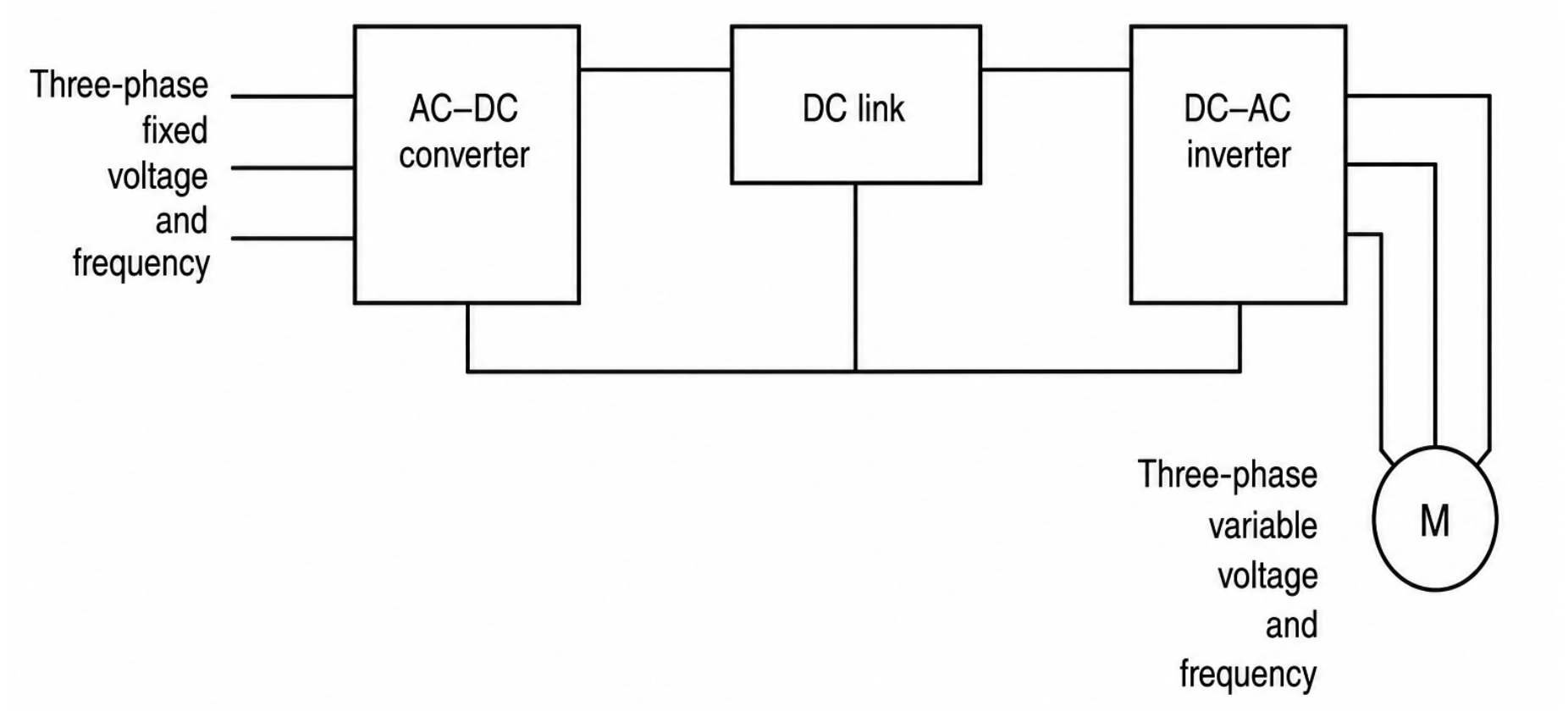
Variable Frequency Drive Block Diagram
-
Question 10
What is the primary purpose of a VFD?Reveal answerThe primary purpose of a variable frequency drive (VFD) is to control the speed and torque of an AC motor by varying the frequency and voltage supplied to the motor. This allows motors to operate more efficiently and provides better process control in many industrial applications.
-
Question 11
How does a VFD control the speed of an induction motor?Reveal answerA VFD changes the frequency of the applied AC voltage. Since synchronous speed depends on frequency, changing frequency changes motor speed.
-
Question 12
What is meant by the V/Hz ratio?Reveal answerThe V/Hz ratio is the relationship between the applied voltage and frequency supplied to the motor. Maintaining a constant V/Hz ratio helps preserve the magnetic flux inside the motor and allows it to produce the proper amount of torque over its operating speed range.
