Electric Motor Control
Principles of Electric Motor Control
-
Question 1
What is a controller and what is its function?Reveal answerA controller is a device or group of devices that govern the delivery of a predetermined amount of electric power to apparatus connected to it. The controller’s function is to start, stop, reverse, accelerate, decelerate, regulate, or protect devices connected to it.
-
Question 2
What is meant by remote control?Reveal answerControls that initiate or cause a change in the operation of an electrical device or apparatus, and are located at a different location from the device being controlled, are called remote controls.
An example of a remote control is the push button that energizes a magnetic motor starter that starts a motor.
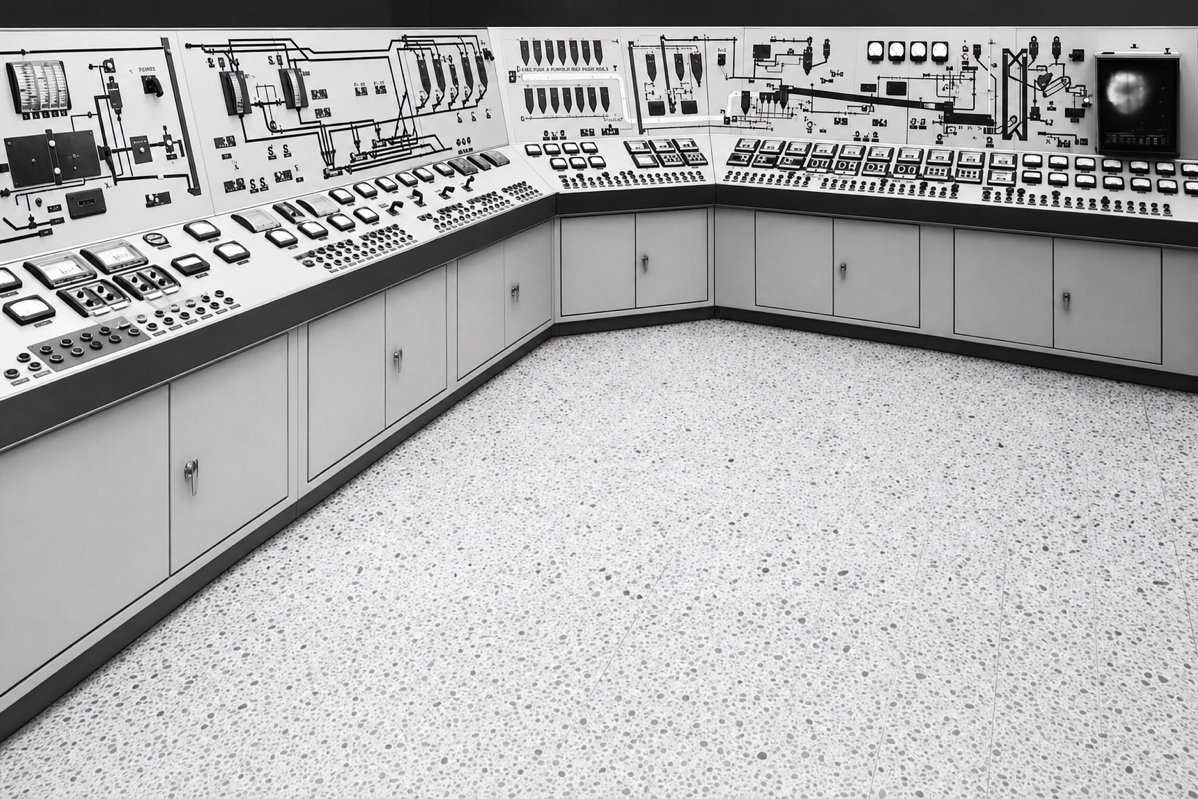
Typical cement mill computer console carefully controlling and monitoring motors located remotely.
-
Question 3
To what does current limiting, or compensating time, acceleration refer?Reveal answerCurrent-limiting acceleration refers to the amount of current or voltage required to open or close magnetic switches. This type of control action is generally used for starting time periods on direct-current (DC) motor control.
-
Question 4
List at least four devices that are used to control a motor automatically. Briefly describe the purpose of each device.Reveal answer- Float switch—to raise or lower liquids
- Pressure switch—to maintain liquid, gas, or air pressures within a desired range
- Time clock—to provide a definite “on and off” action
- Thermostat—to maintain temperature ranges
- Limit switch—used as an overtravel stop on machines
- Interlock—to ensure that all systems are correct before the motor is started
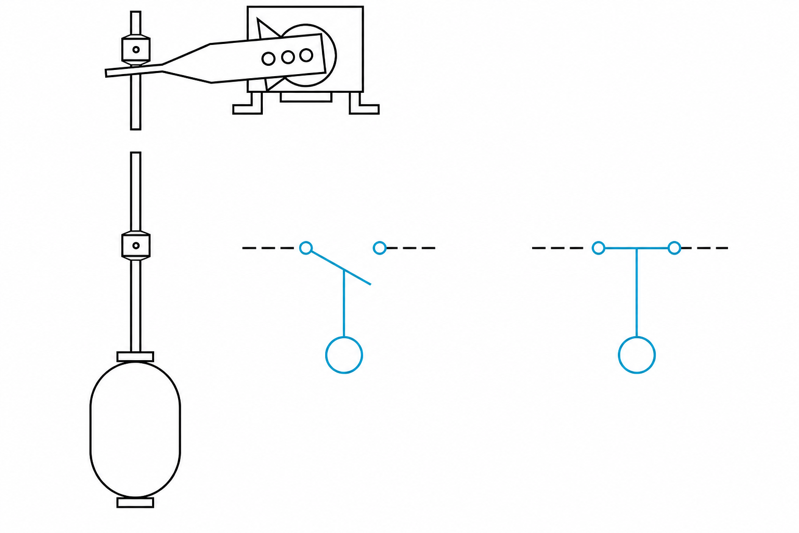
Rod-operated float switch with electrical wiring symbols.
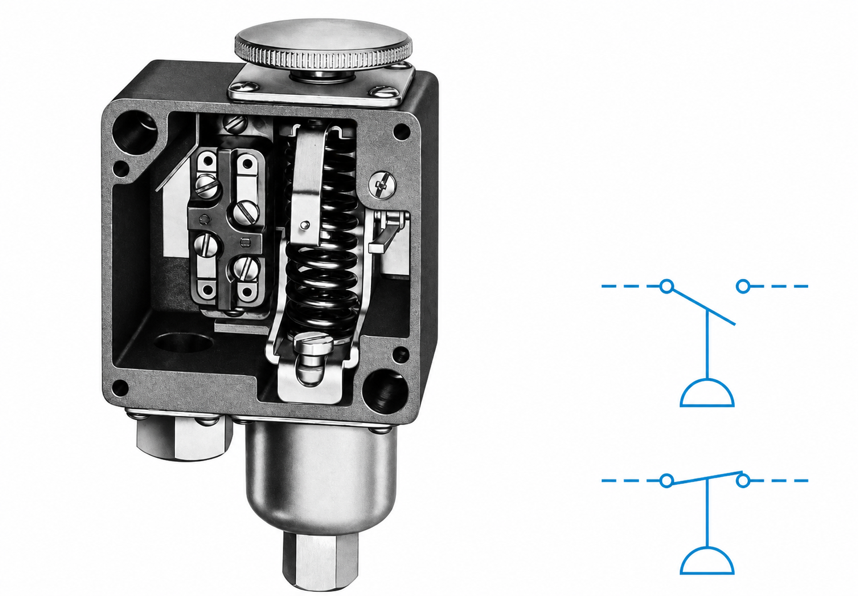
Pressure switch with electrical wiring symbols.
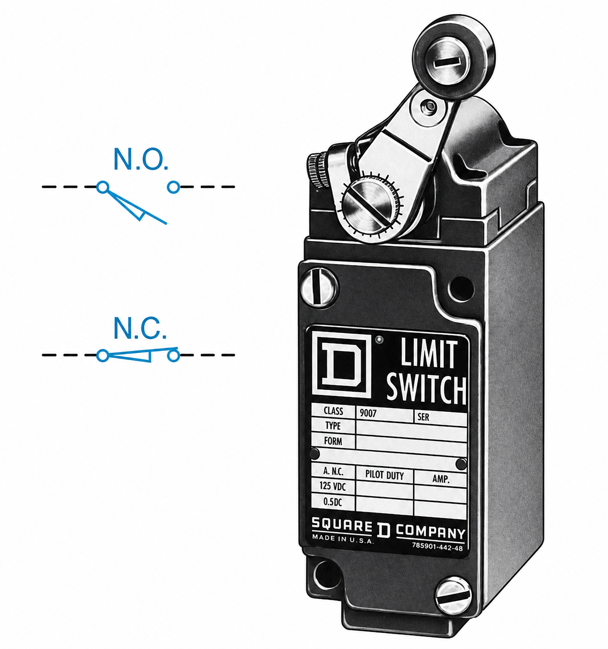
Limit switch shown with electrical wiring symbols.
-
Question 5
How may an automatic operation be achieved when a manual motor starter is used?Reveal answerThe starter may be used for automatic operation by installing an automatic control device, such as a float switch, in the automatic position of a selector switch or in series with the starter and motor. In either case, the automatic control device contacts must have the capacity to pass the full-load motor current.
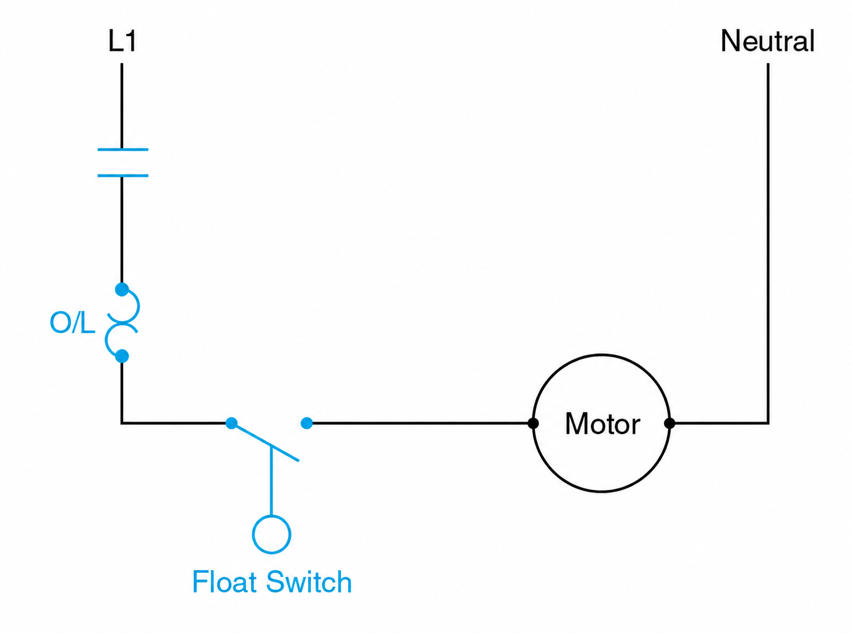
Automatic control with FHP-single-pole, single-phase manual starter for FHP motor without selector switch.
-
Question 6
What does the term trip-free mean as it relates to manual starters?Reveal answer"Trip-free" in manual starters means the starter's internal contacts will open automatically during an overload or fault, even if the operator is holding the start lever/button in the "ON" position. This safety feature ensures the circuit cannot be kept energized while a fault exists, protecting equipment from damage.
-
Question 7
What is a magnetic line voltage motor starter?Reveal answerA magnetic line-voltage motor starter is a magnetic closing switch with overload relays for starting motors at across-the-line voltage. A motor starter protects the motor from burnout due to overloads. It can be controlled remotely with push buttons or other pilot devices.
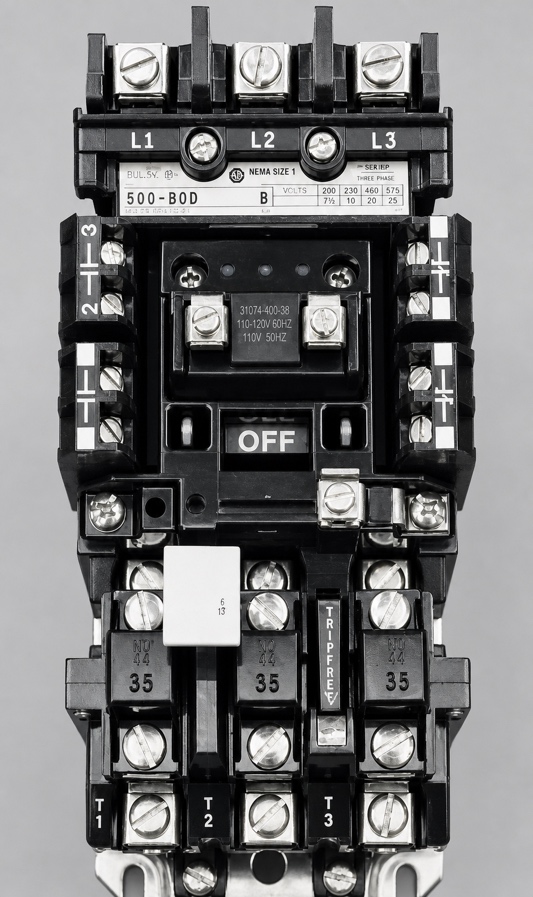
Motor starter with overload relay
-
Question 8
If a motor starter is installed according to directions but will not start, what is a common cause for the failure to start?Reveal answerThe most common cause is the reset mechanism, which closes the overload relay contacts, has not been pressed after heaters have cooled sufficiently.
-
Question 9
Using the time limit overload or the dashpot overload relay, how are the following achieved: timedelay characteristics; tripping current adjustments?Reveal answerTo obtain time-delay characteristics, a valve disc is opened or closed to various sizes of fluid bypass holes in the piston, resulting in a change in the rate of fluid flow.
Tripping current adjustments are obtained by adjusting the plunger core with respect to the overload relay coil.
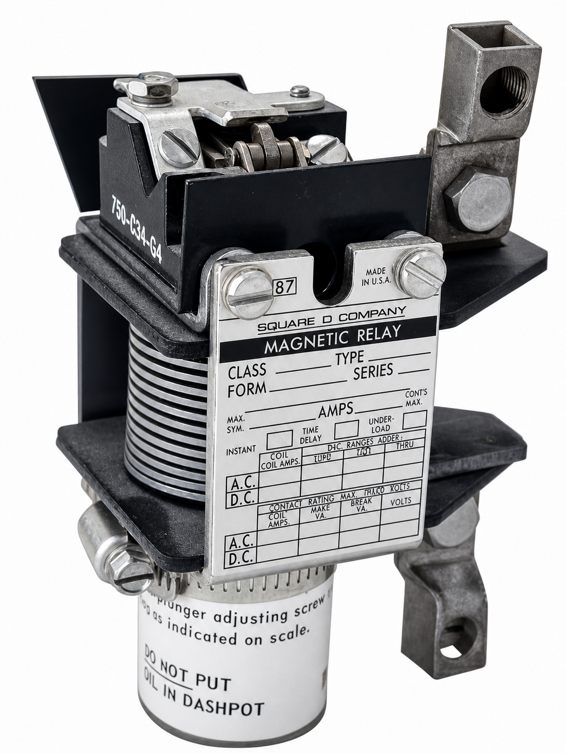
Dashpot Overload Relay
-
Question 10
What causes the AC hum or chatter in AC electromagnetic devices?Reveal answerChattering is the vibration due to zero holding power twice during each cycle; in other words, the contacting surfaces of the magnet separate and come together again twice during each cycle.
-
Question 11
In what AC and DC devices is the principle of the shaded pole used?Reveal answerThe shaded-pole principle is used in AC electromagnets. It is also used to provide a time lag in the decay of flux in DC coils.
-
Question 12
What does the electrician look for to remedy the following conditions: - loud or noisy hum? - chatter?Reveal answerLook for the following:
- foreign matter on machined surfaces of the magnet or plunger;
- misalignment of nonmagnetic sealing surfaces;
- loose laminations or broken rivets;
- poorly matched machined sealing surfaces;
- broken shading coils, or
- possibly foreign objects preventing the magnet parts from contacting completely.
-
Question 13
What advantage is there in using combination starters?Reveal answerThe combination starter takes little space and makes compact electrical installations possible.
-
Question 14
What safety feature does the combination starter provide that individual motor starting assemblies do not?Reveal answerThe cover of the combination starter enclosure is interlocked with the external operating handle of the disconnecting means. The door cannot be opened with the disconnect switch closed. When the door is open, the accessible parts in the enclosure are not connected to the power line.
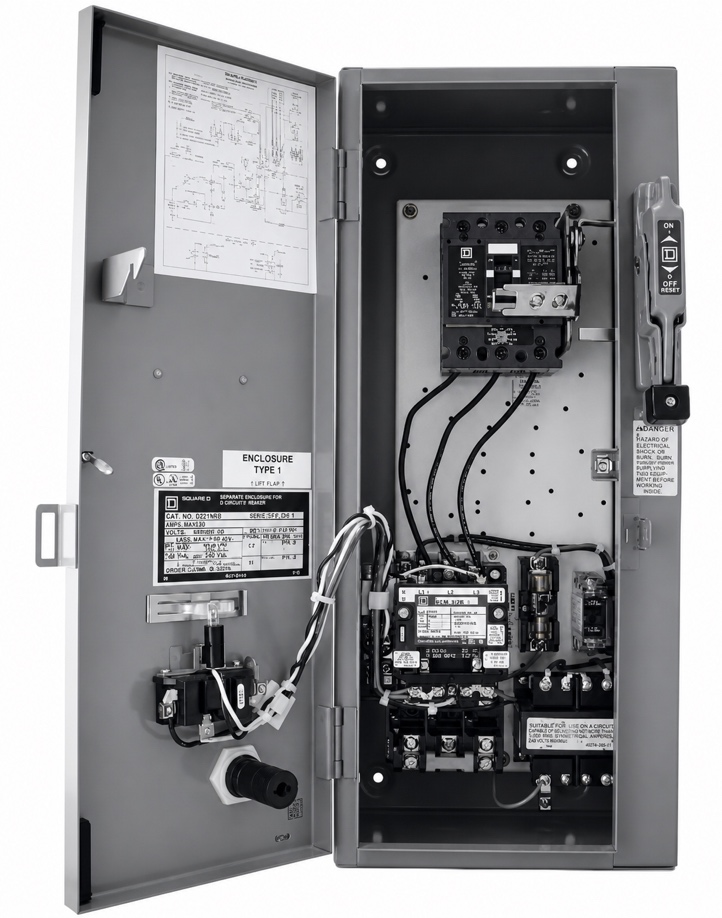
Combination starter with circuit breaker, control transformer, control circuit fuse, and motor starter. The door cannot be opened unless the circuit breaker is open
-
Question 15
List the probable causes if the armature does not release after the magnetic starter is deenergized.Reveal answer- The armature is binding mechanically.
- The air gap of the plunger is too near the part of the magnet that has residual magnetism, or the plunger may be contacting the magnet.
- A short circuit fuses or welds the contacts closed.
- The magnet faces are covered with a gummy substance.
-
Question 16
What is the most common voltage used for control systems?Reveal answerThe most common voltage used for industrial control systems is 120 volts AC (120 VAC).
-
Question 17
What is the difference between a grounded control system and a floating control system?Reveal answerA grounded control system has one side of the control transformer secondary connected to ground. A floating system does not have the transformer secondary connected to ground.
-
Question 18
A control transformer has a primary voltage of 480 volts and a secondary voltage of 120 volts. The transformer has a power rating of 0.5 kVA. What is the maximum output current of the transformer?Reveal answerGiven:
Primary voltage $V_P = 480\ \text{V}$
Secondary voltage $V_S = 120\ \text{V}$
Transformer rating = $0.5\ \text{kVA}$
Step 1: Convert kVA to VA
$$ 0.5\ \text{kVA} = 0.5 \times 1000 = 500\ \text{VA}$$
Step 2: Use the transformer power formula
For the secondary side:
$$ I = \frac{VA}{V}$$
Substitute the known values:
$$ I = \frac{500}{120}$$
Step 3: Calculate the current
$$ I = 4.17\ \text{A}$$
The maximum output current of the transformer is:
$$ 4.17\ \text{A}$$
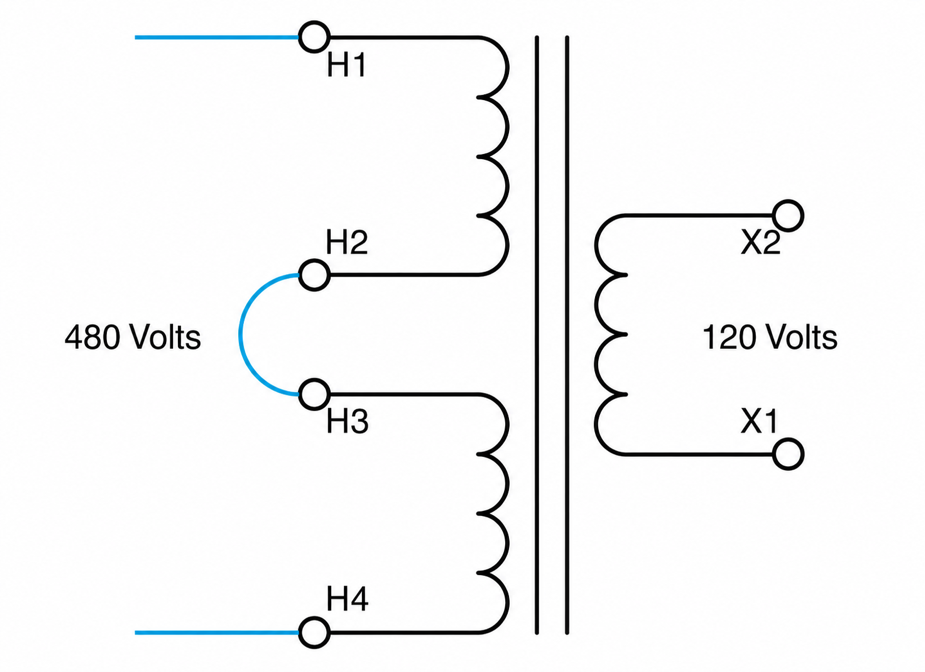
The primary windings of the control transformer are labeled H1, H2, H3, and H4. H1 and H2 are the ends of one primary winding and H3 and H4 are the ends of the second primary winding. The secondary winding is labeled X1 and X2
