Wye-Delta Transformation
This calculator will determine the resistance values for either a Delta-to-Wye or a Wye-to-Delta transformation.
DELTA
WYE
Delta–Wye (Δ–Y) and Wye–Delta (Y–Δ) transformations are algebraic tools for converting a three‑terminal resistive network between two topologies without changing what any external measurement would read between the three accessible nodes. A calculator for these conversions automates the formulas so you can reduce otherwise intractable resistor networks to series/parallel combinations, simplify nodal/mesh setups, and compute equivalent resistances cleanly. This tutorial builds from fundamentals through derivations, implementation details for a robust calculator, and worked examples you can verify by hand.
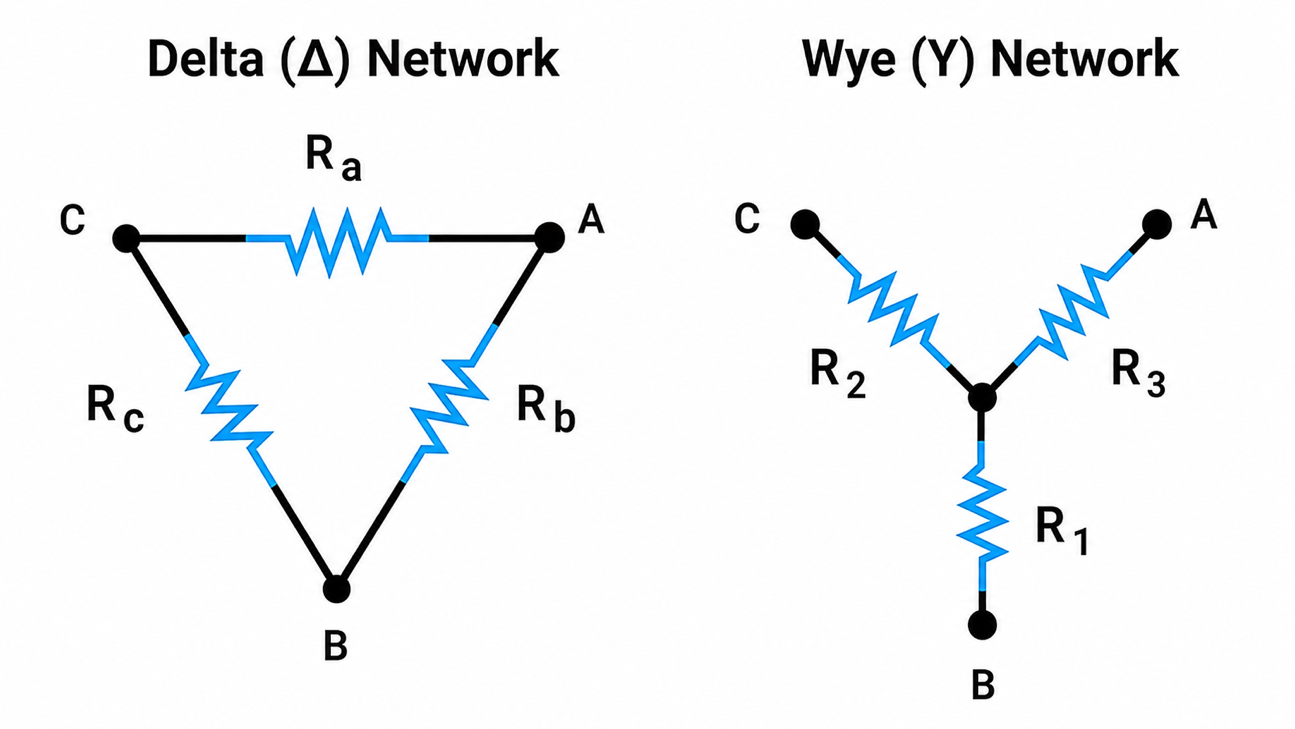
Figure 1. Delta and Wye Resistive Networks
Delta (Δ) Network
- Ra is the resistor on the CA side.
- Rb is the resistor on the AB side.
- Rc is the resistor on the BC side.
External nodes are A (top‑right), B (bottom), C (top‑left).
Wye (Y) Network
- R3 connects node A to the star (neutral) node.
- R1 connects node B to the star node.
- R2 connects node C to the star node.
The same external nodes A, B, C appear at the ends of the Y branches.
Δ → Y Transformation Equations
Let S be the sum of the three Δ resistors:
$$S=R_a+R_b+R_c$$
Then the equivalent Y resistors are
$$R_1=\frac{R_bR_c}{S}$$
$$R_2=\frac{R_aR_c}{S}$$
$$R_3=\frac{R_aR_b}{S}$$
Interpretation with the image’s labels:
- R1 (branch to B) uses the two Δ sides that meet at node B, namely AB (Rb) and BC (Rc).
- R2 (branch to C) uses CA (Ra) and BC (Rc).
- R3 (branch to A) uses CA (Ra) and AB (Rb).
Special symmetric case (quick check)
If Ra = Rb = Rc = RΔ, then R1 = R2 = R3 = RΔ/3.
Y → Δ Transformation Equations
Let P be the sum of pairwise products of the Y resistors:
$$P=(R_1R_2)+(R_2R_3)+(R_3R_1)$$
Then the equivalent Δ resistors are
$$R_b=\frac{P}{R_2}$$
$$R_c=\frac{P}{R_3}$$
$$R_a=\frac{P}{R_1}$$
Special symmetric case (quick check):
If R1 = R2 = R3 = RY, then Ra = Rb = Rc = 3 RY
Numerical Guardrails
- For Δ → Y, ensure S ≠ 0; if S is numerically near zero, the conversion is ill‑conditioned—report an error.
- For Y → Δ, none of R1, R2, R3 may be zero in the denominator used for its opposite Δ side; a zero Y leg implies the opposite Δ side tends to infinity (open circuit).
- After computing, verify any one pair, for example:
- Compute Req(A,B) in Δ: Rb ∥ (Ra + Rc)
- Compute Req(A,B) in Y: R3 + R1
Worked Example (Δ → Y Transformation)
Given the Δ network with
Ra = 30 Ω (side CA), Rb = 120 Ω (side AB), Rc = 60 Ω (side BC)
Step 1: Sum
$$S = R_a + R_b + R_c = 30 + 120 + 60 = 210\ \Omega$$
Step 2: Compute the Y resistors
$$R_1=\frac{R_bR_c}{S}=\frac{120\times60}{210}=\frac{7200}{210}\approx34.2857\ \Omega$$
$$R_2=\frac{R_aR_c}{S}=\frac{30\times60}{210}=\frac{1800}{210}\approx8.5714\ \Omega$$
$$R_3=\frac{R_aR_b}{S}=\frac{30\times120}{210}=\frac{3600}{210}\approx17.1429\ \Omega$$
Check with nodes A and B (C open):
$$\Delta:\quad R_{\mathrm{eq}(A,B)}=R_b \parallel (R_a+R_c)=120 \parallel (30+60)=120 \parallel 90=\frac{120\times90}{210}\approx51.4286\ \Omega$$
$$Y:\quad R_{\mathrm{eq}(A,B)}=R_3+R_1\approx17.1429+34.2857=51.4286\ \Omega$$
$$\text{Match confirmed.}$$
Worked Example 2 (Y → Δ Transformation)
Given the Y network in the image with
R1 = 10 Ω (branch to B), R2 = 30 Ω (branch to C), R3 = 20 Ω (branch to A).
Step 1: Pairwise‑product sum
$$P=(R_1R_2)+(R_2R_3)+(R_3R_1)$$
$$=(10\times30)+(30\times20)+(20\times10)$$
$$=300+600+200=1100\ \Omega^2$$
Step 2: Compute the Δ resistors
$$R_b=\frac{P}{R_2}=\frac{1100}{30}\approx36.6667\ \Omega\qquad \text{(side AB)}$$
$$R_c=\frac{P}{R_3}=\frac{1100}{20}=55\ \Omega\qquad \text{(side BC)}$$
$$R_a=\frac{P}{R_1}=\frac{1100}{10}=110\ \Omega\qquad \text{(side CA)}$$
Check with nodes B and C (A open):
$$Y:\quad R_{\mathrm{eq}(B,C)}=R_1+R_2=10+30=40\ \Omega$$
$$\Delta:\quad R_{\mathrm{eq}(B,C)}=R_c\parallel(R_b+R_a)=55\parallel(36.6667+110)$$
$$=55\parallel146.6667=\frac{55\times146.6667}{201.6667}\approx40\ \Omega$$
$$\text{Match confirmed.}$$
Edge Cases and Sanity Checks
- Equal sides in Δ (Ra = Rb = Rc = RΔ) convert to equal branches in Y: R1 = R2 = R3 = RΔ/3.
- Equal branches in Y (R1 = R2 = R3 = RY) convert to equal sides in Δ: Ra = Rb = Rc = 3 RY.
- If one Δ side is 0 Ω (for example Rb = 0 on AB), the formulas give R1 = 0 and R3 = 0, while R2 = (Ra × Rc)/(Ra + Rc), consistent with A and B being shorted in both representations.
- If one Y branch is 0 Ω (for example R2 = 0 on C), then the opposite Δ side (AB, i.e., Rb = P/R2) becomes infinite (open), which correctly reflects node C being shorted to the star node.
