Infineon Unveils 1300 V SiC Power Module for EV Inverters, Rated for Continuous 205°C Operation
Infineon introduces a 1300 V SiC power module rated for 205°C continuous operation, boosting EV inverter power density and enabling simpler cooling.
Infineon Technologies has introduced a 1300 V silicon‑carbide power module for its HybridPACK Drive family that is specified for continuous operation up to 205°C junction temperature. The company positions the device as an upgrade path for electric‑vehicle inverters seeking higher output power or lower cooling complexity without changing the mechanical footprint.
Infineon also notes that typical automotive modules cap continuous operation around 175°C, so the higher allowable temperature opens design headroom in the same inverter envelope. According to the announcement, the first released device is the FS01M9R13A7MA2B.
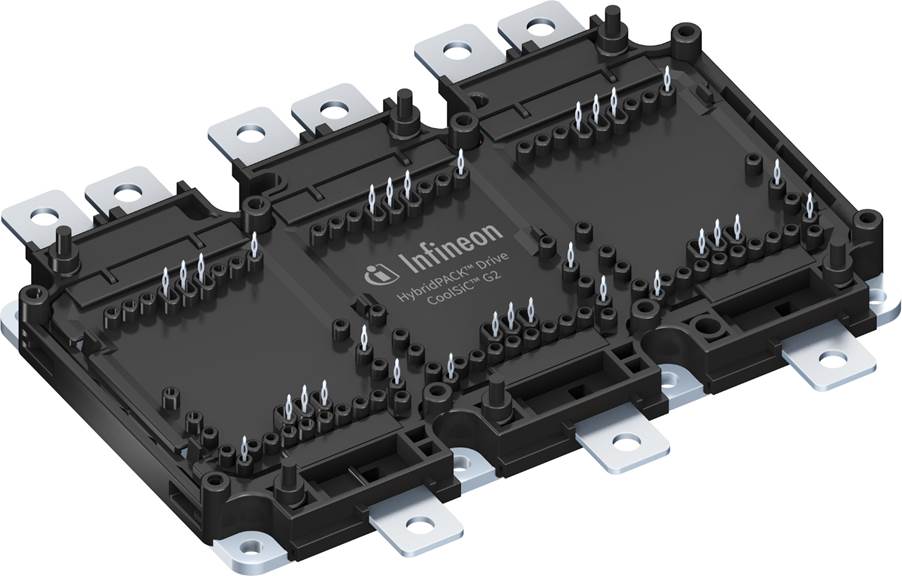
Infineon’s 1300 V SiC power module with 205°C operating temperature
Extending Junction Temperature to 205°C for Higher Output Current
Raising the allowable operating junction temperature to 205°C has direct implications for current capability and thermal design. Infineon reports that the additional temperature headroom can translate to roughly a 15% increase in output current over comparable modules operated at traditional limits, enabling higher peak and continuous inverter power without growing the power stage.
Because the package, footprint, and interfaces are maintained, the device can serve as a drop‑in replacement in existing HybridPACK Drive‑based platforms, minimizing redesign risk and validation time while lifting the power ceiling. For new designs, the higher temperature rating can be traded for smaller heat sinks, reduced coolant flow, or less complex cold‑plate designs, with potential benefits in system cost, vehicle weight, and efficiency.
Operating power modules near 200°C pushes packaging, interconnects, and encapsulants into regimes where material selection and thermomechanical robustness dominate lifetime. While Infineon’s release does not detail construction changes, the product page references a new plastic material, a direct‑cooled pin‑fin baseplate, and PressFIT terminals—choices aligned with managing high‑temperature operation and cyclic stresses in automotive duty cycles.
An integrated temperature‑sensing diode supports active thermal management and fault strategies when inverters are pushed harder thermally. The device’s insulation is specified at 4.2 kV DC for 1 second, addressing creepage/clearance and isolation needs in high‑voltage drivetrains.
1300 V Blocking Voltage for >900 V Battery Architectures
Beyond the temperature extension, the module’s 1300 V rating is intended to increase margin in inverters serving battery systems above 900 V nominal. Higher DC bus voltages allow lower phase currents for the same power, easing copper losses and potentially improving inverter and motor efficiency. A 1300 V ceiling also widens transient headroom for overshoot, ringing, and regenerative events—useful in platforms that operate close to 1000 V during fast charging or at cold temperatures.
Infineon indicates it will extend the 205°C capability across its existing 1200 V SiC portfolio within the HybridPACK Drive line, but this 1300 V variant is the first to combine the higher temperature rating with the elevated blocking voltage in the series.
At the device level, the FS01M9R13A7MA2B implements a six‑switch “B6” bridge in a HybridPACK Drive G2 housing, using second‑generation CoolSiC automotive MOSFETs. The parametrics on the product page list a 1300 V VCES and a 390 A current class for the compact six‑pack configuration, positioning it for mid‑ to high‑power passenger EVs as well as heavy commercial, construction, and agricultural vehicles where thermal cycling and load peaks are severe.
The module integrates guide elements to simplify PCB and cooler assembly in production, and the pin‑fin baseplate is intended for direct liquid cooling to support high heat flux. PressFIT pins can shorten assembly steps and avoid wave solder constraints in automotive manufacturing lines.
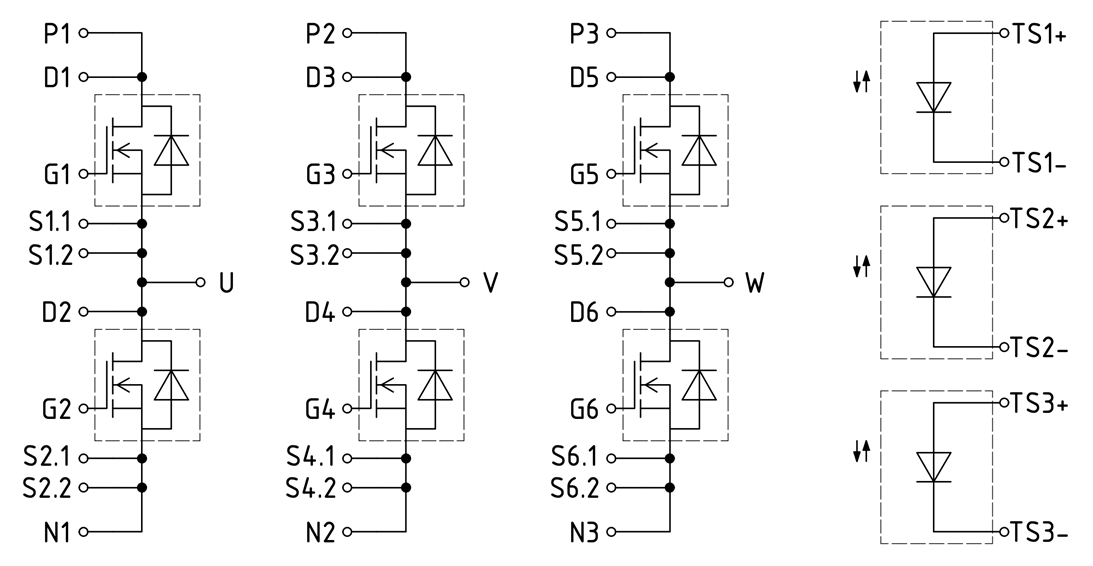
FS01M9R13A7MA2B implements a six‑switch bridge in a HybridPACK Drive G2 Hosing
Packaging Compatibility to Accelerate Platform Upgrades
One of the announcement’s most practical points for engineering teams is mechanical and interface continuity within the HybridPACK Drive ecosystem. Infineon emphasizes that module size, mounting pattern, and electrical interfaces remain unchanged, allowing OEMs and Tier‑1s to re‑use existing inverters, gate‑drive boards, and cooling hardware with little or no metalwork or PCB re‑spins. This can compress validation schedules, limit tooling changes, and simplify supplier qualification compared with adopting a new package family. For programs already qualified on HybridPACK Drive G2 footprints, the path to higher power or reduced cooling overhead becomes primarily a thermal‑budget and calibration exercise rather than a full redesign.
The thermal ramifications are noteworthy. If engineers opt to hold inverter output constant, the elevated Tj,op relaxes heat‑sink performance requirements—potentially enabling smaller cold plates, lower coolant flow rates, or higher permissible coolant outlet temperatures. Each of these levers can yield incremental system‑level gains: reduced pump power, lighter radiators, or better packaging flexibility. Conversely, if the cooling stack is fixed, designers can reclaim headroom for higher phase currents and transient overloads before crossing thermal limits.
In both cases, accurate junction‑to‑coolant thermal models and robust derating strategies remain essential, especially when ambient and coolant temperatures spike during towing, hill climbs, or high‑speed driving.
Engineering Considerations for High‑Temperature SiC Operation
Running closer to 200°C does not remove the need to manage thermomechanical fatigue. Lifetime at the interconnects, substrate, and case is governed by temperature swings and gradients as much as by absolute temperature. Designers will want to pair higher operating limits with strategies that moderate ΔT, such as adaptive coolant control, torque‑based thermal limits, and switching‑frequency adjustments under elevated load. Gate‑drive tuning also deserves attention: as SiC devices switch faster and bus voltages rise, dv/dt containment, common‑mode emissions, and Miller immunity must be balanced against switching‑loss targets. The module’s integrated temperature sensor can support these controls, but achieving the promised power‑density benefits still depends on system‑level integration.
From a safety and compliance standpoint, the 4.2 kV DC/1 s isolation rating and the six‑pack topology fit mainstream traction architectures, including ASIL‑oriented inverter controllers with isolated gate drivers and reinforced shunt or flux‑gate current sensing. The 1300 V class aligns with insulation coordination for 1000 V systems, while still leaving device‑level margin for transients and worst‑case charge states.
For platforms exploring silicon‑carbide across the drivetrain, maintaining a common mechanical interface across voltage and current classes reduces SKU proliferation and simplifies serviceability.
|
Electrical Features |
Mechanical Features |
|
|
In sum, Infineon’s 1300 V HybridPACK Drive SiC module shifts the thermal and voltage envelope for EV inverters while preserving mechanical continuity, giving EV programs a pragmatic path to higher power or simpler cooling with minimal disruption.