Automotive Mechanics
Workshop Practices
-
Question 1
Outline a number of basic servicing procedures.
Reveal answerBasic servicing procedures can include:
- measuring,
- dismantling,
- cleaning,
- inspecting,
- replacing,
- reassembling,
- installing,
- adjusting,
- lubricating and
- diagnosing
-
Question 2
If you were to install something, what might you be doing?
Reveal answerIn the automotive industry, the term installing refers to the fitment or replacement of a part or component. Special tools are sometimes needed to install parts such as oil seals and bearings.
-
Question 3
What is the difference between serviceable and unserviceable?
Reveal answerServiceable components are parts that remain within the manufacturer’s specified limits for wear, damage, and performance, making them suitable for continued use. Unserviceable components are worn, damaged, or defective beyond acceptable limits and must be repaired or replaced to ensure safe and reliable vehicle operation.
-
Question 4
What are specifications and how do they apply to automotive workshop practices?
Reveal answerSpecifications are the measurements, tolerances, clearances, torque settings, wear limits, and adjustment values provided by the vehicle manufacturer. Technicians use these specifications when inspecting, repairing, and assembling components to determine whether parts can be reused, adjusted, repaired, or must be replaced.
-
Question 5
What does it mean to diagnose a fault in a vehicle?
Reveal answerDiagnosing is the systematic process of identifying the cause of a problem by performing inspections, tests, and measurements. By following a logical sequence of checks, a technician can isolate the fault, determine its root cause, and recommend the appropriate repair.
-
Question 6
If a part requires machining, what needs to be done to it?
Reveal answerMachining involves removing a controlled amount of material from a component using machine tools such as lathes, milling machines, grinders, or drills. This process is used to restore worn surfaces, achieve precise dimensions, improve surface finish, or prepare a component for reuse.
-
Question 7
What is a casting?
Reveal answerCasting is a process where molten metal is poured into a shaped mould made of sand or metal. It is typically a production process for large parts, such as an engine block, cylinder head and transmission housings.
-
Question 8
What is an extrusion?
Reveal answerThis is a process of forcing metals such as aluminium or plastic through a shaped die. When the material emerges, it has the same shape as the die opening. Moulded plastic and aluminium strips are made by this method.
-
Question 9
What process might be used to produce a body panel?
Reveal answerPressing is used for body panels that are produced from sheet steel or, in some cases, sheet aluminium. This is done with large presses which press the metal between dies. Pressing operations can include shaping, folding, bending and hole punching.
-
Question 10
Explain four common methods of welding.
Reveal answerArc welding. A process where metals are welded using heat generated from an electric arc. This is the most basic type of welding.
TIG welding. Tungsten inert gas (TIG) uses a tungsten electrode to create the weld. This type of welding can produce a high-quality finish.
MIG welding. Metal inert gas (MIG) uses a combination of Argoshield gas and a seamless wire electrode to create a weld.
Gas welding. A flame is created using a combination of oxygen and acetylene gas and is used to weld and cut metals.
-
Question 11
Explain the basic safety precautions required when welding.
Reveal answerWhile using welding equipment or observing welding tasks, it is vitally important to wear appropriate personal protective equipment (PPE). Welding produces rays that damage eyes and burn skin. Safety glasses, welding shields, leather aprons, leather gloves, welding caps and flame-resistant cotton clothing that covers the entire body should be worn to prevent injury.
-
Question 12
What is a forging?
Reveal answerForging is a process where metal (usually steel) is heated until it is white-hot and then hammered to shape. Front axles on trucks are an example of what is called a large forging; open-ended spanners are an example of a small forging.
-
Question 13
Outline a range of locking devices and explain where each is used.
Reveal answerLocking devices are used to prevent fasteners from loosening due to vibration, shock, or repeated loading. Common examples include:
- Lock washers (spring washers): Used with bolts and screws, often in body and chassis assemblies, to maintain tension and resist loosening.
- Lock nuts (nyloc or prevailing torque nuts): Commonly used on suspension components and shock absorber mounts where vibration is present.
- Thread-locking compounds: Applied to threaded fasteners such as brake caliper bolts and engine fasteners to secure them against loosening.
- Snap rings: Used to retain bearings, gears, and other components within housings, particularly in transmissions.
- Circlips: Installed in grooves to retain components such as piston pins, shafts, and bearings.
- Tab washers: Used in steering, suspension, and drivetrain assemblies, where tabs are bent against a nut or bolt to lock it in place.
- Locking wire (safety wire): Commonly used on critical fasteners such as flywheel bolts and in motorsport or aviation applications to prevent accidental loosening.
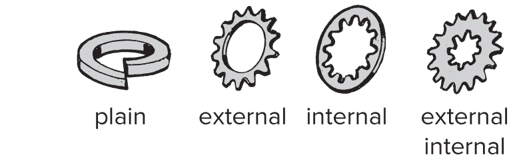
Lock Washers
-
Question 14
What is a spline?
Reveal answerSplines are external grooves cut into a shaft that mesh with the internal grooves of another mating shaft. A parallel spline allows a shaft to slide, accommodating variations in shaft length. A tapered spline ensures that all parts are held firmly together.
-
Question 15
What is a snap ring?
Reveal answerThese are internal or external rings of spring steel that spring or snap into place when installed. Smaller rings, often called circlips, are made of round wire; larger snap rings are usually flat.
External snap rings are used on shafts to hold bearings, gears or collars in place. They fit into a groove in a shaft and are expanded with special circlip pliers when being installed or removed.
Internal snap rings are used within the grooves that are machined into housings that retain bearings or other parts. They have to be contracted when being installed or removed so that they can fit inside the housing and then be fitted into the groove.
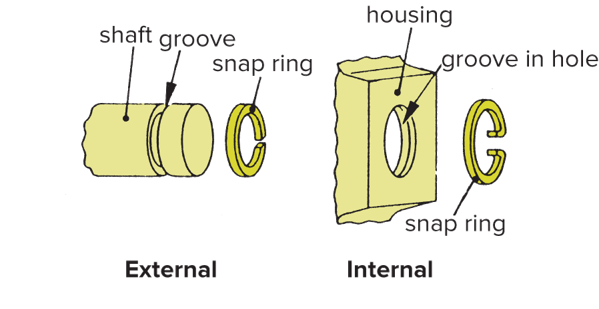
External and Internal Snap Rings
-
Question 16
Explain the four basic thread forms and what they refer to.
Reveal answerThere are four common screw thread forms. Their names relate to the shape of their particular thread section.
V-thread. This is the most common, and is used for bolts, nuts and other fastenings. It is easily produced in the workshop by using taps and dies.
Square thread. Rugged in design, this is used for screw jacks, vices, clamps and similar tools.
Acme thread. This is used particularly on lathe lead screws. The sloping sides of the thread allow the half-nuts, which are used as a form of clutch, to be easily opened and closed on the thread.
Buttress thread. Where there is a thrust against the screw in one direction only, a buttress thread can be used. Some vice threads and clamp threads are of this type.
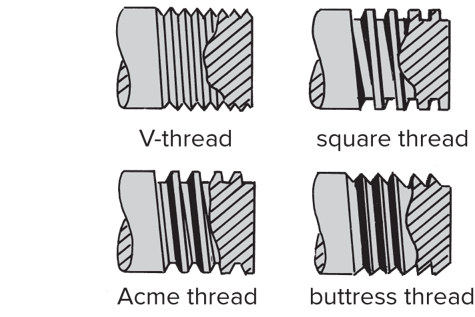
Four common Screw Thread Forms
-
Question 17
What is the pitch of a thread?
Reveal answerPitch is the distance from a point on the crest of one thread to a corresponding point on the crest of the next thread.
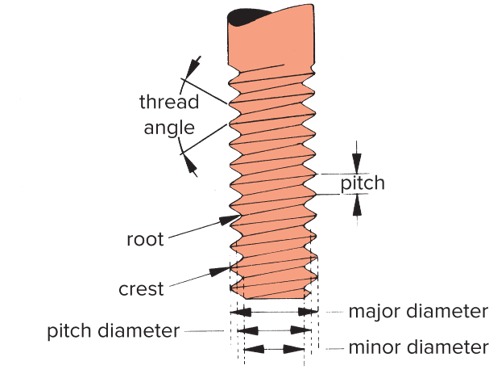
Pitch of a Thread
-
Question 18
Illustrate the different production processes used to manufacture automotive parts.
Reveal answer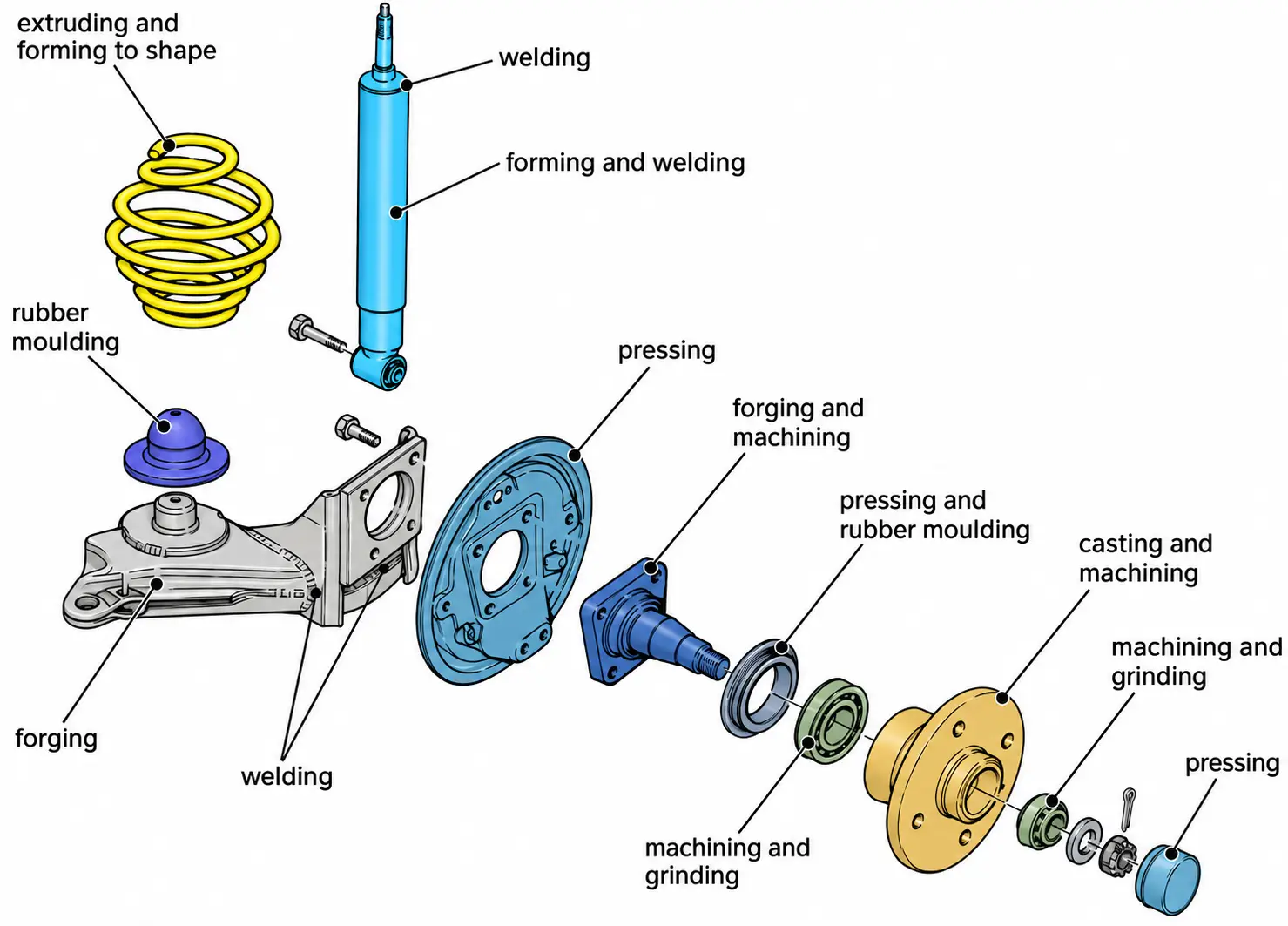
Part of a rear suspension showing the manufacturing processes that produce the various parts
