Electric Motor Control
Control Pilot Devices
-
Question 1
What is meant by normally open contacts and normally closed contacts?
Reveal answer“Normally open” or “normally closed” refers to the position of the contacts at a rest position, held there by spring tension, and is not subject to either electrical or mechanical forces.
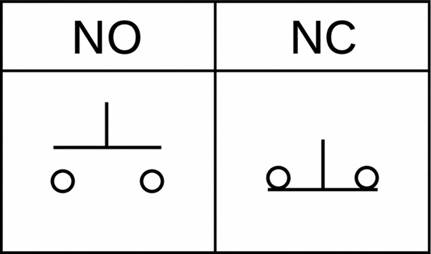
Normally Open and Normally Closed Contacts
-
Question 2
Why is it that normally open and normally closed contacts cannot be closed simultaneously?
Reveal answerThey cannot be closed simultaneously because the movable contact is common to both the normally open and normally closed conditions; therefore, to make the open contact circuit the movable contact moves away from the closed position contact.
-
Question 3
How are colored pilot lights indicated in wiring diagrams?
Reveal answerColor pilot lights are identified by a letter within the circle of the symbol for the pilot light;
R = red, G = green.
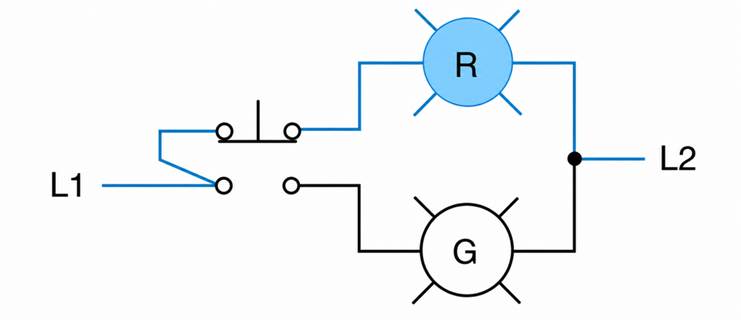
Control Pilot Lights are Identified by a letter within the circle
-
Question 4
What are control relays?
Reveal answerControl relays are small magnetic switches used on simple branch circuits to control complex wiring system operations.
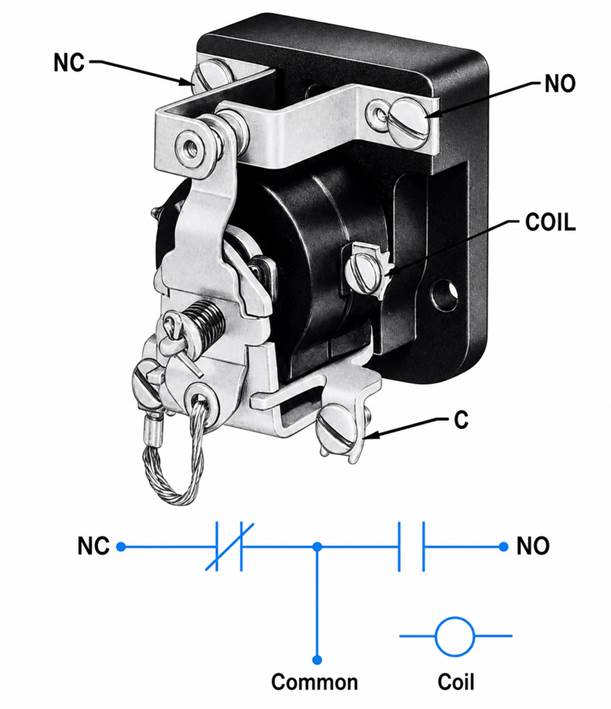
Single-pole, double-throw, single-break AC general-purpose control relay with wiring symbols.
-
Question 5
What are typical uses for control relays?
Reveal answerControl relays are used for the control of large motor starter and contactor coils and the switching of solenoids, other relays, and loads such as electric heaters, lighting, and audible signal devices.
-
Question 6
What are the advantages of a mechanically held relay?
Reveal answerA mechanically held relay is absolutely quiet in operation; current is not continually applied to the coils of the relay, thus conserving energy; circuit continuity is maintained during a power failure, and the relay need not be reset when the power returns.
-
Question 7
Why are mechanically held relays energy-saving devices?
Reveal answerThe coils are energized only momentarily and not continuously.
-
Question 8
Which device is used to connect the load to the line in a solid-state relay intended to control a DC load?
Reveal answerA power transistor
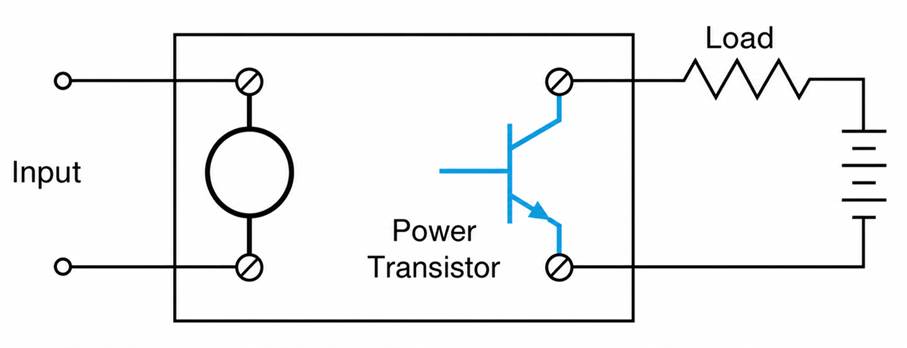
A power transistor is used to connect a DC load to the line.
-
Question 9
Which device is used to connect the load to the line in a solid-state relay intended to control an AC load?
Reveal answerA triac
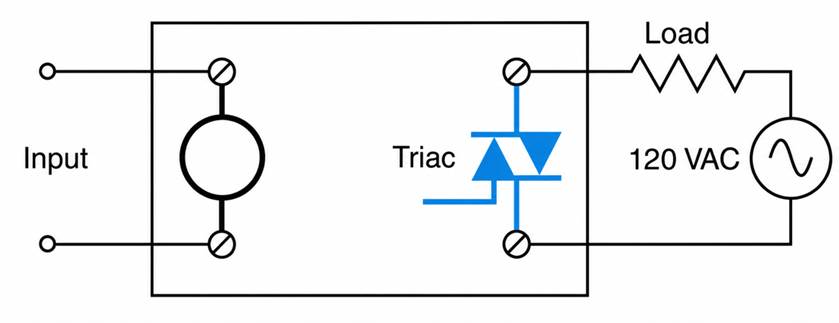
A solid-state relay intended to connect an AC load to the line uses a triac.
-
Question 10
What is optoisolation?
Reveal answerThe load side of the circuit is separated from the control side by a light beam.
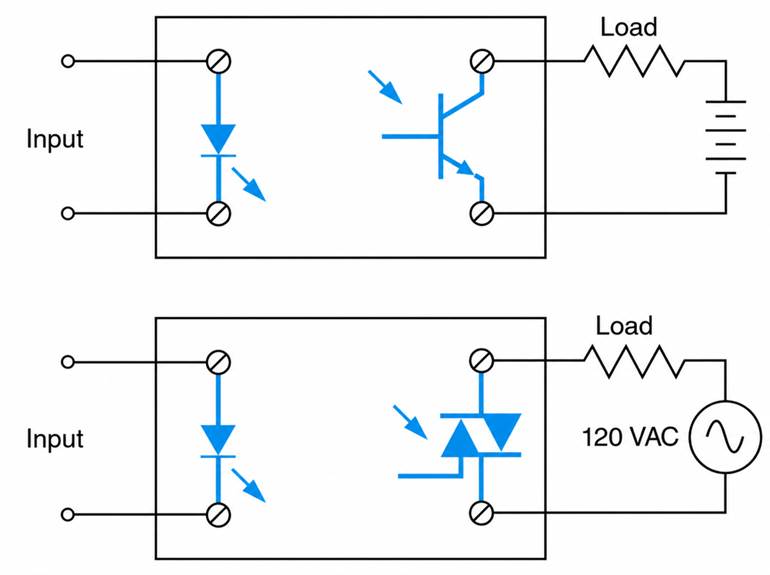
Optoisolation uses a light-emitting diode (LED) to control a phototransistor or phototriac.
-
Question 11
What type of device is used to suppress voltage spikes in relay circuits?
Reveal answerThe transient suppressor is a solid-state device called a metal oxide varistor (M.O.V.). The M.O.V. is basically a voltage-sensitive resistor.
- As long as the voltage remains below a certain point, the M.O.V. exhibits a very high resistance in the range of several hundred thousand ohms.
- When the voltage reaches a certain point, the M.O.V. suddenly drops to a very low value of resistance, acting almost like a short circuit. This change in resistance occurs rapidly, generally in the range of 3 to 5 nanoseconds, preventing the voltage spike from going any higher.
The energy in the spike is dissipated as heat by the M.O.V. The M.O.V. will have a voltage rating slightly higher than the circuit voltage.
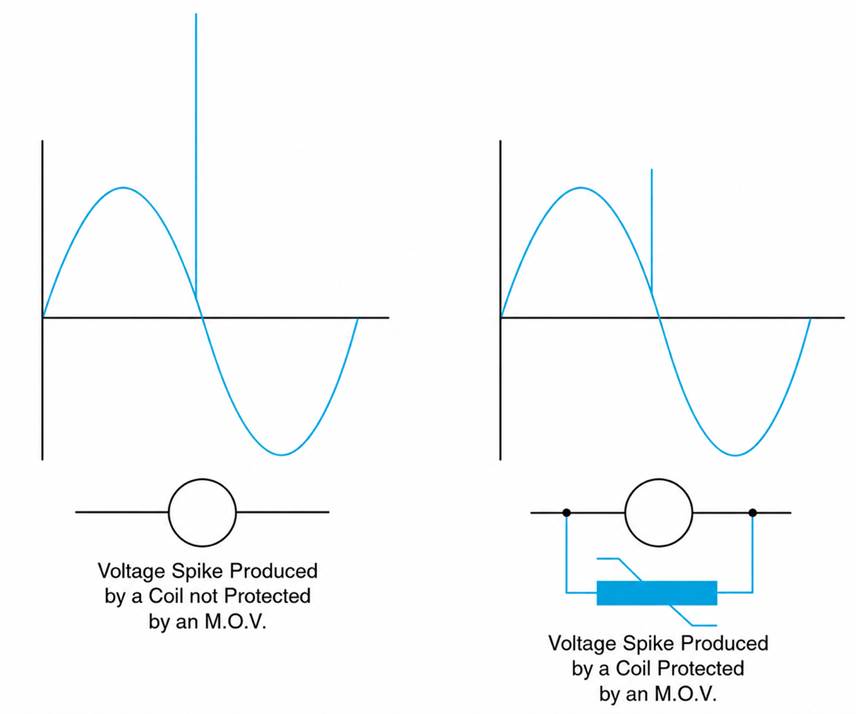
The M.O.V. prevents the voltage spike from rising above a certain point.
-
Question 12
Why are contactors described as both control pilot devices and large magnetic switches controlled by pilot devices?
Reveal answerBecause of the range in sizes available, small contactors may be used as control devices for
larger controls, while large contactors can control heavy currents where overload protection
is unnecessary or provided separately. Large contactors may be controlled by relays.
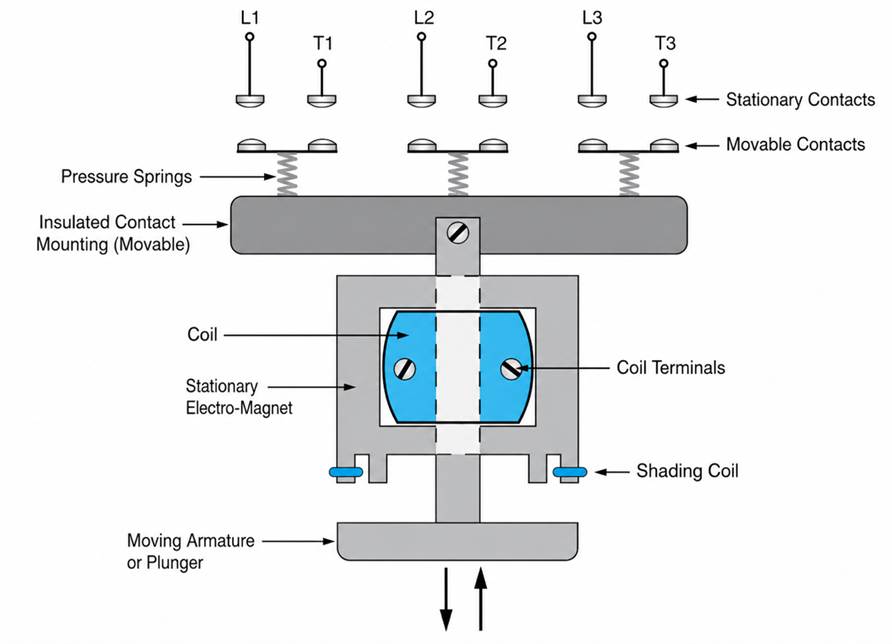
Three-pole, solenoid-operated magnetic switch contactor.
-
Question 13
What is the principal difference between a contactor and a motor starter?
Reveal answerA motor starter contains overload relays; a contactor does not.
-
Question 14
What causes the arc to move upward in a blowout magnet?
Reveal answerThe motor action established by the magnetic fields of the blowout coil and the arc plus the use of arc deflectors or arcing horns cause the arc to lengthen and move upward.
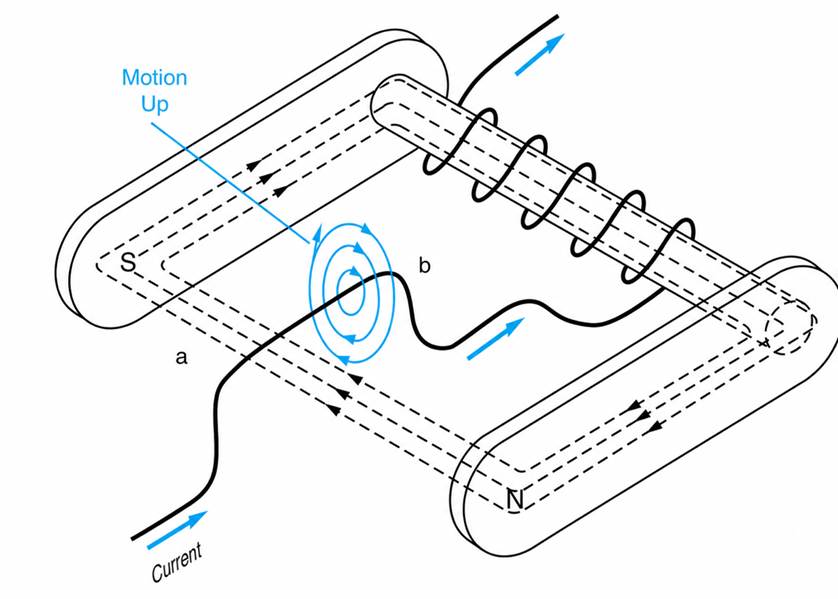 Illustration of the magnetic blowout principle. Straight conductor simulates arc.
-
Question 15
List several applications for a motor-driven timer.
Reveal answerWhen a process has definite on and off or has a sequence of successive operations, a motor driven timer is used. For example, automatic clothes washers use this type of timing relay. These relays are also used where infrequent starting of large motors is required.
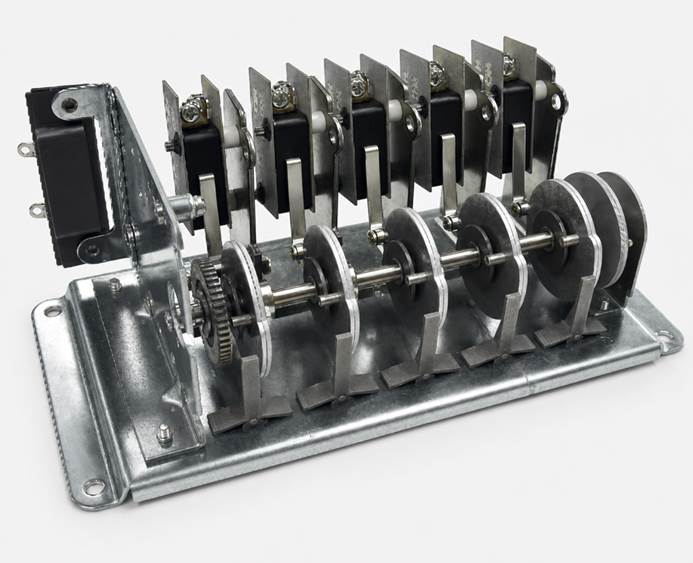
Motor-driven process timer. Often referred to as a cam timer.
-
Question 16
Which timer is the most commonly used in industrial applications?
Reveal answerThe construction and performance features of the pneumatic (air) timer make it suitable for the majority of industrial applications. Pneumatic timers have the following characteristics:
- unaffected by normal variations in ambient temperature or atmospheric pressure
- adjustable over a wide range of timing periods
- good repeat accuracy
- available with a variety of contact and timing arrangements
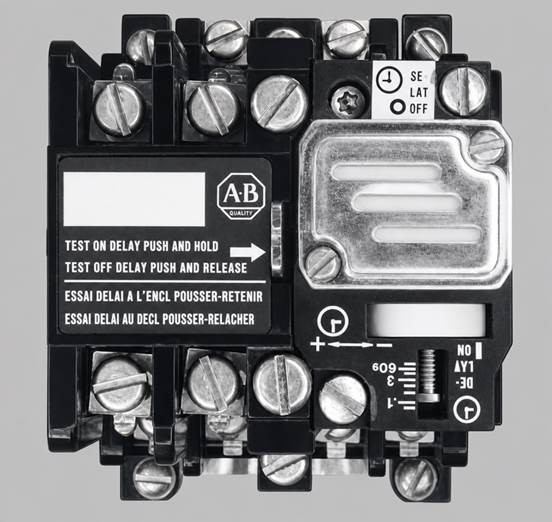
Pneumatic timer attachment
-
Question 17
List six factors to be considered when selecting a timing relay for a particular use.
Reveal answer- Length of time delay required
- Timing range required
- Allowable error
- Cycle of operation and reset time
- Cost
- Additional requirements (electrical ratings, size, temperature)
-
Question 18
What type of pressure switch is generally used to sense small changes in low- pressure systems?
Reveal answerDiaphragm-actuated switch can be used when a sensitive response is required to small pressure changes at low-pressure ranges.
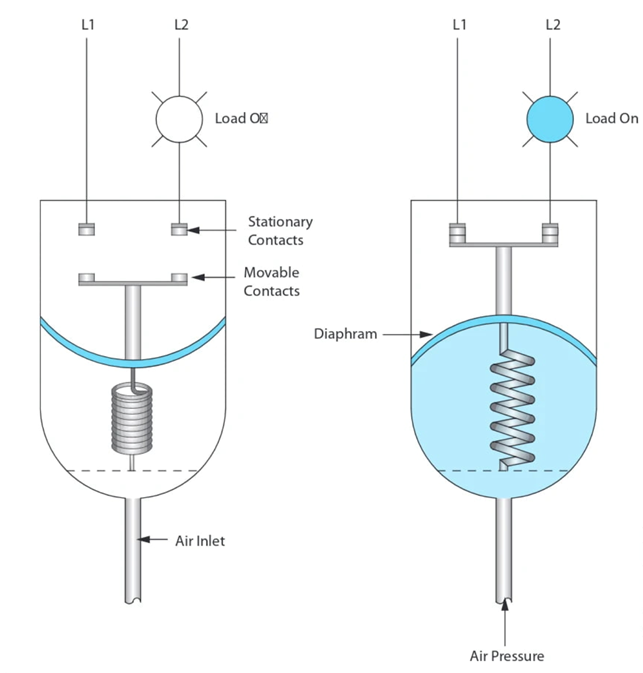
Diaphragm-Type Pressure Switch
-
Question 19
On what principle does an inductive proximity sensing unit work?
Reveal answerInductive proximity switches operate on the eddy current principle. When a metal object moves into the electromagnetic field of the sensing head, eddy currents are induced in the object. This causes a change in the loading of the oscillator (electronics producing the field), which then operates the output device.
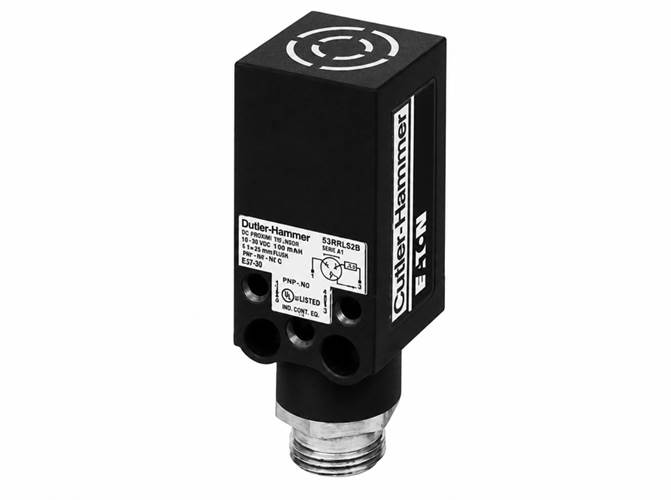
Compact inductive proximity sensor with pin base connector.
-
Question 20
What is the advantage of a photodiode in a photodetector?
Reveal answerPhotodetectors basically consist of a light source and a light detector. The light source is generally a long-life incandescent lamp or LED and the light detector can be a photodiode or a photoconductive device called a cad cell. Photodiodes are used if high-speed operation is an important factor.
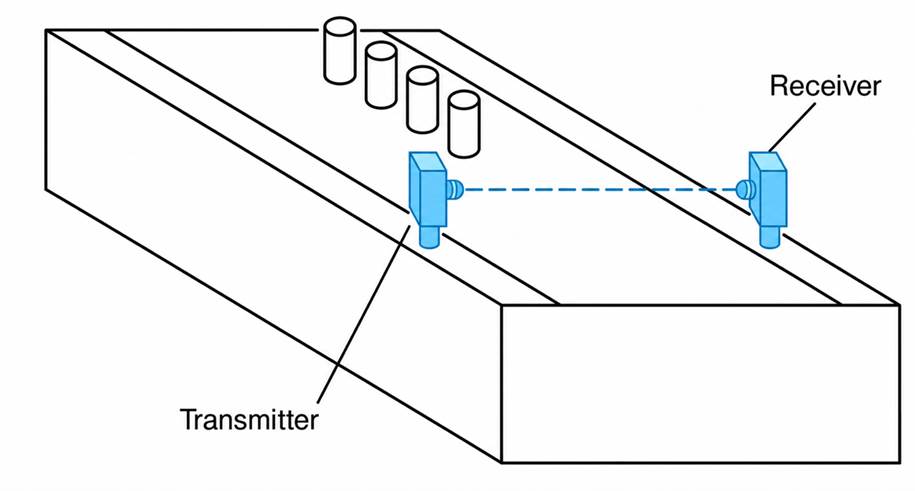
Photodetector with separate transmitter and receiver.
-
Question 21
Hall effect sensors do not depend on electromagnetic induction to operate. Explain how they can sense the presence of a magnetic field if induction is not involved.
Reveal answerThey cause the current path through a piece of semiconductor material to bend when exposed to a magnetic field. This produces a voltage difference across the semiconductor material.
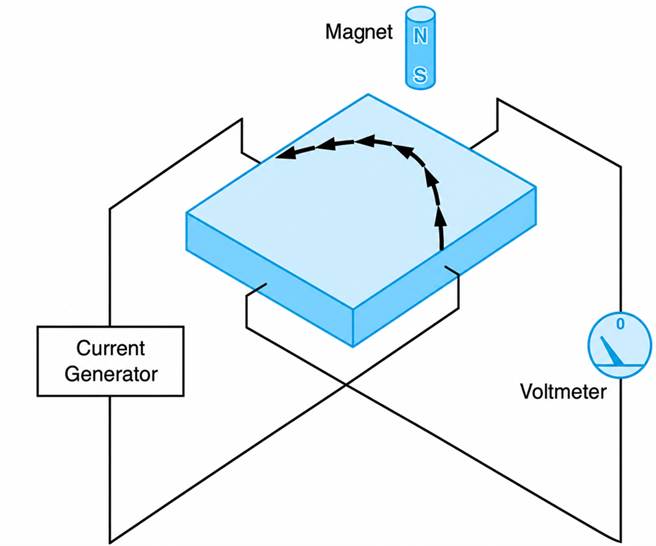
A magnetic field causes the current path to bend.
-
Question 22
How do ultrasonic proximity detectors operate?
Reveal answerThe ultrasonic detector emits a high-frequency sound wave and then detects the echo when it bounces off the object. These detectors can accurately calculate the distance to an object by measuring the time delay between pulse emission and pulse return. For this reason ultrasonic detectors are often used to position objects.
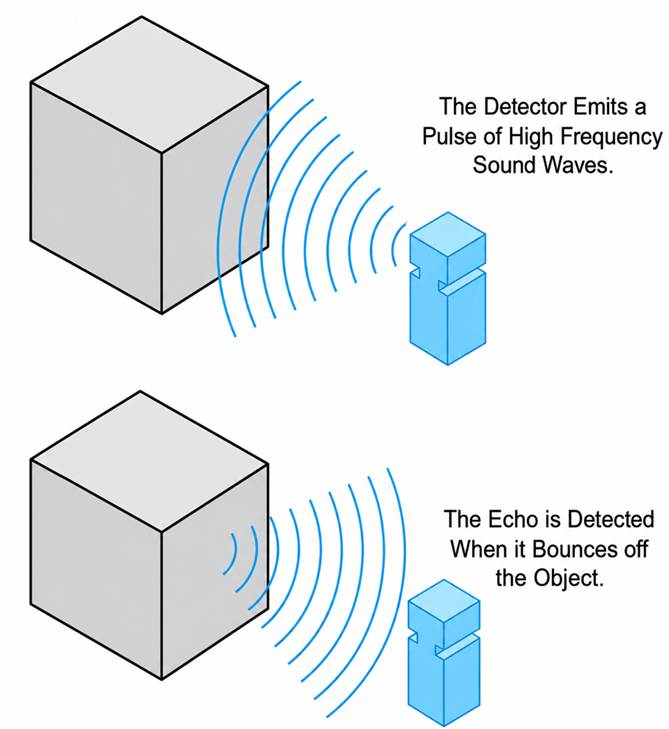
Ultrasonic detectors operate by emitting high-frequency sound waves.
-
Question 23
What two factors determine the amount of voltage produced by a thermocouple?
Reveal answerThe amount of voltage produced by a thermocouple is determined by the following:
- The type of materials used to make the thermocouple
- The temperature difference of the two junctions
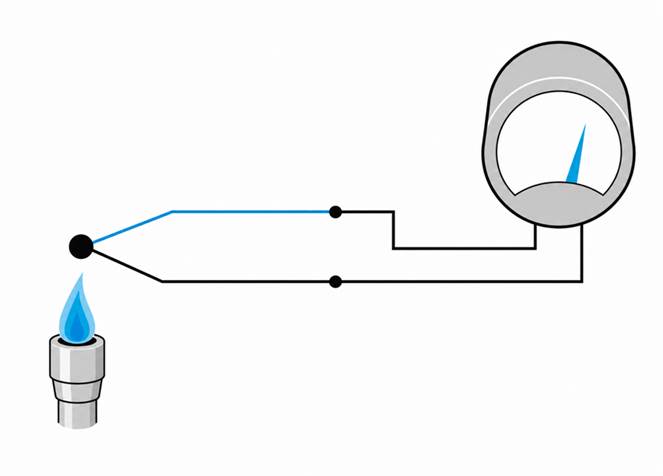
A thermocouple produces a voltage when heated.
-
Question 24
What is a thermopile?
Reveal answerBecause the voltage of thermocouples is so low, they are often connected in series, as shown in Figure. This connection is referred to as a thermopile. Thermocouples and thermopiles are often used for making temperature measurements, and are also used to detect the presence of a pilot light in devices that operate on natural gas.
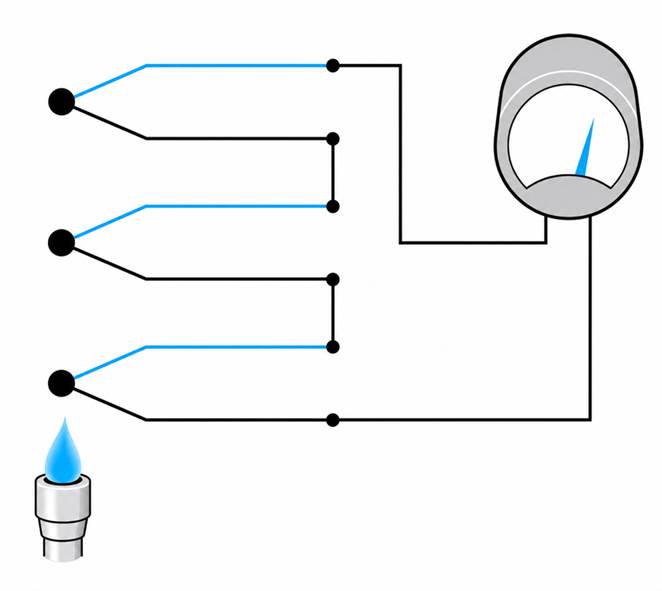
Thermopile
-
Question 25
Why are thermistors often used as solid-state starting relays?
Reveal answerBecause of thermistors’ ability to change their resistance rapidly with a change of temperature, they are commonly used as solid-state starting relays. Hermetically sealed compressors often use them to disconnect the start windings of a motor when it reaches about 75% of its rated speed.
-
Question 26
What type of chemical is used to cause a pressure change in a bellows-type thermostat?
Reveal answerRefrigerants confined in a sealed container increase their pressure with an increase in temperature. If a bellows is connected to a line containing refrigerant, the bellows will expand as the pressure inside the sealed system increases. When the surrounding air temperature decreases, the pressure inside the system will decrease and the bellows will contract.
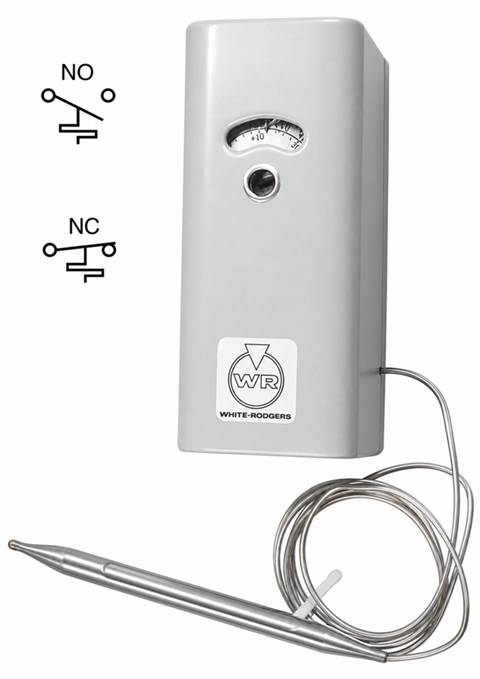
A bellows-type thermostat and the standard NEMA symbols used to represent a temperature-operated switch
