Electric Motor Control
Basic Control Circuits
-
Question 1
What are some advantages of the use of two-wire control devices?
Reveal answerAutomatic controls may be used to control a motor or an operation without requiring the Presence of an operator. For example, if the power fails, the motor will restart if the contacts of the two-wire control device are closed when the power is restored.
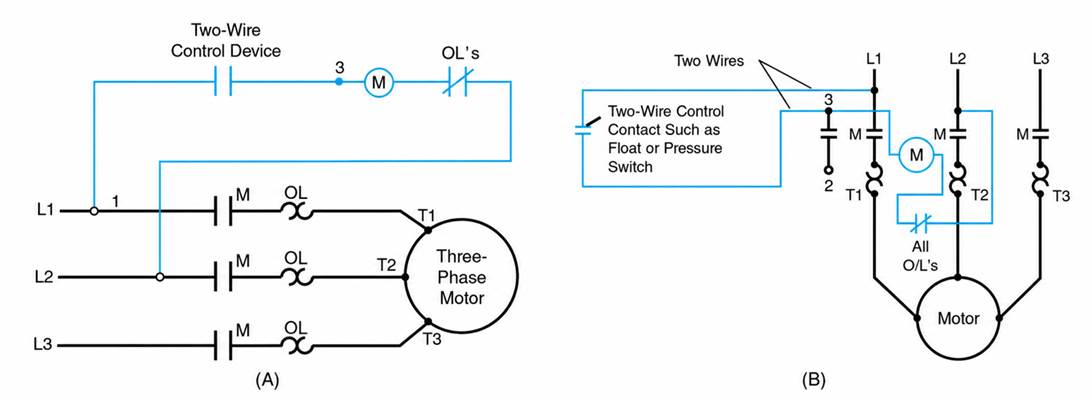
(A) Basic two-wire control circuit—elementary diagram. (B) Basic two-wire control circuit—wiring diagram.
-
Question 2
How many wires are required for a two-wire control device?
Reveal answerTwo wires are required for the device. One wire carries the control signal to the device, while the second wire provides the return path, allowing the control circuit to operate properly.
-
Question 3
What is an intrinsically safe system?
Reveal answerIntrinsically safe systems cannot supply enough energy to ignite the atmosphere in a hazardous location. The NEC permits the use of intrinsically safe systems in areas that contain hazardous vapors. These systems are much more cost effective than installing explosion proof fixtures.
-
Question 4
What is the most common control voltage used in an intrinsically safe system?
Reveal answer24 volts is the most common control voltage used in intrinsically safe systems. This low voltage helps minimize the risk of sparks or excessive heat, making it suitable for hazardous locations where flammable gases or vapors may be present.
-
Question 5
A selector switch and two-wire pilot device cannot be used to control a large motor directly but rather must be connected to a magnetic starter. Explain why this is true.
Reveal answerA selector switch and the automatic pilot device can control a motor directly if their contacts are large enough to pass safely the full-load current of the motor. However, the contact capacity of these devices is usually not large enough for large motors.
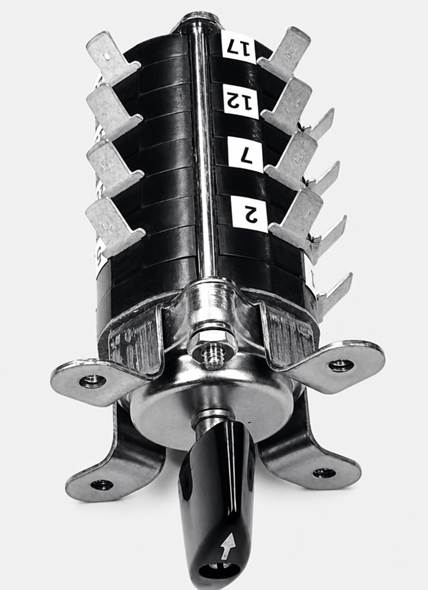
Selector switch with multiple contacts.
-
Question 6
How is a change in the direction of rotation of a three-phase motor accomplished?
Reveal answerThe direction of rotation of three-phase motors can be reversed by interchanging any two-motor leads to the line. If magnetic control devices are to be used, then reversing starters accomplish the reversal of the motor direction. Reversing starters wired to NEMA standards interchange lines L1 and L3.
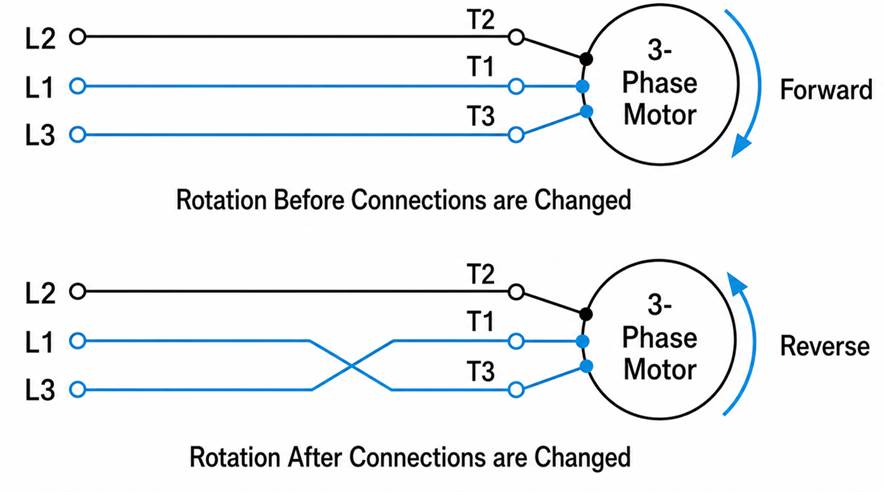
Reversing rotation of an induction motor.
-
Question 7
What is the purpose of interlocking?
Reveal answerThe purpose of interlocking is to prevent contactors from being energized simultaneously or closing together; in this way short circuits are avoided. There are three basic methods of interlocking.
- Mechanical Interlock
- Push-Button Interlock
- Auxiliary Contact Interlock
-
Question 8
How is auxiliary contact interlocking achieved on a reversing starter?
Reveal answerInterlocking is obtained by normally closed auxiliary contacts on the forward and reverse contactors of the starter. When the motor is running forward, a normally closed contact (F) on the forward con-tactor opens and prevents the reverse contactor from being energized by mistake and by closing. The same operation occurs if the motor is running in reverse.
-
Question 9
If pilot lights are to indicate which coil is energized, where should they be connected? Additional auxiliary contacts are not to be used.
Reveal answerThe “forward” indicating light should be connected in parallel with the “forward” coil (across the coil) to receive full voltage when the coil is energized. The “reverse” light should be connected in a similar manner to the reverse coil.
-
Question 10
Describe what is meant by sequence control.
Reveal answerSequence control is the method by which starters are connected so that one cannot be started until the other is energized. This type of control is required whenever the auxiliary equipment associated with a machine, such as high-pressure lubricating and hydraulic pumps, must be operating before the machine itself can be operated safely. Another application of sequence control is in main or subassembly line conveyors.
-
Question 11
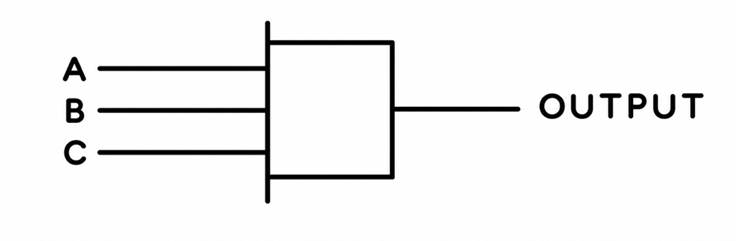
Draw a symbol for a solid-state logic element “AND.”
Reveal answerA symbol (NEMA) for a solid-state logic element “AND”
-
Question 12
What is the safety feature of a lock-stop push button?
Reveal answerA stop button of a control circuit can be padlocked in the off position; thus, it is difficult for anyone to start a machine. This procedure is similar to pulling a safety disconnect switch and locking it in the off position. Lock stops open only the control circuits and provide safety to workers who may be injured while working on a machine if it is started suddenly.
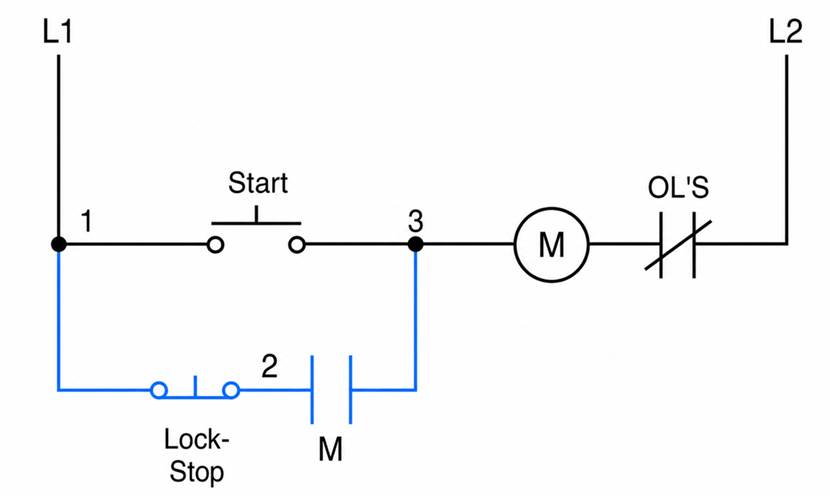
Lock-stop push button in a jogging circuit.
-
Question 13
Explain in detail the purpose of a time-delay, low-voltage release relay assembly installed in a motor control circuit.
Reveal answerA time-delay, low-voltage release relay assembly protects equipment and personnel during power interruptions.
- It prevents the motor from automatically restarting after a prolonged power failure when voltage is restored, reducing the risk of damage or unsafe conditions.
- For brief voltage dips, the relay allows the motor to reconnect to the power supply after a preset time delay, enabling normal operation without unnecessary shutdowns.
