Complex Numbers
Complex Numbers
The designation and significance of the letter J go back several centuries. At that time, mathematicians, when finding the roots of equations with negative square roots, thought that their physical interpretation was impossible or imaginary. Further studies by many mathematicians, and in particular Demoivre and Euler, demonstrated that a phasor can be represented by its polar form or rectangular form incorporating the factor j. For example, a phasor can be written as follows
$$\begin{matrix} \underbrace{r e^{j\theta} = r \angle \theta}_{\text{Polar form}}=\underbrace{r \left( \cos\theta + j \sin\theta \right)}_{\text{Rectangular form}}\ & (1.6) \end{matrix}$$
The factor r is the magnitude of the phasor. This equation can be derived by using the Maclaurin series or the exponential representation of the trigonometric functions.
Figure 1-4 illustrates the polar and rectangular form of phasors.
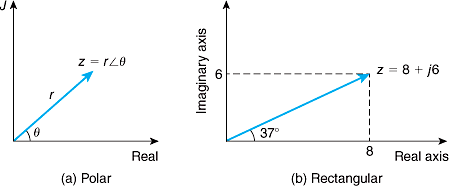
Figure 1-4 Phasors.
About j
In engineering, the coefficient j represents the component of a phasor in the y-axis, which is referred to as the imaginary axis. It is not imaginary, however. It is so designated because the x-axis is named the real axis. Some of the highlights of j are the following:
$$\begin{equation}j = \sqrt{-1}\tag{1.7}\end{equation}$$
$$\begin{equation}j = 1 \angle 90^\circ\tag{1.8}\end{equation}$$
$$\begin{equation}\textrm{If } A + jB = C + jD\tag{1.9}\end{equation}$$
Then
$$\begin{equation}A = C,\quad B = D\end{equation}$$
IV) It changes differential equations of linear systems to algebraic form. It is part of the Laplace operator(s)
$$\begin{equation}s = j\omega + \alpha\tag{1.10}\end{equation}$$
where $\alpha$ approaches zero and $\omega$ is the angular speed of the phasor in radians/second (voltage, current, etc.).
When a linear differential equation (DE) is written in terms of s (see Appendices), then you can use algebra to solve it. In general, a time-domain function has its equivalent Laplace domain representation and vice versa. These representations or transformations are available in Laplace transform tables.
Besides that, representation of a function by its equivalent Laplace equivalent reveals (as will be demonstrated in the follow-up sections) the value of the function at time equal to zero and at time equal to infinite.
Properties of Complex Numbers
When two phasors Z1 and Z2 are as follows
$$\begin{equation}Z_1 = R_1 + jX_1 = r_1 \angle \theta_1 \,\Omega\tag{1.11}\end{equation}$$
$$\begin{equation}Z_2 = R_2 + jX_2 = r_2 \angle \theta_2 \,\Omega\tag{1.12}\end{equation}$$
Then from the properties of complex numbers,
$$\begin{equation}Z_1 + Z_2 = R_1 + R_2 + j(X_1 + X_2)\,\Omega\tag{1.13}\end{equation}$$
$$\begin{equation}Z_1 Z_2 = r_1 r_2 \angle (\theta_1 + \theta_2)\,\Omega\tag{1.14}\end{equation}$$
$$\begin{equation}\frac{Z_1}{Z_2} = \frac{r_1}{r_2} \angle (\theta_1 - \theta_2)\,\Omega\tag{1.15}\end{equation}$$
The addition, multiplication, and division of complex numbers are used in many aspects of Electrical Engineering and, as such, will be used throughout this book.
Example 1-2
When $Z_1 = 3 + j4 \,\Omega$ and $Z_2 = 10 \angle -37^\circ \,\Omega$, determine $Z_1 + Z_2$, $Z_1 Z_2$ and $\frac{Z_1}{Z_2}$.
Solution
Refer to Figure 1-5.
$$Z_1 = 3 + j4 = 5 \angle 53^\circ \,\Omega,\quad Z_2 = 8 - j6 \,\Omega$$
And
$$Z_1 + Z_2 = 3 + 8 + j(4 - 6) = 11 - j2 = 11.18 \angle -10.3^\circ \,\Omega$$
$$Z_1 Z_2 = 5 \angle 53^\circ \,(10 \angle -37^\circ) = 50 \angle 16^\circ \,\Omega$$
$$\frac{Z_1}{Z_2} = \frac{5 \angle 53^\circ}{10 \angle -37^\circ} = 0.5 \angle 90^\circ = j0.5 \,\Omega$$
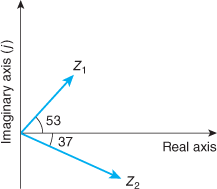
Figure 1-5 Complex phasors.
