Harmonics
Harmonics are sinusoidal waveforms whose frequency is a fraction or a multiple of the 60 Hz fundamental frequency of the generating stations (in some other parts of the world the fundamental frequency is 50 Hz).
The third harmonic (180 Hz) is of particular importance because of resonance concerns and because of its overheating effects.
The adverse effects of the harmonics are as follows:
- Increasing the device’s power losses, and thus contributing to its overheating.
- Modifying the voltage waveforms throughout the distribution network.
- Overloading the circuits.
- Can set up harmful resonant conditions.
- Inducing voltages on adjacent metallic objects that may cause the malfunction of the 5 V microprocessors.
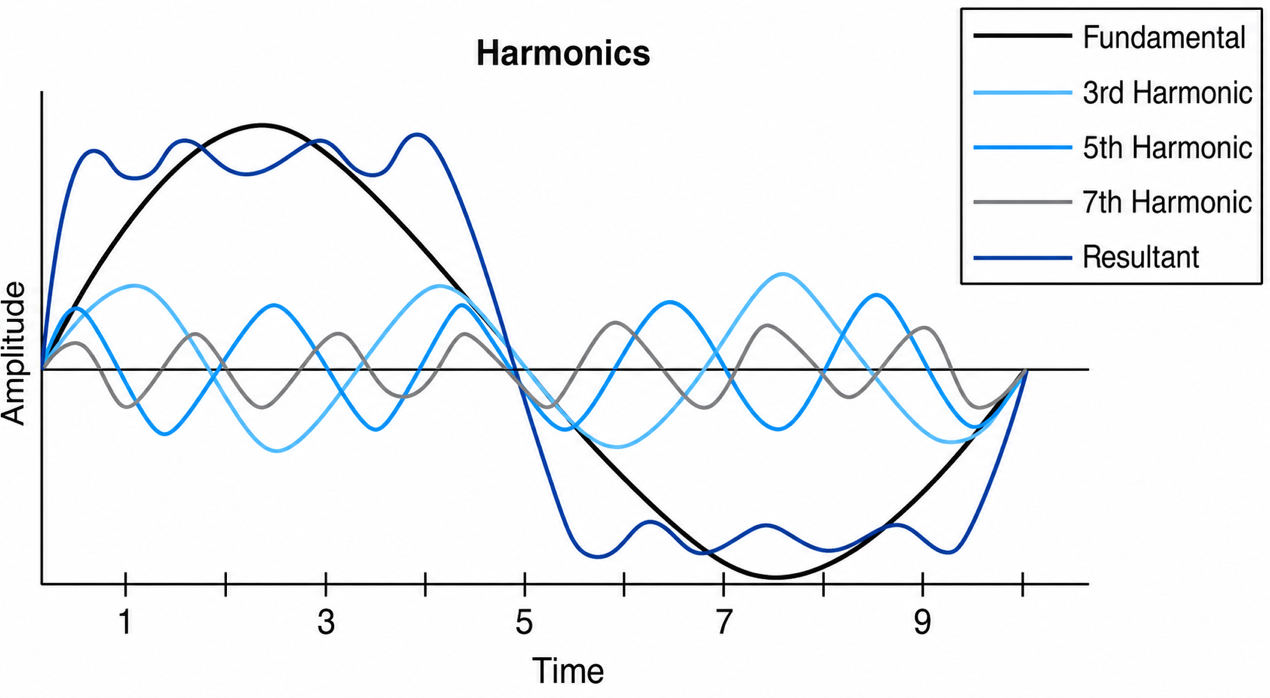
Figure 1-39 Harmonics in Power Systems
One method that can mitigate these effects is to filter them out or, where possible, prevent their development. A rather inexpensive method is to supply sensitive equipment through an isolating transformer. Harmonics could be of a transient or steady state.
Harmonics are an inherent part of power distribution systems and can be either transient or permanent.
Transient Harmonics
Any time a switch is switched ON or OFF (control of lighting, of electric heaters, etc.), the device’s current is momentarily changed, and as a result, the voltages and currents throughout the distribution system are suddenly altered in order to satisfy the basic principles of electricity. After all, the voltage in a coil depends on the slope of the current waveform ($v=L\frac{di}{dt}$) at the instant under consideration.
The supply transformer windings voltage is also altered, and the otherwise sinusoidal waveforms are momentarily distorted and thus full of harmonics. Their development is shown diagrammatically in the Ladder diagram representation (Figure 1-40).
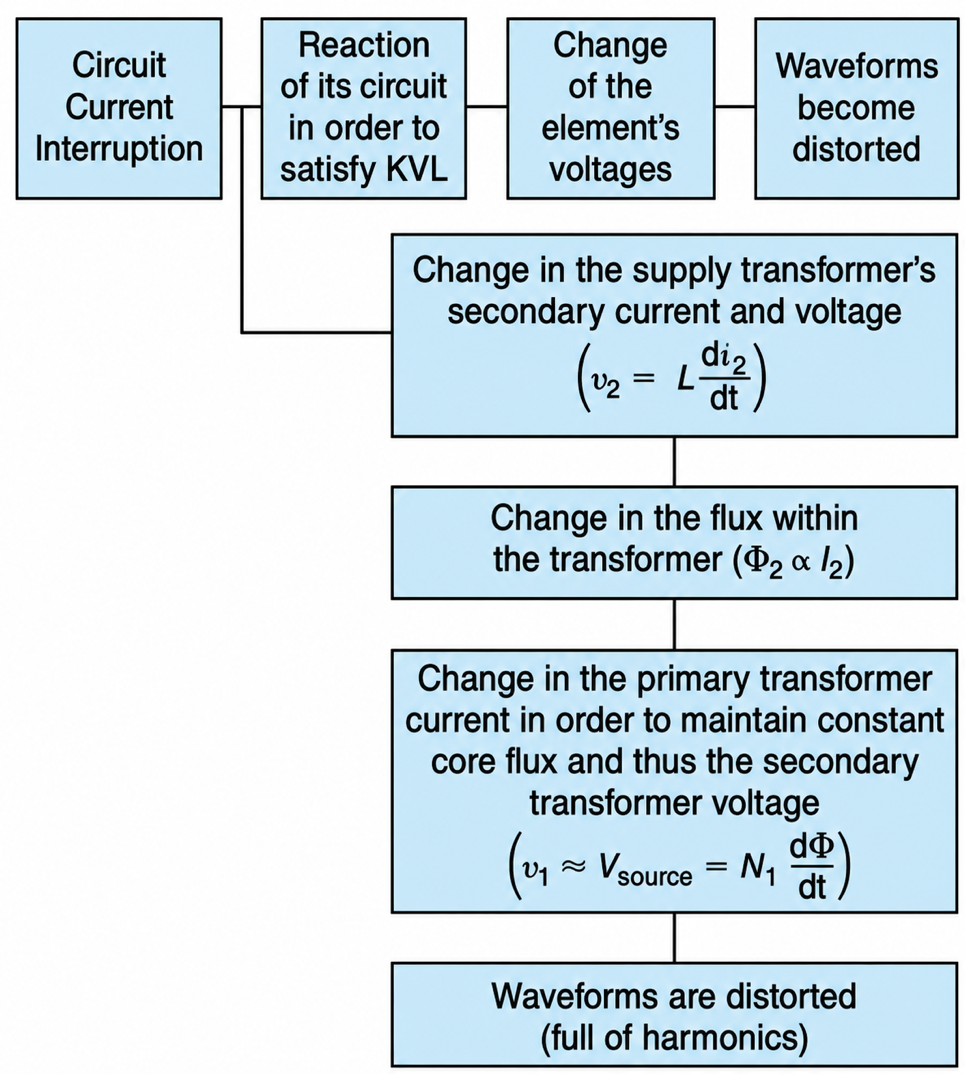
Figure 1-40 Ladder diagram representation of the generation of transient harmonics.
These phenomena are of a transient nature, and their duration, depending on the circuit’s time constant, lasts several m-sec. They are very important in understanding the operation of motors, transformers, and the like.
Steady-State Harmonics
At nominal operating conditions and in order to minimize the energy usage, the variable speed drives, high-efficiency lighting fixtures, computers, and so on, draw from their voltage supplies nonsinusoidal current waveforms. That is, at steady state, these waveforms contain many harmonics of a wide range of magnitudes and frequencies.
In the follow-up discussion, the harmonics associated with the operation of computers, variable speed drives, lighting fixtures and electric machines are briefly described.
Computerized Equipment
A typical voltage and current waveform of a computer is as shown in Figure 1-41.
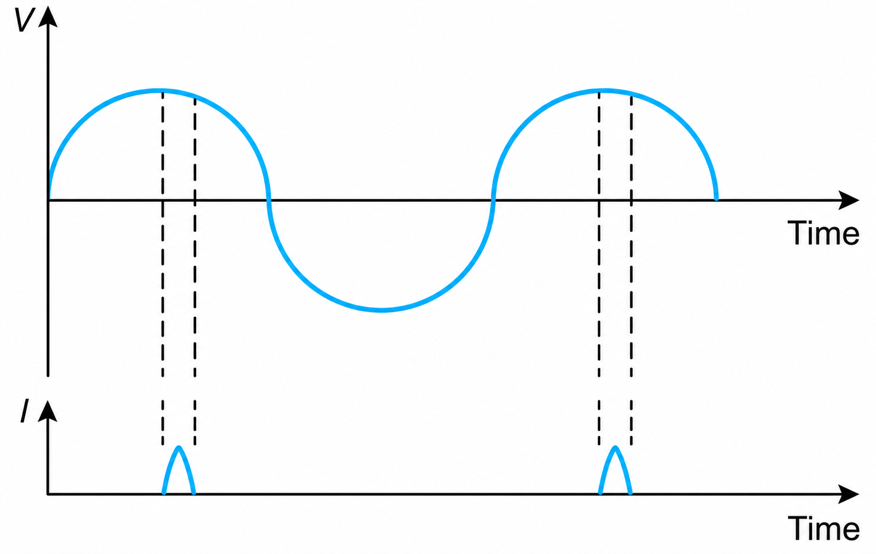
Figure 1-41 Voltage and current waveforms in a computer.
These devices incorporate an electronic switch that is timed to let current through only for a small part of the voltage cycle which minimizes the energy consumed and prevents overheating.
These current pulses $(\iota)$ can be represented, as per Fourier Series analysis, by the following equation:
$$\iota = I_{m1}\cos\omega t + I_{m2}\cos 2\omega t + I_{m3}\cos 3\omega t + \cdots + I_{mn}\cos n\omega t \ \ \ (1.89)$$
where $I_{m1}$ is the amplitude of the fundamental, $I_{m2}$ and $I_{m3}\cdots I_{mn}$ are the maximum values of the second, third, nth harmonic.
Equation (1.89) is general for the current to a nonlinear load. The total rms value of the current is
$$I=\sqrt{\left(\frac{I_{m1}}{\sqrt{2}}\right)^2+\left(\frac{I_{m2}}{\sqrt{2}}\right)^2+\left(\frac{I_{m3}}{\sqrt{2}}\right)^2+\cdots +\left(\frac{I_{mn}}{\sqrt{2}}\right)^2} \ \ \ (1.90)$$
Speed Control of Motors
In contrast to these unique current pulses, the motor’s controls incorporate circuits that develop variable width current pulses—and thus produce harmonics—that are used to vary the speed of motors.
Lighting Circuits
Older incandescent bulbs were purely resistive linear loads, meaning they drew a smooth, proportional AC current. Modern lighting fixtures, particularly LEDs and fluorescent systems with electronic ballasts, behave as nonlinear loads. During the conversion from AC to DC power, they draw current in short pulses rather than a smooth sine wave. This injects harmonic distortion (HD)—especially triplen harmonics—back into the electrical distribution system.
Table 1-2 Lighting Fixtures Harmonics and Their Frequency Range
|
Lighting Fixture |
Approximate Total Harmonic Current in Percent of the Fundamental |
Frequency of Harmonics |
|
With electromagnetic ballasts |
19% |
< 1000 |
|
With electronic ballasts |
49% |
> 20,000 |
|
Plug-in compact fluorescent lamps |
120% |
> 20,000 |
Electric Machines
Electric machines and transformers are generally designed to operate near the "knee" (the top of the linear region) of their B-H curve to maximize magnetic flux density and efficiency. If the nominal voltage increases, the core is pushed into deep magnetic saturation, causing a severe distortion in the magnetizing current and generating significant harmonic currents.
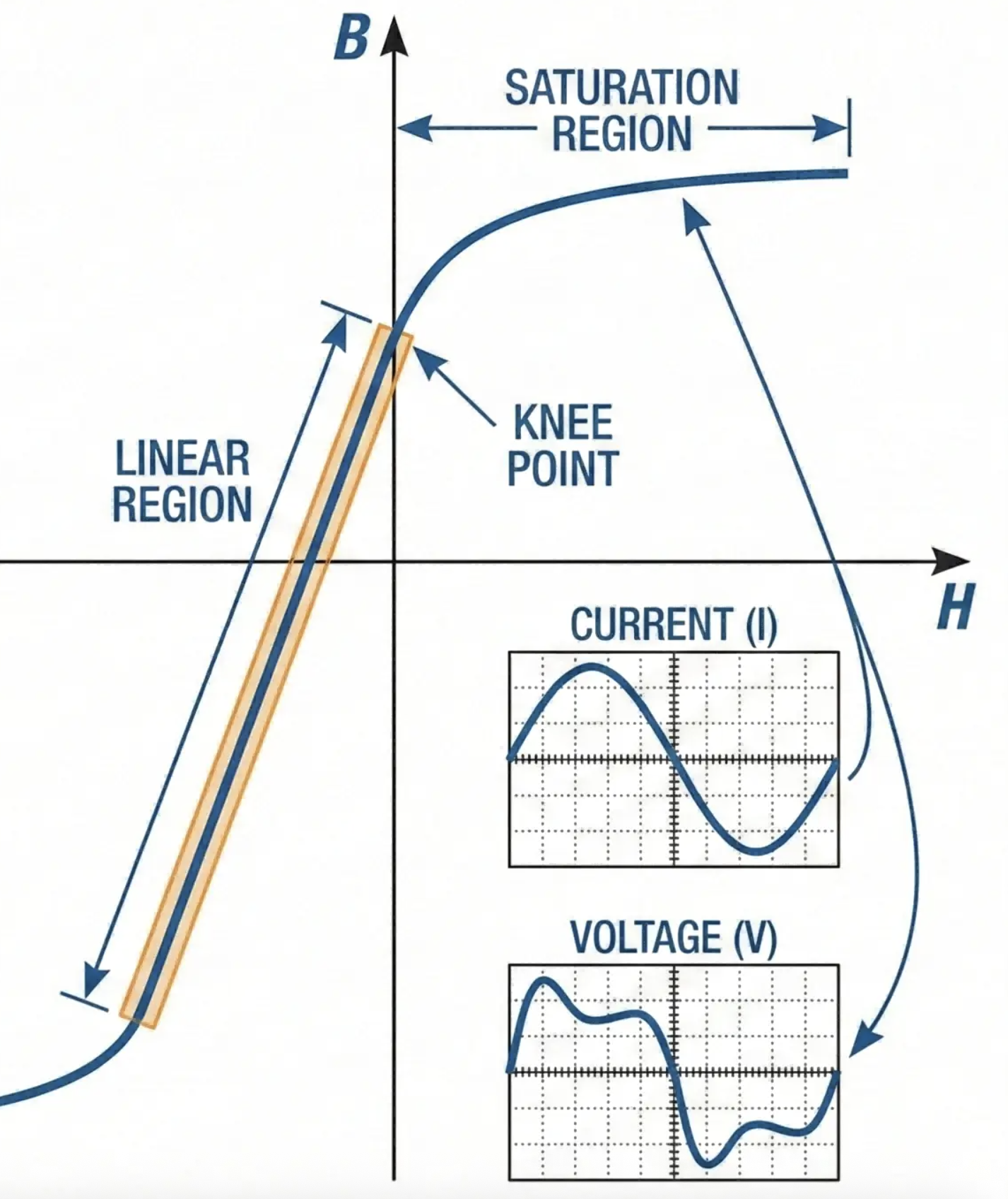
BH Characteristics Curve
Voltage and/or current waveforms that contain harmonics can be accurately measured by the so-called true rms meters. In contrast, the low-priced meters that are sensing the average but indicating the rms, depending on the waveform, are not accurate.
Example 1-15
It is given that the current in a circuit is
$$\iota = 10\sin\omega t + 5\sin 3\omega t + 3\sin 5\omega t$$
Determine:
a. The rms value of the current.
b. The total harmonic current in percent of the fundamental.
Solution
a.
$$I = \sqrt{\left(\frac{10}{\sqrt{2}}\right)^2 + \left(\frac{5}{\sqrt{2}}\right)^2 + \left(\frac{3}{\sqrt{2}}\right)^2}$$
$$I = 8.19\ \text{A}$$
b.
$$I_n = \sqrt{\left(\frac{5}{\sqrt{2}}\right)^2 + \left(\frac{3}{\sqrt{2}}\right)^2} = 4.12\ \text{A}$$
In percent of the fundamental,
$$\frac{4.12}{10/\sqrt{2}}\times 100 = 58.31\%$$
