B-H Curve and Magnetic Domains
The intrinsic properties of a magnetic material are, to a certain extent, revealed by the material’s B-H curve. Typical B-H curves for cast iron and cast steel are shown in Figure 1-57(a). The flux density (B) is the ordinate (y-axis) of the curves, and the field intensity (H) is their abscissa (x-axis).
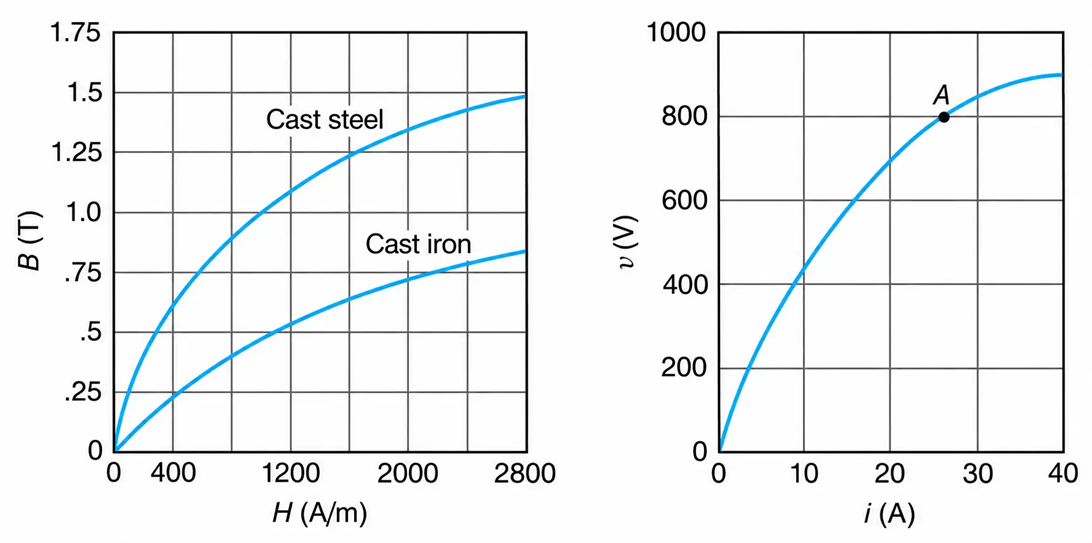
Figure 1-57 Characteristics of magnetic materials: (a) B-H curve. (b) Open-circuit characteristic.
Since the flux density is proportional to the voltage $(v)$, and the field intensity is proportional to the current (i), then the B-H curve of a machine can be represented, as shown in Figure 1-57(b), by its equivalent v-i characteristic curve.
The v-i characteristic of a machine is referred to as its “open-circuit” or “magnetization” characteristic (MC).
Under normal operating conditions, a machine operates at a flux level that is very close to point A. Point A is referred to as the knee of the magnetization characteristic.
- When the parameters of electric machines are measured at a flux density lower than that of point A, the resulting values are referred to as unsaturated.
- When they are measured at a flux density that is higher than that of point A, they are referred to as saturated values.
The intrinsic properties of magnetic materials, and thus their particular B-H characteristics, depend on the orientation of the materials’ magnetic moments.
Magnetic moments are caused by the spinning and orbiting of an atom’s electrons. Rotating electrons (electric charges) constitute a flow of current and thus produce flux and a corresponding magnetic moment whose direction can be determined by using the right-hand rule. The electrons’ configuration depends on the temperature and on the chemical composition of the material under consideration.
Magnetocaloric effect refers to a material’s temperature increase when it is magnetized and to a temperature decrease when it is demagnetized. This is due to the material’s unique orientation of its magnetic domains. Temperature changes up to 5 oC have been reported. As such, it replaces and/or supplements some of the standard compressor refrigerant systems. Its advantages are low operating costs and maintenance costs.
At a very high temperature known as the Curie point, magnetic moments cease to exist, and thus the magnetic material loses its magnetic properties.
The Curie point for iron is about 775 oC.
The strength of magnetic moments is also attenuated by time and ambient conditions. The degradation of a material’s magnetic properties as a function of time and temperature is known as the disaccommodation factor.
The smallest region in which a group of atoms has a common magnetic moment is called a magnetic domain. Magnetic domains may be thought of as being the basic building blocks of magnetism.
The approximate volume and number of atoms within one domain are as follows:
|
Volume |
10-8 cm3 |
|
Number of atoms |
109 to 1012 |
Adjacent domains are separated by boundaries called domain walls. The application of an external magnetic field modifies the domain walls and orients the magnetic moment vectors toward the direction of the applied field (see Figure 1-58).
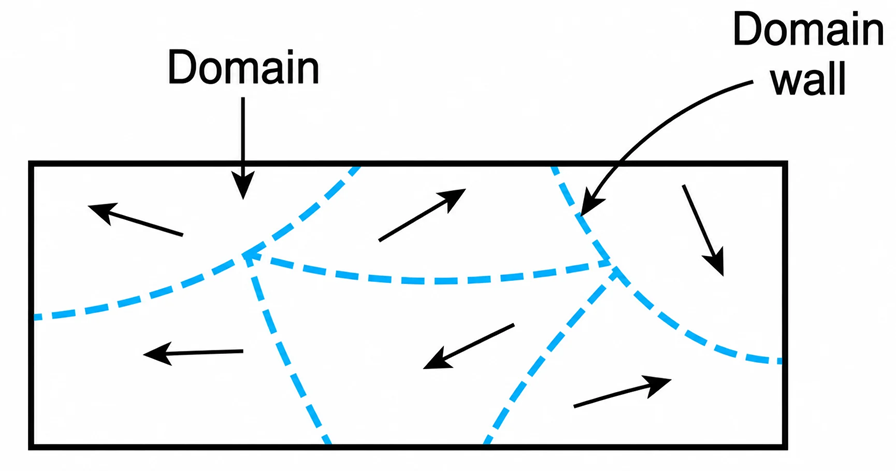
Figure 1-58 Orientation of magnetic domains.
Figure 1-59(a) is an elementary representation of a magnetic material’s random magnetization. For simplicity, only part of the magnetic material is considered. The orientation of the individual magnetic moments is such that no external field is produced. This is indicated by point A1 in the flux density–field intensity characteristic of the material shown in Figure 1-59(d).
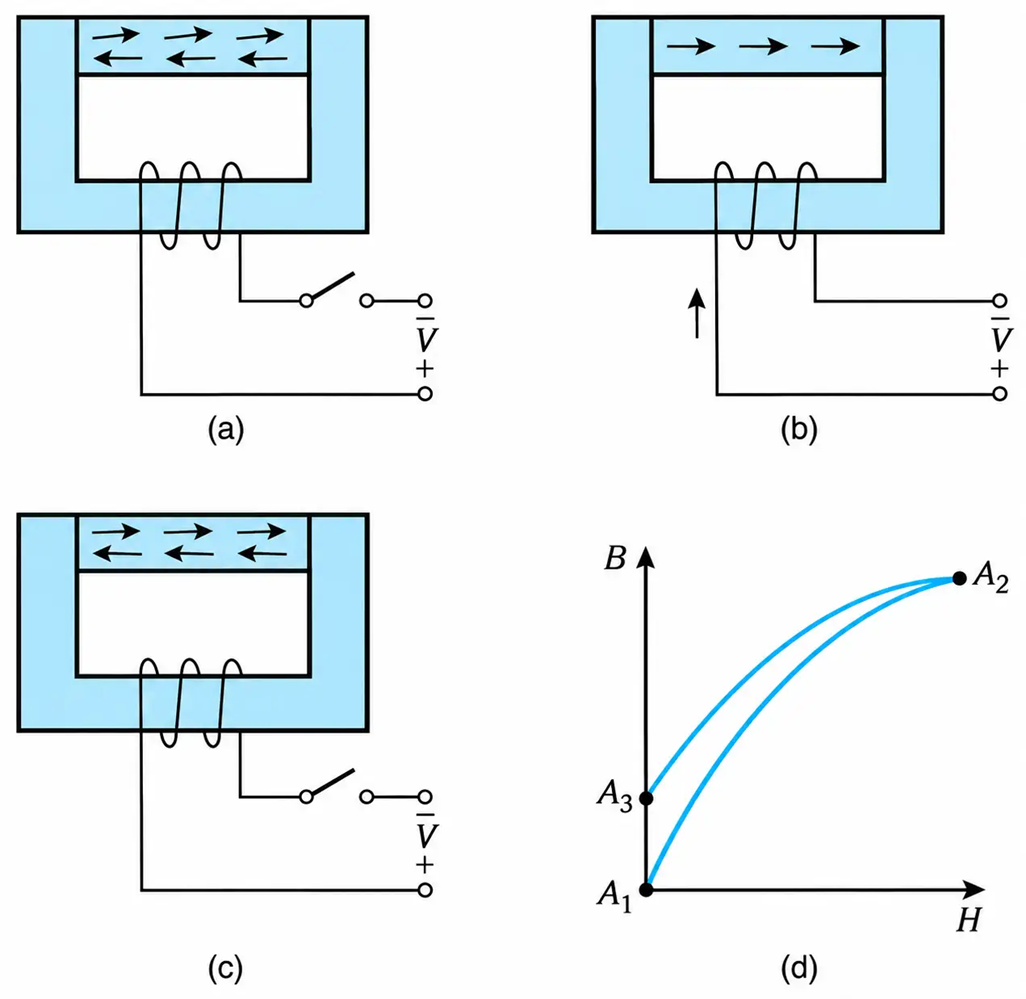
Figure 1-59 Orientation of magnetic domains and the B-H curve: (a) Opposite orientation. (b) Parallel orientation toward the induced field. (c) Partial orientation. (d) Corresponding B-H curve.
In Figure 1-59(b), the magnetic domains are completely oriented in the direction of the applied field, and the magnetization of the material is indicated by point A2 in Figure 1-59(d).
When the external field is removed, the magnetic domains remain partially oriented, as shown in Figure 1-59(c). As a result, the material is said to have residual magnetism. This corresponds to point A3 in the B-H curve of the material.
Hysteresis Loop
When a material is subjected to a cyclic variation of a magnetizing force, its B-H characteristic at steady state forms a closed loop, commonly referred to as the hysteresis loop. A typical hysteresis loop for cast iron is shown in Figure 1-60.
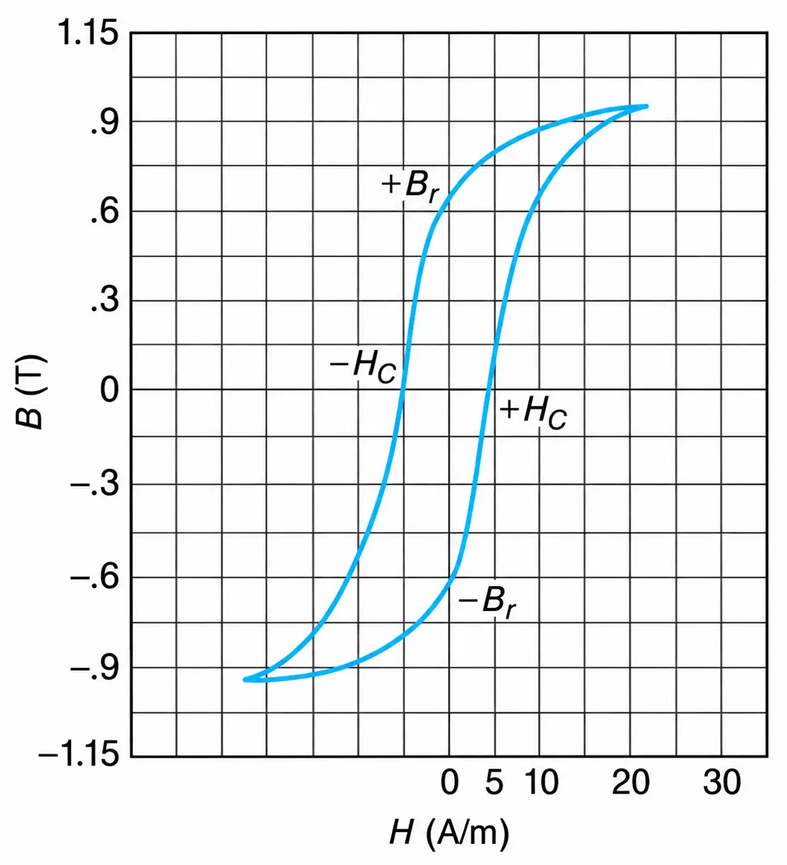
Figure 1-60 A typical hysteresis loop.
The magnetizing force (Hc) that corresponds to zero flux density is referred to as the coercive force.
The product of the residual flux density (Br) times the coercive force (Hc) is used to designate the quality of permanent magnet material. The higher the BrHc product of a material, the better the material is suited for permanent-magnet applications.
