Energy Content of Magnetic Materials
The energy content of a magnetic material depends on its:
- Level of magnetization
- Physical size
- Intrinsic characteristics
Refer to Figure 1-72. The incremental change of its electrical input energy (dw) is
$$dw=\upsilon i\,dt\qquad (1.149)$$
where v is the voltage induced on its coil and i is the instantaneous value of the coil’s current.
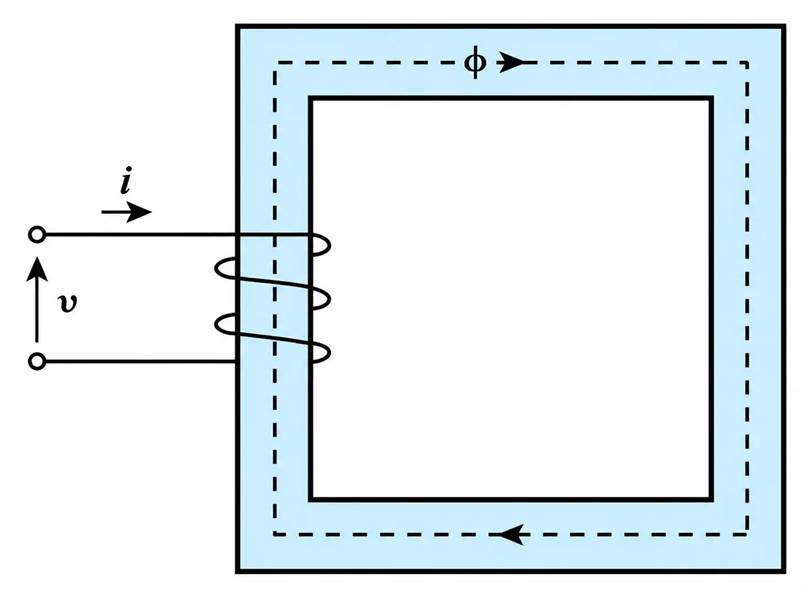
Figure 1-72 Magnetic Material
The magnitude of the voltage induced is
$$\upsilon=N\frac{d\Phi}{dt}=NA\frac{dB}{dt}\qquad (1.150)$$
And
$$H=\frac{Ni}{l}\qquad (1.151)$$
Or
$$i=H\frac{l}{N}\qquad (1.152)$$
From Equations (1.149), (1.150), and (1.152) we obtain
$$dw=(Al)H\,dB\qquad (1.153)$$
Recognizing that the product Al has the unit of volume, and assuming that the magnetic material is energized from zero up to B tesla, the energy stored per given volume of magnetic material is
$$\frac{W}{\text{volume}}=\int_0^B H\,dB\qquad (1.154)$$
Assuming an operation along the linear part of the magnetization characteristic, we obtain
$$\frac{W}{\text{volume}}=\frac{1}{\mu}\int_0^B B\,dB=\frac{1}{2\mu}B^2\qquad (1.155)$$
The energy stored in a magnetic material is
$$W=\frac{1}{2\mu}B^2\,(\text{Vol})\qquad (1.156)$$
Thus, the energy stored in a magnetic system is directly proportional to its volume and to the square of its flux density and inversely proportional to its permeability.
Consider Figure 1-64(a). The total energy stored within the magnetic circuit is equal to the energy stored in the magnetic material plus the energy stored in its air gap. Mathematically,
$$W=\frac{B^2}{2\mu_0}\left(\frac{\text{Vol}_{\text{magn. mat.}}}{\mu_r}+\text{Vol}_{\text{air gap}}\right)\qquad (1.157)$$
Example 1-24
The relative permeability of the material shown in Figure 1-64(a) is 1200. The mean length of the magnetic material is 0.75 m, and that of the air gap is 0.75 cm. The coil has 60 turns and draws 8 A from the 120 V ac supply. The volume of the magnetic material is 6 × 10⁻³ m3, and the volume of the air gap is 60 × 10-6 m3. Determine the energy stored:
a. In the magnetic material.
b. In the air gap.
Solution
The magnetic flux density is calculated as follows:
$$B=\frac{\Phi}{A}=\frac{Ni}{\mathcal{R}_T A}=\frac{Ni}{A\left(\frac{l_m}{\mu_m A_m}+\frac{l_g}{\mu_g A_g}\right)}$$
Disregarding fringing, we obtain
$$B=\frac{Ni\mu_0}{\frac{l_m}{\mu_r}+l_g}$$
Substituting the given values, we get
$$B=\frac{60(8)(4\pi\times10^{-7})}{\frac{0.75}{1200}+0.0075}=74.24\times10^{-3}\text{ T}$$
a. The energy stored in the magnetic material is
$$W_m=\frac{B^2}{2\mu}\text{Vol}_{(m)}=\frac{(74.24\times10^{-3})^2}{2\times1200(4\pi\times10^{-7})}(6\times10^{-3})=\underline{10.96\text{ mJ}}$$
b. The energy stored in the air gap is
$$W_g=\frac{(74.24\times10^{-3})^2}{2(4\pi\times10^{-7})}(60\times10^{-6})=\underline{131.6\text{ mJ}}$$
Comparing the results, we see that the energy stored in the air gap is about 12 times greater than the energy stored in the magnetic material.
